Wednesday, April 30, 2014

225 Years Ago Today - First Presidential Inauguration of His Excellency, George Washington


225 years ago today - 30 April 1789, George Washington was inaugurated as our Nation's first President on the steps of Federal Hall in New York City. In his First Inaugural Address, President Washington TWICE invoked God and asked for His divine guidance and blessings upon the new Nation:
"... Such being the impressions under which I have, in obedience to the public summons, repaired to the present station, it would be peculiarly improper to omit in this first official act my fervent supplications to that Almighty Being who rules over the universe, who presides in the councils of nations, and whose providential aids can supply every human defect, that His benediction may consecrate to the liberties and happiness of the people of the United States a Government instituted by themselves for these essential purposes, and may enable every instrument employed in its administration to execute with success the functions allotted to his charge. In tendering this homage to the Great Author of every public and private good, I assure myself that it expresses your sentiments not less than my own, nor those of my fellow-citizens at large less than either. No people can be bound to acknowledge and adore the Invisible Hand which conducts the affairs of men more than those of the United States. Every step by which they have advanced to the character of an independent nation seems to have been distinguished by some token of providential agency; and in the important revolution just accomplished in the system of their united government the tranquil deliberations and voluntary consent of so many distinct communities from which the event has resulted can not be compared with the means by which most governments have been established without some return of pious gratitude, along with an humble anticipation of the future blessings which the past seem to presage. These reflections, arising out of the present crisis, have forced themselves too strongly on my mind to be suppressed. You will join with me, I trust, in thinking that there are none under the influence of which the proceedings of a new and free government can more auspiciously commence...

"... Having thus imparted to you my sentiments as they have been awakened by the occasion which brings us together, I shall take my present leave; but not without resorting once more to the benign Parent of the Human Race in humble supplication that, since He has been pleased to favor the American people with opportunities for deliberating in perfect tranquillity, and dispositions for deciding with unparalleled unanimity on a form of government for the security of their union and the advancement of their happiness, so His divine blessing may be equally conspicuous in the enlarged views, the temperate consultations, and the wise measures on which the success of this Government must depend."


Previous Pro Ecclesia posts on this subject:
Happy 281st Birthday to the Father of Our Country, His Excellency George Washington

His Excellency, George Washington

Remember Remember the Fifth of November

In Honor of the Father of Our Country - His Excellency, George Washington

Bill Would Honor Washington and Lincoln Separately

The Conversion of George Washington

Labels: , , , ,

Sunday, January 05, 2014

A Poem for Twelfth Night - "How the Puritans Stole Christmas"

Yes, it's that time of year again. Christmastide is approaching it's festive conclusion, punctuated by the Twelfth Night revelry. And, of course, that means that it's time, once again, for my traditional Twelfth Night post* : a poem titled "How the Puritans Stole Christmas" ...

... with apologies to Dr. Seuss:


How the Puritans Stole Christmas

Every High-Church Anglican and Catholic
Living in Jolly Olde England
Liked Christmas a lot...

But the Puritans,
Who were infected with Calvinism,
Did NOT!

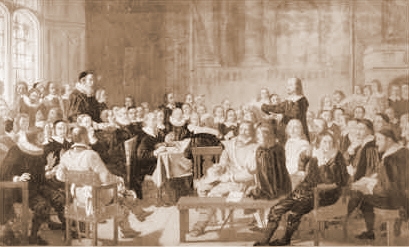
Puritans

The Puritans hated Christmas!
The whole Christmas season!
Now, please don't ask why. No one quite knows the reason.
It could be that their round heads weren't screwed on just right.
It could be, perhaps, their predestinarian arses were too tight.

But I think that the most likely reason of all
Was a distaste for mince pies - shaped like a manger-bed in a stall.
 

But,
Whatever the reason,
Mince pies or their arses,
The Puritans saw the yuletide celebrations as farces,
Staring down on the festivities with sour, dour frowns
At the merriment and good will of those in the towns.
For they knew all the revelers were engaged in such vices
As eating tarts made of suet and spices.

"And they're eating plum pudding!" they snarled with a sneer.
"Tomorrow is Christmas! It's practically here!"
Then they growled, with their greedy fingers nervously drumming,
"We MUST find a way to keep Christmas from coming!"
For, tomorrow, they knew...

...That the Christmas events
Would involve the consumption of pies made of mince!
And then! Oh, the noise! Oh, the noise! Noise! Noise! Noise!
That's one thing they hated! The NOISE! NOISE! NOISE! NOISE!
Then the revelers, young and old, would sit down to a feast.
And they'd feast! And they'd feast!
And they'd FEAST! FEAST! FEAST! FEAST!
They would start on plum pudding, and rare roast-beef
Foods again giving Puritans nothing but grief!

And THEN
They'd do something Puritans liked least of all!
Every merry-maker in town, the tall and the small,
Would stand close together, with Christmas bells ringing.
They'd stand hand-in-hand. And they all would start singing!
They'd sing! And they'd sing!
AND they'd SING! SING! SING! SING!
And the more the Puritans thought of the whole Christmas-Sing
The more the Puritans thought, "We must stop this whole thing!
"Why for over sixteen hundred years we've put up with it now!
We MUST stop Christmas from coming!
...But HOW?"

Then they got an idea!
An awful idea!
THE PURITANS
GOT A WONDERFUL, AWFUL IDEA!

"We know just what to do!" The Puritans began plot-ting.
And they made civil war against England's King.
And they built a new model army, and the Puritans said,
"When we've won this war, we'll remove the King's head!"

"All we need is a ploy..."
To get the job done.
But since kings are kings,
It was difficult to come up with one.
Did that stop the Puritans...?
No! The Puritans said,
"Charges of treason and Romish sympathies will cost him his head!"
So they called a rump court; charges the King refused to refute.
And the court issued the sentence to execute.

THEN
They loaded poor Charles
Dressed in clothes resembling sacks
On a ramshakle scaffold
And severed his head with an ax.

Then the Puritans said, "Huzzah!"
For they had brought the King down
And they began to march
On all the churches in town.

All their stained-glass windows were dark. Quiet filled the air.
All the vestrymen were all dreaming sweet dreams without care
When the Puritans came to the first church in the square.
"This is stop number one," The Puritans hissed
And each Puritan approached shaking his fist.

Then they broke all the stained-glass.
And smashed statues galore.
Their horses dishonored the graves in the floor.
Then they burned all the vestments,
And prayer books, too.
Then they said "Let's move on, we have much to do!"

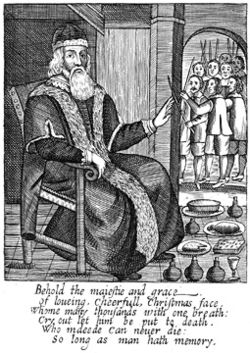
Father Christmas on Trial

Then they slithered and slunk, with dour looks most unpleasant,
Around the whole town, to despoil places where Christ was once present!
Stained glass! Statuary! Painted images! Candles!
All manner of popish influences that for years had caused scandals!
And they smashed them to pieces and threw them on piles
And set them ablaze, smiling devilish smiles!

Then they turned to the larders. They banned the Yule feast,
The plum pudding, the boar's head, and all toasts to that beast!
They forbade all the foods that had given offense.
And they succeeded in banning the pies made of mince!

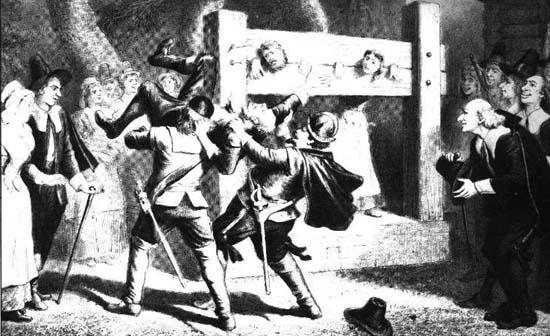
The Puritan Ban on Christmas

Then the last thing they took
Was the yule log for the fire.
On the walls they left nothing but hooks, and some wire.

And the one little speck
Left in the church house
Was a crumb that was even too small for a mouse.

Then
They did the same thing
To the other church houses

Leaving crumbs
Much too small
For the other church mouses!

And what happened then...?
Well...in England they say

That the Lord Protector's round head
Grew three sizes that day!
And the minute that "defender of liberty" felt safe from the strife,
He became the Commonwealth's dictator for life!
And he enforced the outlawing of Christmas! And all the foods for that feast!
And he...

...HE HIMSELF...!
The Lord Protector ruled the realm like a tyrannical beast!


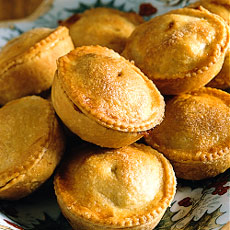
Mince Pie Still Life


NB: Christmas was not only outlawed in the British Isles but in parts of colonial America, as well. In 1659, a law was passed by the General Court of Massachusetts Bay Colony requiring a five-shilling fine from anyone caught "observing any such day as Christmas or the like, either by forbearing of labor, feasting, or any other way."


* Originally posted as "A Poem for the Twelve Days of Christmas - 'How the Puritans Stole Christmas' ..." on 3 January 2007, and again on 5 January 2007 under the title "A Poem for Twelfth Night - 'How the Puritans Stole Christmas' ..."


Previous Pro Ecclesia posts on this subject: 
How the Puritans Stole Our Lady

A Song for the End of Christmas

A Song (and a Poem) for the End of Christmas

Labels: , , , , , , , , ,

Tuesday, September 10, 2013

"We Have Met the Enemy and They Are Ours"

Perry's Victory on Lake Erie by Currier and Ives.

On this day 200 years ago - 10 September 1813, Master Commandant Oliver Hazard Perry, United States Navy, won a resounding victory over a British fleet near Put-in-Bay, Ohio, in the Battle of Lake Erie during the War of 1812:
At dawn on the morning of September 10, 1813, a lookout spotted six British vessels to the northwest of Put-in-Bay beyond Rattlesnake Island. Immediately Master Commandant Oliver Hazard Perry issued a flurry of orders and made preparations to sail forth to engage the British. 
 
Oliver Hazard Perry by Gilbert Stuart

With Perry's fleet on Lake Erie the British supply route from Fort Malden to Port Dover had been severed. The British had to either fight, or abandon Fort Malden. The British squadron consisted of six ships with sixty-three cannons, while the American flotilla comprised nine vessels and fifty-four guns. The British were armed with long guns that could throw a cannonball approximately one mile, accurately to about one-half mile. The American ships primarily armed with carronades had less than half the range of a long gun. The carronades could inflict much more damage at close range. Perry needed the wind to his back to close within carronade range.

When the squadron sailed from Put-in-Bay harbor at 7 a.m. the American vessels were steering west-northwest; the wind was blowing from the west-southwest. For more than two hours Perry repeatedly tacks his ships in an effort to put the wind to his back, but with no success. The frustrated Perry, conceded to mother nature at 10 a.m., issuing orders to turn his fleet in the opposite direction. But before the order could be executed the wind suddenly shifted and blew from the southeast, placing the wind directly behind the Americans.


Perry's opponent, Commander Robert Heriot Barclay, was an experienced Royal Navy officer who had fought with Lord Nelson at Trafalgar in 1805, and two years later he lost an arm fighting the French. Barclay's options did not alter when the wind shifted, so the Scotsman pointed his bow sprits to the westward, and hove to in line of battle.


With the wind at his back and the British battle line finally revealed, Perry made his own tactical adjustments. The Schooners Ariel and Scorpion were placed off the flagship's weather bow to engage the first British vessel and to prevent the enemy from raking his fleet. The Lawrence, a 20-gun brig serving as Perry's flagship, was third in line and would engage the Detroit, Barclay's 19-gun flagship. Next in line floated the Caledonia, a small brig with only three guns. Fifth in the American line of battle was the Niagara, Perry's other 20-gun brig and the Lawrence's sistership.


The Niagara, captained by Master Commandant Jesse Elliott, would engage the 17-gun Queen Charlotte, the second largest British ship. Lastly came the smaller schooners and sloop; these would engage the smaller British vessels.


Just before the engagement opened Perry hoisted his battle flag to the flagship's main truck. The large navy blue banner was emblazoned with the crudely inscribed words, "DONT GIVE UP THE SHIP". For his battle slogan Perry used the dying words of Captain James Lawrence, a friend of the commodore who was killed on June 1, 1813. Perry's flagship was named for the fallen Lawrence, and the dead hero's inspiring words clearly indicated Perry's determination to prevail.


Perry's Battle Flag, "Don't Give Up the Ship"
U.S. Naval Academy Museum, Annapolis, MD

[...]

By 2:30 p.m. the flagship was a floating wreck; every gun on her engaged side was disabled and four of every five men fit for duty were either killed or wounded. Perry was facing the dismal prospect of surrender.

Then, as he gazed across to the Niagara, still out of range and relatively undamaged, the commodore made a fateful decision. Collecting four unwounded men Perry manned the flagship's first cutter and rowed through a hail of shot to the Niagara. Miraculously Perry and his boat crew reached the Niagara unscathed.


Perry transfers (along with his battle flag) from the badly damaged flagship Lawrence to the unscathed Niagara.

[...]

The British, though they had pounded the Lawrence into a crippled hulk, had suffered terribly. During the engagement Barclay was severely wounded, plus the captain and first lieutenant of every British vessel was incapacitated. The English fleet was now commanded by junior officers - brave men, but with little or no experience maneuvering ships in the chaos of combat. When they observed the Niagara bearing down on their line the British attempted to wear ship - to turn their vessels around to bring the unused starboard broadsides to bear. Orders were issued, but amidst the tumult of battle the battered Detroit and Queen Charlotte collided, becoming helplessly entangled.


Taking full advantage of the enemy blunder, Perry steered the Niagara through the jumbled British battle line. Unleashing both broadsides, the American commodore ravaged the vulnerable British ships. As the Niagara pressed through the British line Perry backed the maintop sail, holding the Niagara stationary while her belching carronades decimated the enemy decks. The wind had also picked up by this time, allowing the sluggish gunboats to rush forward and rake the enemy from astern.


A few minutes after 3 p.m. the British bowed to the inevitable, the four largest vessels surrendering one by one. The gunboats Chippawa and Little Belt sheered off and tried to escape, but they were tracked down and snared by the Scorpion and Trippe. The entire British fleet had been captured.

The vessels anchored and hasty repairs were underway near West Sister Island when Perry composed his now famous message to William Henry Harrison. Scrawled in pencil on the back of an old envelope, Perry wrote, "Dear General: We have met the enemy and they are ours. Two ships, two brigs, one schooner and one sloop. Yours with great respect and esteem, O.H. Perry".


The Battle of Lake Erie proved one of the most resounding triumphs of the War of 1812. The victory secured control of the lake, forcing the British to abandon Fort Malden and retreat up the Thames River. Harrison's army pursued, decisively defeating the small British army and its allied Indian force on October 5, 1813 at the Battle of the Thames. And later, during the peace talks, the dual victories of Lake Erie and the Thames insured that the states of Ohio and Michigan would remain the sovereign territory of the United States of America.
 
 Perry's Victory and International Peace Memorial and a modern replica of the Flagship Niagara at Put-in-Bay, Ohio, during the Battle of Lake Erie Bicentennial celebrations over Labor Day weekend.


The blogger at Put-in-Bay for the Battle of Lake Erie Bicentennial, wearing his "Don't Give Up the Ship" battle flag tie from Buffalo Jackson Trading Co.

Don't Give Up the Ship!


Additional Online Resources:
Fort Meigs: Ohio's War of 1812 Battlefield
Tecumseh

Recommended Books:
A Signal Victory: The Lake Erie Campaign, 1812-1813 by David Curtis Skaggs and Gerard T. Altoff
Perry's Lake Erie Fleet: After the Glory (PA) (The History Press)
 

Labels: , , , , , , ,

Monday, June 24, 2013

Scots Wha Hae

"Scots Wha Hae" is a poem written by Robert Burns that is supposed to approximate the speech Robert the Bruce, King of Scots, delivered to his troops prior to leading them into battle against the English under Edward II at Bannockburn. The poem was set to music and became one of Scotland's great anthems of national pride.


Scots, wha hae wi' Wallace bled,
Scots, wham Bruce has aften led;
Welcome to your gory bed,
         Or to victory!

Now's the day, and now's the hour;
See the front o' battle lour;
See approach proud Edward's power—
         Chains and slavery!

Wha will be a traitor knave?
Wha can fill a coward's grave!
Wha sae base as be a slave?
         Let him turn and flee!

Wha for Scotland's king and law
Freedom's sword will strongly draw,
Freeman stand, or freeman fa',
         Let him follow me!

By oppression's woes and pains!
By your sons in servile chains!
We will drain our dearest veins,
         But they shall be free!

Lay the proud usurpers low!
Tyrants fall in every foe!
Liberty's in every blow!—
         Let us do or die!

Labels: , , , ,

Battle of Bannockburn - 699 Years Ago Today


On this day 699 years ago - 24 June 1314, Robert the Bruce, King of Scots, led his vastly outnumbered army into battle against the English under King Edward II at Bannockburn, near Stirling Castle, in Scotland. Edward had more than 2000 battle-hardened knights to Bruce’s 500 horsemen, and a force of 16,000 infantry to Bruce's 6000 foot soldiers.

It was Midsummer Day, the Feast of St John the Baptist.

The day before, an English knight, Sir Henry de Bohun, had seen the Bruce separated from the rest of his army and turned his war-horse to charge him. De Bohun thundered across the field levelling his lance at Bruce. The Bruce stood his ground and waited until the English knight was almost upon him, then stood up in his stirrups and brought his battle-axe crashing down, splitting de Bohun's helmet and skull in two.

The Bruce would own this day as well. 
 
 
The Scots had carefully chosen their ground at Bannockburn. They used the natural terrain to counter the threat of Edward’s heavy cavalry and dug small pit traps or ‘pots’ to defend their flanks and force the English to fight them head on. Disastrously, Edward ordered his men to cross the Bannockburn river onto boggy ground. Bruce ordered the Scots to push forward and a forest of spears sent Edward’s army crashing back upon itself. The Scots pushed Edward’s army back to the steep-sided Bannockburn until the river was filled with bodies. King Edward II fled the field, escaped to Dunbar Castle, and then sailed back to England. Others weren't so fortunate - the Scots killed or captured many of the greatest knights of England.

For the next 15 years - until the Bruce's death in 1329, the Scots held the upper hand over the English militarily, including a significant victory at the Battle of Byland in Yorkshire, in which a young, newly crowned Edward III was almost captured.

The ultimate result of Bannockburn was that the Scots had won their independence on the battlefield, an achievement that was to receive legal sanction a few years later when the Scots obtained papal recognition of their claim for independence as laid out in the Declaration of Arbroath (considered by many to be a forerunner to the American Declaration of Independence).

(Source)

Labels: , , , , , , , ,

Friday, June 21, 2013

A Man For All Seasons: Feast Day of St. Thomas More, 22 June

___________________________________

“…it would be hard to find anyone who was more truly a man for all seasons and all men…”

~ Erasmus, 1521
___________________________________


The Execution of St. Thomas More - "A Man For All Seasons"


Tomorrow, 22 June, is the feast day of St. Thomas More, martyr and patron of lawyers, civil servants, politicians, statesmen, "difficult marriages", and this blog.

As he went to his death, ordered beheaded by Henry VIII for refusing to swear the Oath of Supremacy declaring the King head of the Church in England, More humbly stated that he would die "the King's good servant, and God's first."

From the Patron Saints Index:
Memorial: 22 June

Profile: Studied at London and Oxford. Page for the Archbishop of Canterbury. Lawyer. Twice married, father of one son and three daughters, and a devoted family man. Writer. Friend of King Henry VIII. Lord Chancellor of England, a position of power second only to the king. Opposed the king on the matter of royal divorce, and refused to swear the Oath of Supremacy which declared the king the head of the Church in England. Resigned the Chancellorship, and was imprisoned in the Tower of London. Martyred for his refusal to bend his religious beliefs to the king's political needs.

Born: 1478 at London, England

Died: beheaded in 1535; head kept in the Roper Vault, Saint Dunstan's church, Canterbury, England; body at Saint Peter ad Vincula, Tower of London, England

Canonized: 1935 by Pope Pius XI

Patronage: adopted children, diocese of Arlington Virginia, civil servants, court clerks, difficult marriages, large families, lawyers, diocese of Pensacola-Tallahassee Florida, politicians, politicos, statesmen, step-parents, widowers
A Prayer to St. Thomas More:
Thomas More, counselor of law and patron of statesmen, merry martyr and most human of saints:

Pray that, for the glory of God and in the pursuit of His justice, I may be able in argument, accurate in analysis, keen in study, correct in conclusion, loyal to clients, honest with all, courteous to adversaries, trustworthy with confidences, courageous in court. Sit with me at my desk and listen with me to my clients' tales. Read with me in my library and stand always beside me so that today I shall not, to win a point, lose my soul.

Pray that my family may find in me what yours found in you: friendship and courage, cheerfulness and charity, diligence in duties, counsel in adversity, patience in pain -- their good servant, and God's first.

Amen.
Quotes:
"The ordinary acts we practice every day at home are of more importance to the soul than their simplicity might suggest."

"What does it avail to know that there is a God, which you not only believe by Faith, but also know by reason: what does it avail that you know Him if you think little of Him?"


"The things that we pray for, good Lord, give us grace to labour for."

(Against Martin Luther) "Come, do not rage so violently, good father; but if you have raved wildly enough, listen now, you pimp. You recall that you falsely complained above that the king has shown no passage in your whole book, even as an example, in which he said that you contradict yourself. You told this lie shortly before, although the king has demonstrated to you many examples of your inconsistency .... But meanwhile, for as long as your reverend paternity will be determined to tell these shameless lies, others will be permitted, on behalf of his English majesty, to throw back into your paternity's sh**ty mouth, truly the sh**-pool of all sh**, all the muck and sh** which your damnable rottenness has vomited up, and to empty out all the sewers and privies onto your crown divested of the dignity of the priestly crown, against which no less than against the kingly crown you have determined to play the buffoon. In your sense of fairness, honest reader, you will forgive me that the utterly filthy words of this scoundrel have forced me to answer such things, for which I should have begged your leave. Now I consider truer than truth that saying: 'He who touches pitch will be wholly defiled by it' (Sirach 13:1). For I am ashamed even of this necessity, that while I clean out the fellow's sh**-filled mouth I see my own fingers covered with sh**. But who can endure such a scoundrel who shows himself possessed by a thousand vices and tormented by a legion of demons, and yet stupidly boasts thus: 'The holy fathers have all erred. The whole church has often erred. My teaching cannot err, because I am most certain that my teaching is not my own but Christ's,' alluding of course to those words of Christ, 'My words are not my own but His who sent me, the Father's' (John 12:49)?


From the Medieval Saints Yahoo Group:
Thomas More, Knight, Lord Chancellor of England, author and martyr, Lay Franciscan
Beheaded in 1535; head kept in the Roper Vault, Saint Dunstan's church, Canterbury, England; body at Saint Peter ad Vincula, Tower of London, England Beatified in 1886;

Canonized by Pope Pius XI in 1935 as the "Martyr of the Papacy"

Commemorated June 22, feast day formerly on July 6 (with fellow martyr, St. John Fisher)

Patronage: adopted children, civil servants, court clerks, difficult marriages, large families, lawyers, politicians, statesmen, step-parents, widowers

In art: English Lord Chancellor carrying a book; English Lord Chancellor carrying an axe


SAINT THOMAS MORE, Martyr (1480-1535)

Saint Thomas More, born in 1480, was the precocious and amiable son of an English magistrate. Very well educated and brilliant, when he was placed at the age of fifteen in the household of the Archbishop of Canterbury, he soon attracted the Archbishop's attention, and was sent by him to study at Oxford. He debated interiorly for a long time as to whether he should become a priest, but decided otherwise with the approbation of his director.

The practice of civil law was not enough to absorb all his time or energy. The author of the famous satire "Utopia," wrote poetry while still young, in both English and Latin. He had completely mastered Latin, as he had also the Greek tongue, "by an instinct of genius," as one of his preceptors said. Saint Thomas in 1505 married a virtuous and beloved wife who, after bearing four children, three daughters and a son, died six years later. His second wife, older than himself, took excellent care of the household and of the children; but it was said she could not grasp the sense of her husband's subtle humor, which was a characteristic trait of his cheerful disposition.

Saint Thomas came under suspicion by King Henry VII when he strove in the Parliament to reduce the burden of excessive taxes which the people bore, though he never spoke against the king. But his capacities were appreciated, and when Henry VII died, his 18-year-old son, who was to become Henry VIII in 1509, showed him great favor during the first twenty years of his reign. Saint Thomas was knighted in 1521, and was made Speaker of the House of Commons in 1523, High Steward of Cambridge University in 1525, and Chancellor of the Duchy of Lancaster in the same year. Nonetheless, the king's protege foresaw what could easily happen to anyone who did not agree with his sovereign; he said to his son-in-law in 1525, "If my head could win him a castle in France, it would not fail to go." In effect, when in 1530 the order was issued to the clergy to acknowledge Henry as "Supreme Head of the Church, insofar as the law of God would permit," Saint Thomas immediately resigned as Lord Chancellor.

His resignation was not accepted. Two years later, in May 1532, after he had lost the royal favor on several counts — his reticence concerning the king's divorce, his non-attendance at the king's illegal marriage, and his formal non-recognition of any future children of Henry and Anne Bolyn as rightful heirs to the throne — he was permitted to retire. The king, the apostate Archbishop Cranmer, and Anne Bolyn were all excommunicated in that year.

Saint Thomas lived in retirement from the age of 52, his revenues considerably diminished, and his health somewhat uncertain. When the king decided to require of the laity, as well as of the clergy, the oath supporting his alleged "supremacy," he wanted to obtain first of all the signature of Thomas More, to make of him an example. The Saint declined to sign the oath and thereby brought upon himself a sentence of incarceration in the Tower of London, and a short time afterwards, of death. He was beheaded in 1535, after having said, with his ordinary humor, that "he did not consider the severing of his head from his body as a circumstance that should produce any change in the disposition of his mind."

Saint Thomas while in retirement continued to write a number of religious treatises of great value, including an unfinished one on the Passion. He was beatified by Pope Leo XIII and canonized by Pius XI in 1935, with Cardinal John Fisher, who was martyred like himself in the same year and for the same reasons. That year was the 400th anniversary of their death.

"These things, good Lord, that we pray for, give us Thy grace to labor for." --Saint Thomas More.


--------------------------------
More on St. Thomas More at:

http://www.cin.org/farmor.html
http://magnificat.ca/cal/engl/07-06.htm


Fr. Robert Barron on St. Thomas More

Links: 
Apostolic Letter of Pope John Paul II, naming St. Thomas More the patron of politicians and statesmen
Saint Thomas More - Open Directory Project (links to practically everything you'd want to know about St. Thomas More)
 

Center for Thomas More Studies
Sir Thomas More (1478-1535) - Luminarium
St. Thomas More on The Franciscan Archive
St. Thomas More on the Patron Saints Index
The St. Thomas More Web Site
Sir Thomas More - Oregon State University Philosophy Dept.
Thomas More Law Center
Thomas More Society
The St. Thomas More Society
Amici Thomae Mori
The Life of St. Thomas More by William Roper
Saint Thomas More - The King's good servant but God's first! (The Angelus)
"Thomas More For Our Season" by Judge Robert Bork (First Things archives)
Saint Thomas More: A Father for All Seasons - Essay on Thomas More as a model Christian father
 
A Man For All Seasons (DVD available from Amazon.com)
Thomas More's England: A Guide Book (pdf file)
Chelsea Old Church - Sir Thomas More

Recommended Reading:
The Life of St. Thomas More by his son-in-law William Roper
Thomas More: A Portrait of Courage by Gerard B. Wegemer
The Life of Thomas More by Peter Ackroyd
A Thomas More Source Book ed. by Gerard B. Wegemer and Stephen W. Smith
Thomas More on Statesmanship by Gerard B. Wegemer
A Man for All Seasons by Robert Bolt
Sir Thomas More: A Play, Now First Printed by William Shakespeare, et al
Utopia by Thomas More
A Dialogue of Comfort Against Tribulation by Thomas More
The Sadness of Christ by Thomas More

Prayers:
 
Prayer to St. Thomas More for Conversion of Pro-Abortion Politicians
Litany of St. Thomas More, Martyr and Patron Saint of Statesmen, Politicians and Lawyers (pdf version here) 
Prayers of St. Thomas More (Psalm on Detachment; A Devout Prayer Before Dying)
Novena to St. Thomas More


Prayer to St. Thomas More for Lawyers and Judges
Dear Scholar and Martyr,
it was not the King of England
but you who were the true Defender of the Faith.
Like Christ unjustly condemned,
neither promises nor threats
could make you accept a civil ruler
as head of the Christian Church.

Perfect in your honesty and love of truth,
grant that lawyers and judges
may imitate you and achieve true justice for all people.
AMEN.


*****

Lawyer's Prayer
"Give me the Grace Good Lord,
to set the world at naught;
to set my mind fast upon Thee
and not to hang upon the blast of men's mouths.
To be content to be solitary.
Not to long for worldly company
but utterly to cast off the world
and rid my mind of the business thereof.
"

*****

Litany of St. Thomas More, Martyr and Patron Saint of Statesmen, Politicians and Lawyers
V. Lord, have mercy
R. Lord have mercy
V. Christ, have mercy
R. Christ have mercy
V. Lord, have mercy
R. Lord have mercy
V. Christ hear us
R. Christ, graciously hear us

V. St. Thomas More, Saint and Martyr,
R. Pray for us (Repeat after each invocation)
St. Thomas More, Patron of Statesmen, Politicians and Lawyers
St. Thomas More, Patron of Justices, Judges and Magistrates
St. Thomas More, Model of Integrity and Virtue in Public and Private Life
St. Thomas More, Servant of the Word of God and the Body and Blood of Christ
St. Thomas More, Model of Holiness in the Sacrament of Marriage
St. Thomas More, Teacher of his Children in the Catholic Faith
St. Thomas More, Defender of the Weak and the Poor
St. Thomas More, Promoter of Human Life and Dignity

V.Lamb of God, you take away the sin of the world
R.Spare us O Lord
V.Lamb of God, you take away the sin of the world
R.Graciously hear us O Lord
V.Lamb of God, you take away the sin of the world
R.Have mercy on us

Let us pray:

O Glorious St. Thomas More, Patron of Statesmen, Politicians, Judges and Lawyers, your life of prayer and penance and your zeal for justice, integrity and firm principle in public and family life led you to the path of martyrdom and sainthood. Intercede for our Statesmen, Politicians, Judges and Lawyers, that they may be courageous and effective in their defense and promotion of the sanctity of human life - the foundation of all other human rights. We ask this through Christ our Lord.

R. Amen.


Labels: , , , , , , , , , , , ,

Wednesday, March 27, 2013

New Experiments on Shroud of Turin Date it to 1st Century A.D.

Vatican Insider reports:
New scientific experiments carried out at the University of Padua have apparently confirmed that the Shroud Turin can be dated back to the 1st century AD. This makes its compatible with the tradition which claims that the cloth with the image of the crucified man imprinted on it is the very one Jesus’ body was wrapped in when he was taken off the cross. The news will be published in a book by Giulio Fanti, professor of mechanical and thermal measurement at the University of Padua’s Engineering Faculty, and journalist Saverio Gaeta, out tomorrow. “Il Mistero della Sindone” (The Mystery of the Shroud) is edited by Rizzoli (240 pp, 18 Euro).
Whether the Shroud is an elaborate hoax, someone else's burial cloth, or the burial cloth of Christ, has no bearing on my faith.

That said, and for the record, since the days of my youth (dating back before I became Catholic when I was growing up Southern Baptist) I have believed the Shroud to be exactly what it has long been purported to be - the cloth in which Jesus was buried - and that the image on the Shroud is that of the Lord.

Call me gullible, but so help me, I do believe it.


Previous Pro Ecclesia posts on this subject:
Inside Catholic: "Shroud Skeptics Bump Up Against Science" [UPDATED]

USAToday on NBC, the Turin Olympics, and the Shroud (or Lack Thereof)
 USAToday: NBC Chooses to Keep the Faith Out of Olympics — For Now

Mention of Shroud Absent From Turin Olympics Opening Ceremonies

Holy or Hoax, Shroud Still a Draw

One Reporter's Futile Attempt to See the Shroud of Turin

Criterion Online Provides "Olympic Coverage With a Catholic Twist"

Shroud of Turin Would Outdraw Winter Olympics

Before the Olympics, Turin Had the Shroud

What I'm REALLY Looking Forward To During the Turin (Torino) Olympics ...

Labels: ,

Thursday, March 14, 2013

The "Myth" of Persecution?

A couple of my friends over at The American Catholic - Don McClarey and Darwin - have some excellent posts about a recently released book by a professor of theology at Notre Dame (of course) that attempts to call into question the history of the Church's early persecution at the hands of the Roman Empire. Read them both here and here.

As I said in my comments at The American Catholic, this professor's motivation appears quite clear (and she pretty much confirms this in her promotion of the book):

If the Church and individual Christians suffer government and/or legal sanction because their beliefs and how they practice those beliefs are at odds with cultural “norms” – be those norms abortion-on-demand, the HHS mandate, or same-sex “marriage” – they are not REALLY being persecuted. In essence, the Church and individual Christians can either get on board with the agenda or not; but if they choose not to, they wouldn’t be able to legitimately cry “persecution” if the legal fallout is not to to their liking.

Moss’s motivation, as with the motivation of many on the religious left who are critical of the Church's teachings, is actually quite transparent: political ideology trumps religious dogma.

Labels: , , , , , , , , ,

Friday, March 01, 2013

Society of Cincinnati Medal Belonging to Polish-Born Hero of American Revolution to be Auctioned in Cleveland


General Thaddeus Kosciuszko was a Polish-born hero of the American Revolution and the Chief Engineer of West Point. In Cleveland next Wednesday, there will be an auction of Kosciuszko's Society of Cincinnati medal.

Lot 156


Enameled Gold Order of the Society of the Cincinnati,

Enameled Gold Order of the Society of the Cincinnati, Designed by Major Pierre L'Enfant and Construction Attributed to Duval & Francastle, Paris, 1784. One of only 140 original eagles designed and conceived by Major Pierre L'Enfant for the inaugural members of the Society of the Cincinnati, the nation's oldest patriotic organization. The Society was founded in 1783 by officers of the Continental Army and their French counterparts who served together in the American Revolution. This particular eagle is believed to have belonged to Thaddeus Kosciuszko, a Polish-born hero of the Revolution and Chief Engineer of West Point. In 1783, Kosciuszko was appointed Brigadier General and initiated into the Order by General George Washington, Commander-in-Chief of the Continental Army.

Gold insignia with eagle and wreath motif, both sides with head and tail feathers having white and black enamel, red enamel eyes, distinct eyebrows and black beaks. Obverse oval medallion showing Cincinnatus receiving a sword from two senators, originally with blue enamel sky and green enamel grass within inscription OMNIA. REINQT. SERVAT. REMPB. (He Forsook All Things to Serve the Republic), but now mostly lacking. Reverse medallion showing Cincinnatus with sun and palisade behind, originally with blue sky and green field enameling within inscription in black on white ground VIRT. PRAEM. SOCI. CIN. RUM. INST. A. D. 1783 (a Prize for Virtue - Society of the Cincinnati Instituted 1783), also mostly lacking. The wreath at top and lower crossed branches likewise originally decorated with green enamel and red berries, with double oval loop suspension ring. Without original blue and white ribbon and bow.

Provenance: Inherited by the consignor through direct descent of Stevens Thompson Mason (1760-1803), a U.S. Senator from Virginia, and his wife, Mary Elizabeth Armistead (1760-1825), who were personally acquainted with Kosciuszko. According to family history, Kosciuszko was awarded the eagle, which he then gifted to Mary Elizabeth Armistead, for whom he had great affection. It has been passed down in the Mason family ever since. Kosciuszko biographer, Casimir Kajencki, references a documented meeting between Stevens Thomson Mason and Kosciuszko at the latter's apartment on Third Street South in Philadelphia over the winter of 1797-1798 (Thaddeus Kosciuszko: Military Engineer of the American Revolution, El Paso, Tex.: Southwest Polonia Press, 1998, pp. 202-203). Thaddeus Kosciuszko (1746-1817), to his friend Mary Elizabeth Armistead Mason (1760-1825), to her grandson Stevens Thomson Mason (1811-1843), to his sister Catherine Armistead Mason (Rowland) (1818-1884), to her son John Thomson Mason (1844-1901), to his son Stevens Thomson Mason (1880-1950), to his daughter Adelaide Houghton Mason (b. 1918), by descent to the present owner

Dimensions: h: 2.5 x w: 1 inch.

A few years ago, George Washington's Society of Cincinnati medal, which had been in the possession of the family of the Marquis de Lafayette (the medal had been a gift to Lafayette by Washington's adopted granddaughter, Nellie Lewis), sold for over $5.3 million.

The Society of Cincinnati is America's oldest patriotic organization, and was established by Major General Henry Knox in honor of George Washington. The Society took its name from Lucius Quinctius Cincinnatus, the ancient Roman who left his farm to accept dictatorial powers during a war emergency, only to relinquish those powers and return to farming when the war was over.


Labels: , , ,

Friday, February 22, 2013

Happy 281st Birthday to the Father of Our Country, His Excellency George Washington


This life-size statue of George Washington in the rotunda of the Virginia State Capitol in Richmond, Virginia, is probably the finest and most accurate likeness of Washington ever made. It was sculpted by Jean-Antoine Houdon from measurements and life masks he took of Washington when the sculptor visited Mount Vernon.

Labels: , , , , ,

Saturday, January 05, 2013

A Poem for Twelfth Night - "How the Puritans Stole Christmas"

Yes, it's that time of year again. Christmastide is approaching it's festive conclusion, punctuated by the Twelfth Night revelry. And, of course, that means that it's time, once again, for my traditional Twelfth Night post* : a poem titled "How the Puritans Stole Christmas" ...

... with apologies to Dr. Seuss:


How the Puritans Stole Christmas

Every High-Church Anglican and Catholic
Living in Jolly Olde England
Liked Christmas a lot...

But the Puritans,
Who were infected with Calvinism,
Did NOT!

Puritans

The Puritans hated Christmas!
The whole Christmas season!
Now, please don't ask why. No one quite knows the reason.
It could be that their round heads weren't screwed on just right.
It could be, perhaps, their predestinarian arses were too tight.
But I think that the most likely reason of all
Was a distaste for mince pies - shaped like a manger-bed in a stall.
But,
Whatever the reason,
Mince pies or their arses,
The Puritans saw the yuletide celebrations as farces,
Staring down on the festivities with sour, dour frowns
At the merriment and good will of those in the towns.
For they knew all the revelers were engaged in such vices
As eating tarts made of suet and spices.

"And they're eating plum pudding!" they snarled with a sneer.
"Tomorrow is Christmas! It's practically here!"
Then they growled, with their greedy fingers nervously drumming,
"We MUST find a way to keep Christmas from coming!"
For, tomorrow, they knew...

...That the Christmas events
Would involve the consumption of pies made of mince!
And then! Oh, the noise! Oh, the noise! Noise! Noise! Noise!
That's one thing they hated! The NOISE! NOISE! NOISE! NOISE!
Then the revelers, young and old, would sit down to a feast.
And they'd feast! And they'd feast!
And they'd FEAST! FEAST! FEAST! FEAST!
They would start on plum pudding, and rare roast-beef
Foods again giving Puritans nothing but grief!

And THEN
They'd do something Puritans liked least of all!
Every merry-maker in town, the tall and the small,
Would stand close together, with Christmas bells ringing.
They'd stand hand-in-hand. And they all would start singing!
They'd sing! And they'd sing!
AND they'd SING! SING! SING! SING!
And the more the Puritans thought of the whole Christmas-Sing
The more the Puritans thought, "We must stop this whole thing!
"Why for over sixteen hundred years we've put up with it now!
We MUST stop Christmas from coming!
...But HOW?"

Then they got an idea!
An awful idea!
THE PURITANS
GOT A WONDERFUL, AWFUL IDEA!

"We know just what to do!" The Puritans began plot-ting.
And they made civil war against England's King.
And they built up an army, and the Puritans said,
"When we've won this war, we'll remove the King's head!"

"All we need is a ploy..."
To get the job done.
But since kings are kings,
It was difficult to come up with one.
Did that stop the Puritans...?
No! The Puritans said,
"Charges of treason and Romish sympathies will cost him his head!"
So they called a rump court; charges the King refused to refute.
And the court issued the sentence to execute.

THEN
They loaded poor Charles
Dressed in clothes resembling sacks
On a ramshakle scaffold
And severed his head with an ax.

Then the Puritans said, "Huzzah!"
For they had brought the King down
And they began to march
On all the churches in town.

All their stain-glassed windows were dark. Quiet filled the air.
All the vestrymen were all dreaming sweet dreams without care
When the Puritans came to the first church in the square.
"This is stop number one," The Puritans hissed
And each Puritan approached shaking his fist.

Then they broke all the stain-glass.
And smashed statues galore.
Their horses dishonored the graves in the floor.
Then they burned all the vestments,
And prayer books, too.
Then they said "Let's move on, we have much to do!"

Father Christmas on Trial

Then they slithered and slunk, with dour looks most unpleasant,
Around the whole town, to despoil places where Christ was once present!
Stained glass! Statuary! Painted images! Candles!
All manner of popish influences that for years had caused scandals!
And they smashed them to pieces and threw them on piles
And set them ablaze, smiling devilish smiles!

Then they turned to the larders. They banned the Yule feast,
The plum pudding, the boar's head, and all toasts to that beast!
They forbade all the foods that had given offense.
And they succeeded in banning the pies made of mince!

The Puritan Ban on Christmas

Then the last thing they took
Was the yule log for the fire.
On the walls they left nothing but hooks, and some wire.

And the one little speck
Left in the church house
Was a crumb that was even too small for a mouse.

Then
They did the same thing
To the other church houses

Leaving crumbs
Much too small
For the other church mouses!

And what happened then...?
Well...in England they say
That the Lord Protector's round head
Grew three sizes that day!
And the minute that "defender of liberty" felt safe from the strife,
He became the Commonwealth's dictator for life!
And he enforced the outlawing of Christmas! And all the foods for that feast!
And he...

...HE HIMSELF...!
The Lord Protector ruled the realm like a tyrannical beast!


Mince Pie Still Life


NB: Christmas was not only outlawed in the British Isles but in parts of colonial America, as well. In 1659, a law was passed by the General Court of Massachusetts Bay Colony requiring a five-shilling fine from anyone caught "observing any such day as Christmas or the like, either by forbearing of labor, feasting, or any other way."


* Originally posted as "A Poem for the Twelve Days of Christmas - 'How the Puritans Stole Christmas' ..." on 3 January 2007, and again on 5 January 2007 under the title "A Poem for Twelfth Night - 'How the Puritans Stole Christmas' ..."


Previous Pro Ecclesia posts on this subject: 
How the Puritans Stole Our Lady

A Song for the End of Christmas

A Song (and a Poem) for the End of Christmas

Labels: , , , , , , , , ,

hit counter for blogger