Monday, March 17, 2014

Happy Feast Day of St. Patrick - 17 March


[NOTE: This is my annual St. Patrick's Day post, originally posted on St. Patrick's Day 2005]


Lá Fhéile Pádraig Sona Daoibh!
(Happy St. Patrick's Day!)

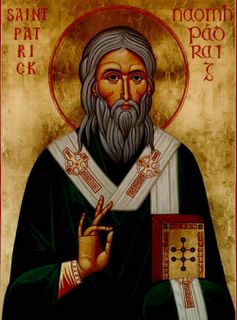
As a Roman Catholic of Irish descent, I am, quite predictably, a big fan of St. Patrick. Long before I became Catholic, St. Patrick - with his bishop's mitre and crozier - stood there beckoning me home to the Church of my forebears. Indeed, the first rosary I ever purchased (again, before I ever became Catholic) had a St. Patrick junction and a Celtic Cross Crucifix. St. Patrick's feast day, therefore, is a cause for great celebration in our household.

But just what is it about this British-born saint - who (1) was kidnapped as a boy from his home in Britain by Irish pirates, (2) was sold into slavery in Ireland, (3) escaped from his Irish oppressors, and (4) returned to Ireland to evangelize his former captors (the same Irish who would, a century later, with saints like Columba and Aidan, re-evangelize Britain after the Anglo-Saxon invasions) - that makes his feast day celebrated to a greater extent around the world than most other saints?

Perhaps it is because of the extent of the Irish Diaspora, which stretches from Continental Europe to North America to South America to Australia, and numbers in the tens of millions - making St. Patrick not only the patron saint of Ireland, but of all Irish all over the world. Possibly, it could be St. Patrick's contribution to Celtic Christianity, an influence that can be seen in the Lorica of St. Patrick, which has been attributed to him.

For more on the story behind why St. Patrick is such a significant personage within the Church, especially where the Irish are concerned,
go here: Patron Saints Index - Patrick,

and here: The History of St. Patrick's Day,

and here: Catholic Online - St. Patrick.
But unfortunately, I think the real reason this particular feast day has such resonance with so many people has nothing whatsoever to do with its religious significance. St. Patrick's Day, like Christmas, is a religious feast day that has lost much of its meaning due to over-secularization. Rather than a day to celebrate the life of this great British saint who evangelized the Irish, St. Patrick's Day has become just another excuse to get drunk and tell stupid Irish jokes.

Personally, one of the biggest problems I have with the secular celebrations of St. Patrick's Day is the ubiquitous presence of the leprechaun. On and around St. Patrick's Day, this little fairy creature can be seen on the front pages of major newspapers, on greeting cards, and on televisions selling used cars, credit cards, and beer in a cheesy Irish brogue accent.

Given the artistic legacy of beautiful music, poetry, literature, and liturgical art bequeathed to us by the Irish; given the indispensable contributions the Irish have made to Christianity and Western Civilization as documented by Thomas Cahill in his best-selling book How the Irish Saved Civilization; and given the steadfastness of the Irish in overcoming historical persecution - racial, cultural, economic, and religious; I find the use of the leprechaun on St. Patrick's Day as a symbol of the Irish people and their cultural contributions about as appropriate as a lawn jockey on Martin Luther King Day.

Some will think that is not an apt comparison. Sorry, but I think it quite apt. The leprechaun as a symbol of this holy feast day is just plain offensive, and should go the way of the kerchief-headed version of Aunt Jemima.

The Irish - that mystical race of warriors and poets, saints and scholars, who brought us great works of literature like Ulysses and Gulliver's Travels, early medieval illuminated manuscripts like the Books of Kells and Durrow, musicians like Turlough O'Carolan, Altan, U2 and Van Morrison, wordsmiths like W.B. Yeats and Seamus Heaney, kings like Brian Boru and ... (well, Brian's about it as far as great Irish kings go), political heroes like Daniel O'Connell and Michael Collins, and saints like Columcille (a.k.a. Columba), Brendan, Aidan, and Columbanus - deserve better on the feast day of their patron saint than to be represented by a short, ruddy (and might I add, pagan) fairy dressed in a green suit.

The University of Notre Dame is also guilty of this blood libel against the children of Erin. The University does quite a disservice to the true spirit of the "Fighting Irish" by representing that spirit in the form of a leprechaun (of course, some would argue that Notre Dame also does a disservice to Ex Corde Ecclesiae by calling itself "Catholic" while allowing such nonsense as prominent positions for Fr. Richard McBrien and Prof. Candida Moss in the Theology Department, not to mention honoring the anti-Catholic bigot and all-around pro-abort, President Obama, with an honorary law degree). Bring back the Irish Terrier to represent the Fighting Irish, as it did in the days of Knute Rockne. Just get rid of that damned leprechaun!!! (Oops! Sorry about that. That should be "damned leprechaun".)

Okay. Rant over.

Hopefully, we can try to keep in mind today (1) the spiritual legacy of Ireland's patron saint, and (2) the many cultural contributions of the people he loved so dearly as to bring them the Light of Christ - which are, after all, the primary reasons we celebrate the feast of St. Patrick. Even if the rest of the world is too deep in a drunken stupor to notice.

And so I end with the following blessing:
Beannachtaí na Féile Pádraig oraibh!
(St. Patrick's Day Blessing On You!)


Recommended Reading: 
Patrick: The Pilgrim Apostle of Ireland by Maire B. de Paor 
The Confession of St. Patrick by John Skinner 
How the Irish Saved Civilization by Thomas Cahill
Wisdom of the Celtic Saints by Edward C. Sellner
Sun Dancing by Geoffrey Moorhouse


Previous Pro Ecclesia posts on this subject:
St. Patrick's Breastplate (The Deer's Cry)

Happy Feast Day of St. Patrick - 17 March (2010)

Happy Feast Day of St. Patrick - 17 March (2009)

Happy Feast Day of St. Patrick - 17 March (2008)

What I'm Listening to in Honor of St. Patrick's Day

Don't Drink Green Beer!

St. Pat's Spat Pits Church vs. Cities
Happy Feast Day of St. Patrick - 17 March (2007)

 
"... The Slur of the Fighting Irish"

 
Happy Feast Day of St. Patrick - 17 March (2006)

Search Terms: St. Patrick's Day, Lent, Abstinence, Meat - Corned Beef, Dispensation, Indult, Catholic


Happy Feast Day of St. Patrick - 17 March (2005)

Labels: , , ,

Sunday, January 05, 2014

A Poem for Twelfth Night - "How the Puritans Stole Christmas"

Yes, it's that time of year again. Christmastide is approaching it's festive conclusion, punctuated by the Twelfth Night revelry. And, of course, that means that it's time, once again, for my traditional Twelfth Night post* : a poem titled "How the Puritans Stole Christmas" ...

... with apologies to Dr. Seuss:


How the Puritans Stole Christmas

Every High-Church Anglican and Catholic
Living in Jolly Olde England
Liked Christmas a lot...

But the Puritans,
Who were infected with Calvinism,
Did NOT!

Puritans

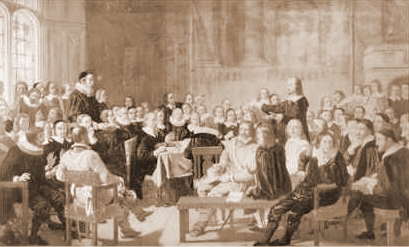
The Puritans hated Christmas!
The whole Christmas season!
Now, please don't ask why. No one quite knows the reason.
It could be that their round heads weren't screwed on just right.
It could be, perhaps, their predestinarian arses were too tight.

But I think that the most likely reason of all
Was a distaste for mince pies - shaped like a manger-bed in a stall.
 

But,
Whatever the reason,
Mince pies or their arses,
The Puritans saw the yuletide celebrations as farces,
Staring down on the festivities with sour, dour frowns
At the merriment and good will of those in the towns.
For they knew all the revelers were engaged in such vices
As eating tarts made of suet and spices.

"And they're eating plum pudding!" they snarled with a sneer.
"Tomorrow is Christmas! It's practically here!"
Then they growled, with their greedy fingers nervously drumming,
"We MUST find a way to keep Christmas from coming!"
For, tomorrow, they knew...

...That the Christmas events
Would involve the consumption of pies made of mince!
And then! Oh, the noise! Oh, the noise! Noise! Noise! Noise!
That's one thing they hated! The NOISE! NOISE! NOISE! NOISE!
Then the revelers, young and old, would sit down to a feast.
And they'd feast! And they'd feast!
And they'd FEAST! FEAST! FEAST! FEAST!
They would start on plum pudding, and rare roast-beef
Foods again giving Puritans nothing but grief!

And THEN
They'd do something Puritans liked least of all!
Every merry-maker in town, the tall and the small,
Would stand close together, with Christmas bells ringing.
They'd stand hand-in-hand. And they all would start singing!
They'd sing! And they'd sing!
AND they'd SING! SING! SING! SING!
And the more the Puritans thought of the whole Christmas-Sing
The more the Puritans thought, "We must stop this whole thing!
"Why for over sixteen hundred years we've put up with it now!
We MUST stop Christmas from coming!
...But HOW?"

Then they got an idea!
An awful idea!
THE PURITANS
GOT A WONDERFUL, AWFUL IDEA!

"We know just what to do!" The Puritans began plot-ting.
And they made civil war against England's King.
And they built a new model army, and the Puritans said,
"When we've won this war, we'll remove the King's head!"

"All we need is a ploy..."
To get the job done.
But since kings are kings,
It was difficult to come up with one.
Did that stop the Puritans...?
No! The Puritans said,
"Charges of treason and Romish sympathies will cost him his head!"
So they called a rump court; charges the King refused to refute.
And the court issued the sentence to execute.

THEN
They loaded poor Charles
Dressed in clothes resembling sacks
On a ramshakle scaffold
And severed his head with an ax.

Then the Puritans said, "Huzzah!"
For they had brought the King down
And they began to march
On all the churches in town.

All their stained-glass windows were dark. Quiet filled the air.
All the vestrymen were all dreaming sweet dreams without care
When the Puritans came to the first church in the square.
"This is stop number one," The Puritans hissed
And each Puritan approached shaking his fist.

Then they broke all the stained-glass.
And smashed statues galore.
Their horses dishonored the graves in the floor.
Then they burned all the vestments,
And prayer books, too.
Then they said "Let's move on, we have much to do!"

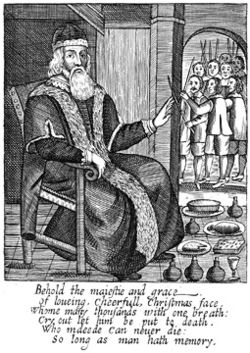
Father Christmas on Trial

Then they slithered and slunk, with dour looks most unpleasant,
Around the whole town, to despoil places where Christ was once present!
Stained glass! Statuary! Painted images! Candles!
All manner of popish influences that for years had caused scandals!
And they smashed them to pieces and threw them on piles
And set them ablaze, smiling devilish smiles!

Then they turned to the larders. They banned the Yule feast,
The plum pudding, the boar's head, and all toasts to that beast!
They forbade all the foods that had given offense.
And they succeeded in banning the pies made of mince!

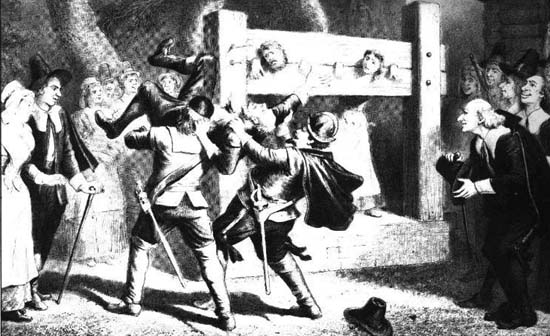
The Puritan Ban on Christmas

Then the last thing they took
Was the yule log for the fire.
On the walls they left nothing but hooks, and some wire.

And the one little speck
Left in the church house
Was a crumb that was even too small for a mouse.

Then
They did the same thing
To the other church houses

Leaving crumbs
Much too small
For the other church mouses!

And what happened then...?
Well...in England they say

That the Lord Protector's round head
Grew three sizes that day!
And the minute that "defender of liberty" felt safe from the strife,
He became the Commonwealth's dictator for life!
And he enforced the outlawing of Christmas! And all the foods for that feast!
And he...

...HE HIMSELF...!
The Lord Protector ruled the realm like a tyrannical beast!


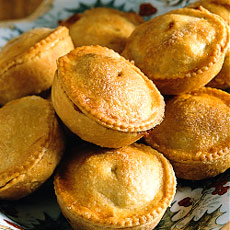
Mince Pie Still Life


NB: Christmas was not only outlawed in the British Isles but in parts of colonial America, as well. In 1659, a law was passed by the General Court of Massachusetts Bay Colony requiring a five-shilling fine from anyone caught "observing any such day as Christmas or the like, either by forbearing of labor, feasting, or any other way."


* Originally posted as "A Poem for the Twelve Days of Christmas - 'How the Puritans Stole Christmas' ..." on 3 January 2007, and again on 5 January 2007 under the title "A Poem for Twelfth Night - 'How the Puritans Stole Christmas' ..."


Previous Pro Ecclesia posts on this subject: 
How the Puritans Stole Our Lady

A Song for the End of Christmas

A Song (and a Poem) for the End of Christmas

Labels: , , , , , , , , ,

Monday, June 24, 2013

Battle of Bannockburn - 699 Years Ago Today


On this day 699 years ago - 24 June 1314, Robert the Bruce, King of Scots, led his vastly outnumbered army into battle against the English under King Edward II at Bannockburn, near Stirling Castle, in Scotland. Edward had more than 2000 battle-hardened knights to Bruce’s 500 horsemen, and a force of 16,000 infantry to Bruce's 6000 foot soldiers.

It was Midsummer Day, the Feast of St John the Baptist.

The day before, an English knight, Sir Henry de Bohun, had seen the Bruce separated from the rest of his army and turned his war-horse to charge him. De Bohun thundered across the field levelling his lance at Bruce. The Bruce stood his ground and waited until the English knight was almost upon him, then stood up in his stirrups and brought his battle-axe crashing down, splitting de Bohun's helmet and skull in two.

The Bruce would own this day as well. 
 
 
The Scots had carefully chosen their ground at Bannockburn. They used the natural terrain to counter the threat of Edward’s heavy cavalry and dug small pit traps or ‘pots’ to defend their flanks and force the English to fight them head on. Disastrously, Edward ordered his men to cross the Bannockburn river onto boggy ground. Bruce ordered the Scots to push forward and a forest of spears sent Edward’s army crashing back upon itself. The Scots pushed Edward’s army back to the steep-sided Bannockburn until the river was filled with bodies. King Edward II fled the field, escaped to Dunbar Castle, and then sailed back to England. Others weren't so fortunate - the Scots killed or captured many of the greatest knights of England.

For the next 15 years - until the Bruce's death in 1329, the Scots held the upper hand over the English militarily, including a significant victory at the Battle of Byland in Yorkshire, in which a young, newly crowned Edward III was almost captured.

The ultimate result of Bannockburn was that the Scots had won their independence on the battlefield, an achievement that was to receive legal sanction a few years later when the Scots obtained papal recognition of their claim for independence as laid out in the Declaration of Arbroath (considered by many to be a forerunner to the American Declaration of Independence).

(Source)

Labels: , , , , , , , ,

Monday, March 25, 2013

Holy Week


Labels: , , ,

Saturday, March 16, 2013

I Arise Today ...


 Lorica of Saint Patrick 

I arise today
Through a mighty strength, the invocation of the Trinity,
Through a belief in the Threeness,
Through confession of the Oneness
Of the Creator of creation.

I arise today
Through the strength of Christ's birth and His baptism,
Through the strength of His crucifixion and His burial,
Through the strength of His resurrection and His ascension,
Through the strength of His descent for the judgment of doom.

I arise today
Through the strength of the love of cherubim,
In obedience of angels,
In service of archangels,
In the hope of resurrection to meet with reward,
In the prayers of patriarchs,
In preachings of the apostles,
In faiths of confessors,
In innocence of virgins,
In deeds of righteous men.

I arise today
Through the strength of heaven;
Light of the sun,
Splendor of fire,
Speed of lightning,
Swiftness of the wind,
Depth of the sea,
Stability of the earth,
Firmness of the rock.

I arise today
Through God's strength to pilot me;
God's might to uphold me,
God's wisdom to guide me,
God's eye to look before me,
God's ear to hear me,
God's word to speak for me,
God's hand to guard me,
God's way to lie before me,
God's shield to protect me,
God's hosts to save me
From snares of the devil,
From temptations of vices,
From every one who desires me ill,
Afar and anear,
Alone or in a mulitude.

I summon today all these powers between me and evil,
Against every cruel merciless power that opposes my body and soul,
Against incantations of false prophets,
Against black laws of pagandom,
Against false laws of heretics,
Against craft of idolatry,
Against spells of women and smiths and wizards,
Against every knowledge that corrupts man's body and soul.
Christ shield me today
Against poison, against burning,
Against drowning, against wounding,
So that reward may come to me in abundance.

Christ with me, Christ before me, Christ behind me,
Christ in me, Christ beneath me, Christ above me,
Christ on my right, Christ on my left,
Christ when I lie down, Christ when I sit down,
Christ in the heart of every man who thinks of me,
Christ in the mouth of every man who speaks of me,
Christ in the eye that sees me,
Christ in the ear that hears me.

I arise today
Through a mighty strength, the invocation of the Trinity,
Through a belief in the Threeness,
Through a confession of the Oneness
Of the Creator of creation

St. Patrick (ca. 377) 


Labels: , , ,

Friday, March 15, 2013

Happy Feast Day of St. Patrick - 17 March


[NOTE: This is my annual St. Patrick's Day post, posted a couple of days early since 17 March falls on a Sunday this year, originally posted on St. Patrick's Day 2005]


Lá Fhéile Pádraig Sona Daoibh!
(Happy St. Patrick's Day!)

As a Roman Catholic of Irish descent, I am, quite predictably, a big fan of St. Patrick. Long before I became Catholic, St. Patrick - with his bishop's mitre and crozier - stood there beckoning me home to the Church of my forebears. Indeed, the first rosary I ever purchased (again, before I ever became Catholic) had a St. Patrick junction and a Celtic Cross Crucifix. St. Patrick's feast day, therefore, is a cause for great celebration in our household.

But just what is it about this British-born saint - who (1) was kidnapped as a boy from his home in Britain by Irish pirates, (2) was sold into slavery in Ireland, (3) escaped from his Irish oppressors, and (4) returned to Ireland to evangelize his former captors (the same Irish who would, a century later, with saints like Columba and Aidan, re-evangelize Britain after the Anglo-Saxon invasions) - that makes his feast day celebrated to a greater extent around the world than most other saints?

Perhaps it is because of the extent of the Irish Diaspora, which stretches from Continental Europe to North America to South America to Australia, and numbers in the tens of millions - making St. Patrick not only the patron saint of Ireland, but of all Irish all over the world. Possibly, it could be St. Patrick's contribution to Celtic Christianity, an influence that can be seen in the Lorica of St. Patrick, which has been attributed to him.

For more on the story behind why St. Patrick is such a significant personage within the Church, especially where the Irish are concerned,
go here: Patron Saints Index - Patrick,

and here: The History of St. Patrick's Day,

and here: The Ultimate St. Patrick.
But unfortunately, I think the real reason this particular feast day has such resonance with so many people has nothing whatsoever to do with its religious significance. St. Patrick's Day, like Christmas, is a religious feast day that has lost much of its meaning due to over-secularization. Rather than a day to celebrate the life of this great British saint who evangelized the Irish, St. Patrick's Day has become just another excuse to get drunk and tell stupid Irish jokes.

Personally, one of the biggest problems I have with the secular celebrations of St. Patrick's Day is the ubiquitous presence of the leprechaun. On and around St. Patrick's Day, this little fairy creature can be seen on the front pages of major newspapers, on greeting cards, and on televisions selling used cars, credit cards, and beer in a cheesy Irish brogue accent.

Given the artistic legacy of beautiful music, poetry, literature, and liturgical art bequeathed to us by the Irish; given the indispensable contributions the Irish have made to Christianity and Western Civilization as documented by Thomas Cahill in his best-selling book How the Irish Saved Civilization; and given the steadfastness of the Irish in overcoming historical persecution - racial, cultural, economic, and religious; I find the use of the leprechaun on St. Patrick's Day as a symbol of the Irish people and their cultural contributions about as appropriate as a lawn jockey on Martin Luther King Day.

Some will think that is not an apt comparison. Sorry, but I think it quite apt. The leprechaun as a symbol of this holy feast day is just plain offensive, and should go the way of the kerchief-headed version of Aunt Jemima.

The Irish - that mystical race of warriors and poets, saints and scholars, who brought us great works of literature like Ulysses and Gulliver's Travels, early medieval illuminated manuscripts like the Books of Kells and Durrow, musicians like Turlough O'Carolan, Altan, U2 and Van Morrison, wordsmiths like W.B. Yeats and Seamus Heaney, kings like Brian Boru and ... (well, Brian's about it as far as great Irish kings go), political heroes like Daniel O'Connell and Michael Collins, and saints like Columcille (a.k.a. Columba), Brendan, Aidan, and Columbanus - deserve better on the feast day of their patron saint than to be represented by a short, ruddy (and might I add, pagan) fairy dressed in a green suit.

The University of Notre Dame is also guilty of this blood libel against the children of Erin. The University does quite a disservice to the true spirit of the "Fighting Irish" by representing that spirit in the form of a leprechaun (of course, some would argue that Notre Dame also does a disservice to Ex Corde Ecclesiae by calling itself "Catholic" while allowing such nonsense as prominent positions for Fr. Richard McBrien and Prof. Candida Moss in the Theology Department, not to mention honoring the anti-Catholic bigot and all-around pro-abort, President Obama, with an honorary law degree). Bring back the Irish Terrier to represent the Fighting Irish, as it did in the days of Knute Rockne. Just get rid of that damned leprechaun!!! (Oops! Sorry about that. That should be "damned leprechaun".)

Okay. Rant over.

Hopefully, we can try to keep in mind today (1) the spiritual legacy of Ireland's patron saint, and (2) the many cultural contributions of the people he loved so dearly as to bring them the Light of Christ - which are, after all, the primary reasons we celebrate the feast of St. Patrick. Even if the rest of the world is too deep in a drunken stupor to notice.

And so I end with the following blessing:

Beannachtaí na Féile Pádraig oraibh!
(St. Patrick's Day Blessing On You!)


Recommended Reading:Patrick: The Pilgrim Apostle of Ireland by Maire B. de PaorThe Confession of St. Patrick by John SkinnerHow the Irish Saved Civilization by Thomas Cahill
Wisdom of the Celtic Saints by Edward C. Sellner
Sun Dancing by Geoffrey Moorhouse


Previous Pro Ecclesia posts on this subject:
St. Patrick's Breastplate (The Deer's Cry)

Happy Feast Day of St. Patrick - 17 March (2010)

Happy Feast Day of St. Patrick - 17 March (2009)

Happy Feast Day of St. Patrick - 17 March (2008)

What I'm Listening to in Honor of St. Patrick's Day

Don't Drink Green Beer!

St. Pat's Spat Pits Church vs. Cities
Happy Feast Day of St. Patrick - 17 March (2007)
"... The Slur of the Fighting Irish"
Happy Feast Day of St. Patrick - 17 March (2006)

Search Terms: St. Patrick's Day, Lent, Abstinence, Meat - Corned Beef, Dispensation, Indult, Catholic
Happy Feast Day of St. Patrick - 17 March (2005)

Labels: , , ,

Saturday, January 05, 2013

A Poem for Twelfth Night - "How the Puritans Stole Christmas"

Yes, it's that time of year again. Christmastide is approaching it's festive conclusion, punctuated by the Twelfth Night revelry. And, of course, that means that it's time, once again, for my traditional Twelfth Night post* : a poem titled "How the Puritans Stole Christmas" ...

... with apologies to Dr. Seuss:


How the Puritans Stole Christmas

Every High-Church Anglican and Catholic
Living in Jolly Olde England
Liked Christmas a lot...

But the Puritans,
Who were infected with Calvinism,
Did NOT!

Puritans

The Puritans hated Christmas!
The whole Christmas season!
Now, please don't ask why. No one quite knows the reason.
It could be that their round heads weren't screwed on just right.
It could be, perhaps, their predestinarian arses were too tight.
But I think that the most likely reason of all
Was a distaste for mince pies - shaped like a manger-bed in a stall.
But,
Whatever the reason,
Mince pies or their arses,
The Puritans saw the yuletide celebrations as farces,
Staring down on the festivities with sour, dour frowns
At the merriment and good will of those in the towns.
For they knew all the revelers were engaged in such vices
As eating tarts made of suet and spices.

"And they're eating plum pudding!" they snarled with a sneer.
"Tomorrow is Christmas! It's practically here!"
Then they growled, with their greedy fingers nervously drumming,
"We MUST find a way to keep Christmas from coming!"
For, tomorrow, they knew...

...That the Christmas events
Would involve the consumption of pies made of mince!
And then! Oh, the noise! Oh, the noise! Noise! Noise! Noise!
That's one thing they hated! The NOISE! NOISE! NOISE! NOISE!
Then the revelers, young and old, would sit down to a feast.
And they'd feast! And they'd feast!
And they'd FEAST! FEAST! FEAST! FEAST!
They would start on plum pudding, and rare roast-beef
Foods again giving Puritans nothing but grief!

And THEN
They'd do something Puritans liked least of all!
Every merry-maker in town, the tall and the small,
Would stand close together, with Christmas bells ringing.
They'd stand hand-in-hand. And they all would start singing!
They'd sing! And they'd sing!
AND they'd SING! SING! SING! SING!
And the more the Puritans thought of the whole Christmas-Sing
The more the Puritans thought, "We must stop this whole thing!
"Why for over sixteen hundred years we've put up with it now!
We MUST stop Christmas from coming!
...But HOW?"

Then they got an idea!
An awful idea!
THE PURITANS
GOT A WONDERFUL, AWFUL IDEA!

"We know just what to do!" The Puritans began plot-ting.
And they made civil war against England's King.
And they built up an army, and the Puritans said,
"When we've won this war, we'll remove the King's head!"

"All we need is a ploy..."
To get the job done.
But since kings are kings,
It was difficult to come up with one.
Did that stop the Puritans...?
No! The Puritans said,
"Charges of treason and Romish sympathies will cost him his head!"
So they called a rump court; charges the King refused to refute.
And the court issued the sentence to execute.

THEN
They loaded poor Charles
Dressed in clothes resembling sacks
On a ramshakle scaffold
And severed his head with an ax.

Then the Puritans said, "Huzzah!"
For they had brought the King down
And they began to march
On all the churches in town.

All their stain-glassed windows were dark. Quiet filled the air.
All the vestrymen were all dreaming sweet dreams without care
When the Puritans came to the first church in the square.
"This is stop number one," The Puritans hissed
And each Puritan approached shaking his fist.

Then they broke all the stain-glass.
And smashed statues galore.
Their horses dishonored the graves in the floor.
Then they burned all the vestments,
And prayer books, too.
Then they said "Let's move on, we have much to do!"

Father Christmas on Trial

Then they slithered and slunk, with dour looks most unpleasant,
Around the whole town, to despoil places where Christ was once present!
Stained glass! Statuary! Painted images! Candles!
All manner of popish influences that for years had caused scandals!
And they smashed them to pieces and threw them on piles
And set them ablaze, smiling devilish smiles!

Then they turned to the larders. They banned the Yule feast,
The plum pudding, the boar's head, and all toasts to that beast!
They forbade all the foods that had given offense.
And they succeeded in banning the pies made of mince!

The Puritan Ban on Christmas

Then the last thing they took
Was the yule log for the fire.
On the walls they left nothing but hooks, and some wire.

And the one little speck
Left in the church house
Was a crumb that was even too small for a mouse.

Then
They did the same thing
To the other church houses

Leaving crumbs
Much too small
For the other church mouses!

And what happened then...?
Well...in England they say
That the Lord Protector's round head
Grew three sizes that day!
And the minute that "defender of liberty" felt safe from the strife,
He became the Commonwealth's dictator for life!
And he enforced the outlawing of Christmas! And all the foods for that feast!
And he...

...HE HIMSELF...!
The Lord Protector ruled the realm like a tyrannical beast!


Mince Pie Still Life


NB: Christmas was not only outlawed in the British Isles but in parts of colonial America, as well. In 1659, a law was passed by the General Court of Massachusetts Bay Colony requiring a five-shilling fine from anyone caught "observing any such day as Christmas or the like, either by forbearing of labor, feasting, or any other way."


* Originally posted as "A Poem for the Twelve Days of Christmas - 'How the Puritans Stole Christmas' ..." on 3 January 2007, and again on 5 January 2007 under the title "A Poem for Twelfth Night - 'How the Puritans Stole Christmas' ..."


Previous Pro Ecclesia posts on this subject: 
How the Puritans Stole Our Lady

A Song for the End of Christmas

A Song (and a Poem) for the End of Christmas

Labels: , , , , , , , , ,

Saturday, March 17, 2012

Happy Feast Day of St. Patrick - 17 March


[NOTE: This is my annual St. Patrick's Day post, originally posted on St. Patrick's Day 2005]


Lá Fhéile Pádraig Sona Daoibh!
(Happy St. Patrick's Day!)

As a Roman Catholic of Irish descent, I am, quite predictably, a big fan of St. Patrick. Long before I became Catholic, St. Patrick - with his bishop's mitre and crozier - stood there beckoning me home to the Church of my forebears. Indeed, the first rosary I ever purchased (again, before I ever became Catholic) had a St. Patrick junction and a Celtic Cross Crucifix. St. Patrick's feast day, therefore, is a cause for great celebration in our household.

But just what is it about this British-born saint - who (1) was kidnapped as a boy from his home in Britain by Irish pirates, (2) was sold into slavery in Ireland, (3) escaped from his Irish oppressors, and (4) returned to Ireland to evangelize his former captors (the same Irish who would, a century later, with saints like Columba and Aidan, re-evangelize Britain after the Anglo-Saxon invasions) - that makes his feast day celebrated to a greater extent around the world than most other saints?
Perhaps it is because of the extent of the Irish Diaspora, which stretches from Continental Europe to North America to South America to Australia, and numbers in the tens of millions - making St. Patrick not only the patron saint of Ireland, but of all Irish all over the world. Possibly, it could be St. Patrick's contribution to Celtic Christianity, an influence that can be seen in the Lorica of St. Patrick, which has been attributed to him.

For more on the story behind why St. Patrick is such a significant personage within the Church, especially where the Irish are concerned,
go here: Patron Saints Index - Patrick,

and here: The History of St. Patrick's Day,

and here: The Ultimate St. Patrick.
But unfortunately, I think the real reason this particular feast day has such resonance with so many people has nothing whatsoever to do with its religious significance. St. Patrick's Day, like Christmas, is a religious feast day that has lost much of its meaning due to over-secularization. Rather than a day to celebrate the life of this great British saint who evangelized the Irish, St. Patrick's Day has become just another excuse to get drunk and tell stupid Irish jokes.

Personally, one of the biggest problems I have with the secular celebrations of St. Patrick's Day is the ubiquitous presence of the leprechaun. On and around St. Patrick's Day, this little fairy creature can be seen on the front pages of major newspapers, on greeting cards, and on televisions selling used cars, credit cards, and beer in a cheesy Irish brogue accent.

Given the artistic legacy of beautiful music, poetry, literature, and liturgical art bequeathed to us by the Irish; given the indispensable contributions the Irish have made to Christianity and Western Civilization as documented by Thomas Cahill in his best-selling book How the Irish Saved Civilization; and given the steadfastness of the Irish in overcoming historical persecution - racial, cultural, economic, and religious; I find the use of the leprechaun on St. Patrick's Day as a symbol of the Irish people and their cultural contributions about as appropriate as a lawn jockey on Martin Luther King Day.

Some will think that is not an apt comparison. Sorry, but I think it quite apt. The leprechaun as a symbol of this holy feast day is just plain offensive, and should go the way of the kerchief-headed version of Aunt Jemima.

The Irish - that mystical race of warriors and poets, saints and scholars, who brought us great works of literature like Ulysses and Gulliver's Travels, early medieval illuminated manuscripts like the Books of Kells and Durrow, musicians like Turlough O'Carolan, Altan, U2 and Van Morrison, wordsmiths like W.B. Yeats and Seamus Heaney, kings like Brian Boru and ... (well, Brian's about it as far as great Irish kings go), political heroes like Daniel O'Connell and Michael Collins, and saints like Columcille (a.k.a. Columba), Brendan, Aidan, and Columbanus - deserve better on the feast day of their patron saint than to be represented by a short, ruddy (and might I add, pagan) fairy dressed in a green suit.

The University of Notre Dame is also guilty of this blood libel against the children of Erin. The University does quite a disservice to the true spirit of the "Fighting Irish" by representing that spirit in the form of a leprechaun (of course, some would argue that Notre Dame also does a disservice to Ex Corde Ecclesiae by calling itself "Catholic" while allowing such nonsense as The Vagina Monologues and Fr. Richard McBrien on campus, not to mention honoring the anti-Catholic bigot and all-around pro-abort, President Obama, with an honorary law degree). Bring back the Irish Terrier to represent the Fighting Irish, as it did in the days of Knute Rockne. Just get rid of that damned leprechaun!!! (Oops! Sorry about that. That should be "damned leprechaun".)

Okay. Rant over.

Hopefully, we can try to keep in mind today (1) the spiritual legacy of Ireland's patron saint, and (2) the many cultural contributions of the people he loved so dearly as to bring them the Light of Christ - which are, after all, the primary reasons we celebrate the feast of St. Patrick. Even if the rest of the world is too deep in a drunken stupor to notice.

And so I end with the following blessing:

Beannachtaí na Féile Pádraig oraibh!
(St. Patrick's Day Blessing On You!)


Recommended Reading:
Patrick: The Pilgrim Apostle of Ireland by Maire B. de Paor
The Confession of St. Patrick by John Skinner
How the Irish Saved Civilization by Thomas Cahill
Wisdom of the Celtic Saints by Edward C. Sellner
Sun Dancing by Geoffrey Moorhouse


Previous Pro Ecclesia posts on this subject:
St. Patrick's Breastplate (The Deer's Cry)

Happy Feast Day of St. Patrick - 17 March (2010)

Happy Feast Day of St. Patrick - 17 March (2009)

Happy Feast Day of St. Patrick - 17 March (2008)

What I'm Listening to in Honor of St. Patrick's Day

Don't Drink Green Beer!

St. Pat's Spat Pits Church vs. Cities

Happy Feast Day of St. Patrick - 17 March (2007)

"... The Slur of the Fighting Irish"

Happy Feast Day of St. Patrick - 17 March (2006)

Search Terms: St. Patrick's Day, Lent, Abstinence, Meat - Corned Beef, Dispensation, Indult, Catholic

Happy Feast Day of St. Patrick - 17 March (2005)


Labels: , , ,

hit counter for blogger