Monday, June 24, 2013

Scots Wha Hae

"Scots Wha Hae" is a poem written by Robert Burns that is supposed to approximate the speech Robert the Bruce, King of Scots, delivered to his troops prior to leading them into battle against the English under Edward II at Bannockburn. The poem was set to music and became one of Scotland's great anthems of national pride.


Scots, wha hae wi' Wallace bled,
Scots, wham Bruce has aften led;
Welcome to your gory bed,
         Or to victory!

Now's the day, and now's the hour;
See the front o' battle lour;
See approach proud Edward's power—
         Chains and slavery!

Wha will be a traitor knave?
Wha can fill a coward's grave!
Wha sae base as be a slave?
         Let him turn and flee!

Wha for Scotland's king and law
Freedom's sword will strongly draw,
Freeman stand, or freeman fa',
         Let him follow me!

By oppression's woes and pains!
By your sons in servile chains!
We will drain our dearest veins,
         But they shall be free!

Lay the proud usurpers low!
Tyrants fall in every foe!
Liberty's in every blow!—
         Let us do or die!

Labels: , , , ,

Battle of Bannockburn - 699 Years Ago Today


On this day 699 years ago - 24 June 1314, Robert the Bruce, King of Scots, led his vastly outnumbered army into battle against the English under King Edward II at Bannockburn, near Stirling Castle, in Scotland. Edward had more than 2000 battle-hardened knights to Bruce’s 500 horsemen, and a force of 16,000 infantry to Bruce's 6000 foot soldiers.

It was Midsummer Day, the Feast of St John the Baptist.

The day before, an English knight, Sir Henry de Bohun, had seen the Bruce separated from the rest of his army and turned his war-horse to charge him. De Bohun thundered across the field levelling his lance at Bruce. The Bruce stood his ground and waited until the English knight was almost upon him, then stood up in his stirrups and brought his battle-axe crashing down, splitting de Bohun's helmet and skull in two.

The Bruce would own this day as well. 
 
 
The Scots had carefully chosen their ground at Bannockburn. They used the natural terrain to counter the threat of Edward’s heavy cavalry and dug small pit traps or ‘pots’ to defend their flanks and force the English to fight them head on. Disastrously, Edward ordered his men to cross the Bannockburn river onto boggy ground. Bruce ordered the Scots to push forward and a forest of spears sent Edward’s army crashing back upon itself. The Scots pushed Edward’s army back to the steep-sided Bannockburn until the river was filled with bodies. King Edward II fled the field, escaped to Dunbar Castle, and then sailed back to England. Others weren't so fortunate - the Scots killed or captured many of the greatest knights of England.

For the next 15 years - until the Bruce's death in 1329, the Scots held the upper hand over the English militarily, including a significant victory at the Battle of Byland in Yorkshire, in which a young, newly crowned Edward III was almost captured.

The ultimate result of Bannockburn was that the Scots had won their independence on the battlefield, an achievement that was to receive legal sanction a few years later when the Scots obtained papal recognition of their claim for independence as laid out in the Declaration of Arbroath (considered by many to be a forerunner to the American Declaration of Independence).

(Source)

Labels: , , , , , , , ,

Thursday, June 09, 2011

More on St. Columba of Iona (a.k.a. Columcille)

See also my previous post: "Feast of St. Columba of Iona - 9 June"


  • Videos about St. Columba:


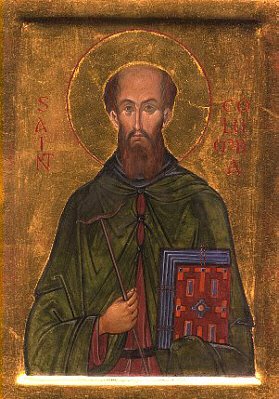
  • An icon of St. Columba:


  • (Hat tip for the icon: Sisters of the Gospel of Life)


  • The prayer of the feast day:

  • O God, you called your servant Columba
    from among the princes of Ireland
    to be a herald and evangelist of your kingdom to the Scottish people:
    Grant that your Church,
    remembering his faith and courage,
    may so proclaim the gospel,
    that all men will come to know your Son as their Saviour,
    and serve him as their King;
    who lives and reigns with you and the Holy Spirit,
    one God, now and for ever.
    Amen.
    (Hat tip for the prayer: Deacon Peter Simpson of St Columba's Roman Catholic Church in Culloden, Inverness)


  • Go here (see also this past issue of Dappled Things) for an absolutely beautiful piece of artwork by Daniel Mitsui, which depicts St. Columba in the mediaeval Irish style, using "a decorative vocabulary taken from the great Celtic illuminated manuscripts - especially the Lindisfarne Gospels, the Book of Kells and the Book of Durrow":
    St. Columba is pictured as an abbot, and holds the Cathach of St. Columba, an illuminated psalter attributed to the saint's own hand.

    At the bottom of the drawing are depicted three events from his life, as retold by Adamnan of Iona ...
    Definitely check it out. The artwork is available for purchase (NOTE TO SELF: add to Father's Day/Birthday/Christmas wish list).


  • Finally, finding a patron saint medal for St. Columba is danged nigh impossible. I've been looking for years, but have never been able to locate one. (If I have any readers in Ireland or Scotland who know how to obtain a patron saint medal depicting St. Columba - at a relatively affordable price, please contact me.)

    In the meantime, for those who are interested, the Ulster Heritage Magazine blog has information regarding a Saint Columba Medal designed by American-born Celtic metal worker and artist, Garth Duncan, who now lives on the Isle of Skye:


    For more information on the Saint Columba Medal, try Duncan's website.
  • Labels: , , , , ,

    Feast of St. Columba of Iona - 9 June


    My Druid is Christ, the son of God,
    Christ, Son of Mary, the Great Abbot,
    The Father, the Son and the Holy Ghost.


    ~ St. Columba of Iona

    O Columba spes Scotorum
    nos tuorum meritorum
    interventu beatorum
    fac consortes angelorum. Alleluia.

    O Columba, hope of Scots,
    By your merits' mediation.
    Make us companions
    of the blessed angels. Halleluia.


    ~ The Inchcolm Antiphoner, C13th


    St. Ephrem may get all the glory in the Roman Calendar, but in the Anderson household, the saint of the day on June 9 is St. Columba of Iona, also known as Columcille.

    Columba is my patron saint. Studying the life of this great saint (as well as honeymooning in Scotland, where we visited many sites associated with him) piqued my interest in the early Church and the spread of Christianity in the British Isles, and thus eventually led to my coming home to the Church. When Sarah and I entered the Church 7 years ago this month, I chose "Columba" as my Confirmation name.

    Among St. Columba's claims to fame - in addition to evangelizing the Picts in the land that eventually became Scotland, and creating on his monastic island of Iona a base of operation whereby Britain was re-evangelized after the native Celts were conquered by the pagan Anglo-Saxons - is that he is credited with the first recorded sighting of the Loch Ness Monster.

    The following history of St. Columba provides more insight into his colorful life (online source no longer available):
    Columba was born into Irish royalty on or around 521A.D.. It is told there was a dispute over the name he was to be given. His mother choosing to name him Columcille (dove), and his father, Crimthan (wolf). Columcille, or Columba as his name was latinized, went at a very young age to study in the monastery at Moville. There he was brought up in the traditional monastic life of the celts. While studying in the monastery, he gained an appreciation for the arts, music (psalters), poetry, and writing. He was said to have been one of the best scribes of his time, writing many Psalters and poems. In 546 Columba founded the monastery in Derry, and later the one in Durrow (556). Columba came into a dispute with his former master Finian in 561, over a dispute of ownership of a copy of the Gospel. Apparently Columba had made his own copy of Finian's original, and when he would no release ownership, the case was taken before king Diarmot. Diarmot was a local King, from a rival clan of Columba's. When the case went before him, Diarmot made the now famous quote "To every cow it's calf, and to every copy it's original". Shamed and insulted by this, Columba called upon his father to rally his clan for possession of the book. What followed was one of the most bloody battles in Irish history "the battle of the books". Three thousand died in Culdrevne, and Columba won the book, but it cost him dearly. As a result, he was exiled by the church from Ireland as a penance for a monk taking up arms.

    ***
    Columba leaving Ireland in 563, with twelve fellow monks, landed on the isle of IONA. It was there, out of sight of beloved Ireland that he established his monastery in which he based his evangelical missions. Having established his monastery and removing the druid priests that were on the Island, by performing a miracle of healing on a crippled girl, he purposed to begin evangelizing what is now known as Scotland. Leaving in 564 and travelling up through the great Scottish Loches towards Inverness, he spread the gospel to all that would hear. Working his way to Inverness to witness to the pictish King Brude, he was once again confronted by druadic priests. The priests demanding that Columba take his God and his twelve fellow monks back to Ireland, declared that theirs was the true religion, and that Christ conflicts with the nature cycle. Claiming that the druid was said to have drawn the life circle in the sand. Columba in response took his staff and drew an intersecting cross within the circle promptly stating that God does not conflict with nature, but being the creator of it, compliments it. Stumped by this and frustrated because they could not shake Columba's faith they departed.

    Saint Columba then proceeded through Loch Ness, where his successor St. Adoman wrote of him : “At another time, when the saint stayed for several days among the Picts, he came to the shores of the River Ness. Reaching the shore, he saw some locals in the midst of burying some unfortunate man. They told him that they had seen a water beast snatch the man and maul him as he was swimming. Some of the men had set out in a small boat to try to rescue the man, but they were too late. They used hooks to retrieve his corpse from the waters. Columba, after being told this story, amazed the crowd by telling his companion Luigne to swim across the water and bring back a boat that was on the far shore. Luigne obeyed the saint without hesitation, removed his clothes except for a tunic, and dove into the water. The beast was at the bottom of the water, its appetite merely whetted by its first victim. Sensing the water stirring above by Luigne’s swimming, it suddenly rushed towards the swimmer with a great roar, its wide mouth open to its prey. The crowd on the shore, both Columba’s men and the locals, watched in terror. The blessed Columba raised his hand and made the sign of the cross, and calling on the name of God, spoke to the monster: ‘Halt! Do not harm the man! Retreat at once!’ The sound of the saint’s voice caused terror in the beast, and it fled so swiftly that it appeared dragged under with ropes. It had been but the length of a pole away from Luigne. Columba’s companions were amazed when Luigne returned to them in the boat, unharmed and safe." This incidentally is the first report of Nessie.

    Columba eventually reached Inverness, and gained audience with the king, and while it was not recorded that king Brude was converted, he did institute Christianity over druidism. Columba gained a measure of favor with Brude, and involved himself to some extent in the politics of Scotland. Although exiled, Columba returned to Ireland many times to involve himself with the politics of home. Once returning to quench a suppressing of the bards by the Irish nobles. Columba died on his Island of IONA in [597]. Below is a prayer attributed to him.

    ***


    A traditional prayer for God's light

    O Lord, grant us that love which can never die, which will enkindle our lamps but not extinguish them, so that they may shine in us and bring light to others. Most dear Savior, enkindle our lamps that they may shine forever in your temple. May we receive unquenchable light from you so that our darkness will be illuminated and the darkness of the world will be made less. Amen.


    The Cathach of St. Columba

    Shrine of the Cathach

    Additional information from the Patron Saints Index:
    COLUMBA
    Also known as:
    Apostle of the Picts; Colmcille; Colum; Columbkille; Columbus; Columcille; Columkill; Combs

    Memorial:
    9 June

    Profile:
    Irish royalty, the son of Fedhlimidh and Eithne of the Ui Neill clan. Bard. Miracle worker. Monk at Moville. Spiritual student of Saint Finnian. Priest. Itinerant preacher and teacher throughout Ireland and Scotland. Spiritual teacher of Saint Corbmac, Saint Phelim, Saint Drostan, and Saint Fergna the White. Travelled to Scotland in 563. Exiled to Iona, he founded a monastic community there and served as its abbot for twelve years. He and the monks of Iona, including Saint Baithen of Iona and Saint Eochod, then evangelized the Picts, converting many, including King Brude. Attended the Council of Drumceat, 575. Legend says he wrote 300 books.

    Born:
    7 December 521 at Donegal, Ireland

    Died:
    9 June 597 at Iona, Scotland, and is buried there

    Canonized:
    Pre-Congregation

    Patronage:
    against floods; bookbinders; diocese of Derry, Ireland; diocese of Dunkeld, Scotland; floods; Ireland; Pembroke, Ontario; diocese of Raphoe, Ireland; poets; Scotland
    See also the quite extensive entry on the life of St. Columba of Iona at http://www.saintpatrickdc.org/ss/0609.shtml (scroll down to get to the entry):
    Ireland has many saints and three great ones: Patrick, Brigid, and Columba. Columba outshines the others for his pure Irishness. He loved Ireland with all his might and hated to leave it for Scotland. But he did leave it and laid the groundwork for the conversion of Britain. He had a quick temper but was very kind, especially to animals and children. He was a poet and an artist who did illumination, perhaps some of those in the Book of Kells itself. His skill as a scribe can be seen in the Cathach of Columba at the Irish Academy, which is the oldest surviving example of Irish majuscule writing. It was latter enshrined in silver and bronze and venerated in churches.

    About the time that Patrick was taken to Ireland as a slave, Columba was born. He came from a race of kings who had ruled in Ireland for six centuries, directly descended from Niall of the Nine Hostages, and was himself in close succession to the throne. From an early age he was destined for the priesthood; he was given in fosterage to a priest. After studying at Moville under Saint Finnian and then at Clonard with another Saint Finnian, he surrendered his princely claims, he became a monk at Glasnevin under Mobhi and was ordained.

    He spent the next 15 years preaching and teaching in Ireland. As was the custom in those days, he combined study and prayer with manual labor. By his own natural gifts as well as by the good fortune of his birth, he soon gained ascendancy as a monk of unusual distinction. By the time he was 25, he had founded no less than 27 Irish monasteries, including those at Derry (546), Durrow (c. 556), and probably Kells, as well as some 40 churches.

    Columba was a poet, who had learned Irish history and poetry from a bard named Gemman. He is believed to have penned the Latin poem Altus Prosator and two other extant poems. He also loved fine books and manuscripts. One of the famous books associated with Columbia is the Psaltair, which was traditionally the Battle Book of the O'Donnells, his kinsmen, who carried it into battle. The Psaltair is the basis for one of the most famous legends of Saint Columba.

    It is said that on one occasion, so anxious was Columba to have a copy of the Psalter that he shut himself up for a whole night in the church that contained it, transcribing it laboriously by hand. He was discovered by a monk who watched him through the keyhole and reported it to his superior, Finnian of Moville. The Scriptures were so scarce in those days that the abbot claimed the copy, refusing to allow it to leave the monastery. Columba refused to surrender it, until he was obliged to do so, under protest, on the abbot's appeal to the High King Diarmaid, who said: "Le gach buin a laogh" or "To every cow her own calf," meaning to every book its copy.

    An unfortunate period followed, during which, owing to Columba's protection of a refugee and his impassioned denunciation of an injustice by King Diarmaid, war broke out between the clans of Ireland, and Columba became an exile of his own accord. Filled with remorse on account of those who had been slain in the battle of Cooldrevne, and condemned by many of his own friends, he experienced a profound conversion and an irresistible call to preach to the heathen. Although there are questions regarding Columba's real motivation, in 563, at the age of 42, he crossed the Irish Sea with 12 companions in a coracle and landed on a desert island now known as Iona (Holy Island) on Whitsun Eve. Here on this desolate rock, only three miles long and two miles wide, in the grey northern sea off the southwest corner of Mull, he began his work; and, like Lindisfarne, Iona became a center of Christian enterprise. It was the heart of Celtic Christianity and the most potent factor in the conversion of the Picts, Scots, and Northern English.


    [More]


    Iona Abbey, Isle of Iona, Argyllshire, Scotland

    And finally, here is more on St. Columba from the Medieval Saints Yahoo Group:
    St. Columba of Iona, Abbot, missionary

    Also known as Colum, Columbus, Combs, Columkill, Columcille, Colmcille

    Died 597 at Iona, and is buried there

    Commemorated June 9
    ST. COLUMBA or COLUMCILLE 521-597

    St Columba is a saint who still, after fourteen hundred years, exerts an appeal upon our imaginations. Born in Ireland, in Donegal in the year 521, he was of the blood royal, and might indeed have become High King of Ireland had he not chosen to be a priest. His vital, vigorous personality has given rise to many legends, and it is a little hard to sift fact from what is more probably fiction. We do know that he was a man of tremendous energy, probably somewhat headstrong in his youth, but with his tendency to violence curbed by a gentle magnanimity.

    It seems certain that he left Ireland as an act of penance, although it is less certain how far this was connected with his quarrelling over a copy of the Gospels he had made, a dispute that led to a bloody battle. He came from Ireland to Scotland, to the colony of Dalriada founded on the west coast by his fellow Irish Scots who were at that time somewhat oppressed by the dominant Picts. With twelve companions he founded his monastery on Iona in the year 563. These Celtic monks lived in communities of separate cells, but Columba and his companions combined their contemplative life with extraordinary missionary activity. Amongst his many accomplishments, Columba was a splendid sailor. He sailed far amongst the islands and travelled deep inland, making converts and founding little churches. In Ireland he had already, it is said, founded a hundred churches.

    Of all the Celtic saints in Scotland, Columba's life is much the best documented, because manuscripts of his Life, written by St Adamnan, one of his early successors as abbot of Iona, have survived. Iona itself remains a place of the greatest beauty, a serene island set in seas that take on brilliant colors in the sunshine, recalling the life and background of this remarkable man whose mission led to the conversion of Scotland and of the north of England, and indeed carried its influence far further afield. It later became the site of a Benedictine Abbey and of a little cathedral. These were dismantled by the Scottish reformers in 1561, and part of Columba's prophecy was fulfilled:

    In Iona of my heart, Iona of my love,
    Instead of monks' voices shall be lowing of cattle,
    But ere the world come to an end
    Iona shall be as it was.

    When Dr Samuel Johnson visited the island in 1773 he observed, 'That man is little to be envied, whose patriotism would not gain force upon the plain of Marathon, or whose piety would not grow warmer among the ruins of Iona!'

    Columba was a poet as well as a man of action. Some of his poems in both Latin and Gaelic have come down to us, and they reveal him as a man very sensitive to the beauty of his surroundings, as well as always, in St Adamnan's phrase, 'gladdened in his inmost heart by the joy of the Holy Spirit.' He died in the year 597.
    ----------------

    More on St. Columba at:

  • http://www.newadvent.org/cathen/04136a.htm


  • http://islesproject.com/2009/01/13/563-597-saint-columba-the-loch-ness-monster-and-the-picts-the-written-word-and-celtic-christianity-spread-to-the-highlands/


  • http://www.allsaintsbrookline.org/celtic_saints/columba.html


  • Adomnan's Life of Columba is available elsewhere

  • in English
  • http://www.fordham.edu/halsall/basis/columba-e.html

  • and Latin
  • http://www.fordham.edu/halsall/basis/columba-l.html


    Columba's famous rule is also online


  • http://www.fordham.edu/halsall/source/columba-rule.html


  • And an article on the history of the island of Iona

  • http://www.knight.org/advent/cathen/08090a.htm


  • Iona Abbey

  • The Iona Community


  • Historic Scotland - Iona Abbey


  • Historic Scotland - Iona, St. Columba Centre


  • Saint Columba Novena and Litany

    ______________________


    The Monymusk Reliquary, or "Brecbennoch" as it was called, dates from c. 750, and purportedly enclosed the bones of St. Columba, the most popular saint in medieval Scotland. It was carried by the Scots into the Battle of Bannockburn in 1314.


    ______________________


    Recommended Reading:
    Life of Columba by Adamnan of Iona
    The Life of Colum Cille by Manus O'Donnell
    Colum Cille and the Columban Tradition by Brian Lacey
    The World of Colmcille, also known as Columba by Mairead Ashe FitzGerald

    The Illustrated Life of Columba
    by John Marsden
    Iona, Kells, and Derry: The History and Hagiography of the Monastic Familia of Columba by Maire Herbert
    The Legend of St. Columba by Padraic Colum
    Columba by Nigel Tranter
    The Magnificent Gael by Reginald B. Hale

    The Cathach of Colum Cille (available on CD-Rom)
    Patron Saints Index Entry for St. Columba

    How the Irish Saved Civilization by Thomas Cahill
    Wisdom of the Celtic Saints by Edward C. Sellner
    Sun Dancing by Geoffrey Moorhouse

    Children's Books About St. Columba:
    The Man Who Loved Books by Jean Fritz
    Across a Dark and Wild Sea by Don Brown
    Saint Colum and the Crane by Eva K. Betz

    Music:
    "Columba, Most Holy of Saints - Medieval Scottish Plainchant"
    ~ Performed by Capella Nova, Alan Tavener

    "In Praise of Saint Columba"
    ~ Performed by the Choir of Gonville & Caius College, Cambridge

    "The Pilgrim - A Celtic Suite for Orchestra, Soloists, Pipe Band and Choir"
    ~ Composed by Shaun Davey


    Labels: , , , , ,

    Thursday, June 24, 2010

    "One of the Three Most Accomplished Knights in Christendom" and the Winning of Scottish Independence at Bannockburn [UPDATED]


    Today is the 696th anniversary of one of the greatest battles ever fought on British soil, and certainly the most significant battle in Scottish history.

    On 24 June 1314, Robert Bruce, King of Scots, led a vastly outnumbered army to an overwhelming victory against the might of the English forces under King Edward II at the Battle of Bannockburn, near Stirling Castle in central Scotland.


    Bannockburn turned out to be the decisive victory in the First Scottish War of Independence, and was a precursor to the restatement of Scotland's historic independence from England, which was formally declared by the Community of the Realm of Scotland 6 years later at Arbroath.

    Despite the completeness of the Scottish victory at Bannockburn and, later, papal recognition of the Scottish claims in the Declaration of Arbroath, full English recognition of Scottish independence was not achieved until more than ten years after Bannockburn, just prior to the death of King Robert. In the meantime, throughout that decade following Bannockburn, Robert completely dominated the English militarily: conducting frequent raids across the border deep into the heartlands of Yorkshire and Lancashire; exacting tribute from English communities (who bought off the Scots to avoid being laid waste in Robert's efforts to force English recognition of Scotland's independence); invading and nearly subduing Ireland in an abortive attempt to place Robert's brother, Edward Bruce, on the Irish throne; capturing the Isle of Man; and raiding a Welsh sea-port.

    Robert Bruce kills Sir Henry de Bohun in single combat at Bannockburn. Source.


    Robert Bruce statue at Bannockburn. Source.


    Another view of the Bruce statue at Bannockburn. Source.

    Without doubt, Bruce was Scotland's greatest king, and he achieved, during his lifetime, world renown as one of the greatest warriors of the age.

    Source; © The Heraldry Society Scotland 2004 The Heraldry Society of Scotland


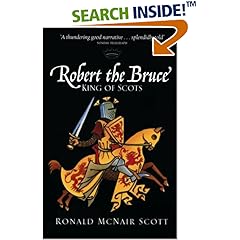
    Ronald McNair Scott, in his biography Robert the Bruce, King of Scots, cites to Liber Pluscardiensis in declaring that "in his prime Robert Bruce was ranked with the Holy Roman Emperor Henry and Sir Giles D'Argentan as one of the three most accomplished knights in Christendom ..." Scott later refers to the Bruce as "the victor in a hundred tournaments".


    Scots, wha hae wi' Wallace bled,
    Scots, wham Bruce has aften led,
    Welcome to your gory bed,
    Or to victory.
    Now's the day, and now's the hour;
    See the front of battle lower;
    See approach proud Edward's power—
    Chains and slavery.

    Wha will be a traitor knave?
    Wha can fill a coward's grave?
    Wha sae base as be a slave?
    Let him turn and flee.
    Wha for Scotland's King and law
    Freedom's sword will strongly draw,
    Freeman stand, or freeman fa',
    Let him on wi' me.

    By oppression's woes and pains!
    By your sons in servile chains!
    We will drain our dearest veins,
    But they shall be free.
    Lay the proud usurpers low!
    Tyrants fall in every foe!
    Liberty's in every blow
    Let us do—or die."


    UPDATE
    You can read about plans for commemorating the battle's 700th anniversary in 2014 here.

    Also, here's an interesting story about the controversial decision of the Scottish National Trust to avoid offending English sensibilities and in an effort to tamp down over-exhuberant Scottish patriotism by portraying the Battle of Bannockburn as a melee between two medieval kings jockeying for supremacy and land to add to their holdings, as opposed to a battle between the Scots and the English.

    The problem with the National Trust's proposed interpretation is that, in the context of the emerging Scottish nationalism of the late 13th and early 14th centuries, as represented by William Wallace's struggle against English oppression and culminating in the Community of the Realm's declaring its independence at Arbroath, it is complete ahistorical bollocks.

    Here is just an excerpt from the Declaration of Arbroath, which provides some context regarding the prevaling nationalistic sentiments in Scotland during the Wars of Independence:
    ... But from these countless evils we have been set free, by the help of Him Who though He afflicts yet heals and restores, by our most tireless Prince, King and Lord, the Lord Robert.

    He, that his people and his heritage might be delivered out of the hands of our enemies, met toil and fatigue, hunger and peril, like another Macabaeus or Joshua and bore them cheerfully.

    Him, too, divine providence, his right of succession according to or laws and customs which we shall maintain to the death, and the due consent and assent of us all have made our Prince and King.

    To him, as to the man by whom salvation has been wrought unto our people, we are bound both by law and by his merits that our freedom may be still maintained, and by him, come what may, we mean to stand.

    Yet if he should give up what he has begun, and agree to make us or our kingdom subject to the King of England or the English, we should exert ourselves at once to drive him out as our enemy and a subverter of his own rights and ours, and make some other man who was well able to defend us our King; for, as long as but a hundred of us remain alive, never will we on any conditions be brought under English rule.

    It is in truth not for glory, nor riches, nor honours that we are fighting, but for freedom
    - for that alone, which no honest man gives up but with life itself...
    (emphasis added)

    In short, the National Trust is full of shite.

    Labels: , , , ,

    Wednesday, June 09, 2010

    More on St. Columba of Iona (a.k.a. Columcille) [UPDATED]

    See also my previous post: "Feast of St. Columba of Iona - 9 June"


    (Hat tip for the video: Da Mihi Animas)


    (Hat tip for the icon: Sisters of the Gospel of Life)


    The prayer of the feast day:
    O God, you called your servant Columba
    from among the princes of Ireland
    to be a herald and evangelist of your kingdom to the Scottish people:
    Grant that your Church,
    remembering his faith and courage,
    may so proclaim the gospel,
    that all men will come to know your Son as their Saviour,
    and serve him as their King;
    who lives and reigns with you and the Holy Spirit,
    one God, now and for ever.
    Amen.
    (Hat tip for the prayer: Deacon Peter Simpson of St Columba's Roman Catholic Church in Culloden, Inverness)


    Finally, go here [UPDATE: see also this recent issue of Dappled Things] for an absolutely beautiful piece of artwork by Daniel Mitsui, which depicts St. Columba in the mediaeval Irish style, using "a decorative vocabulary taken from the great Celtic illuminated manuscripts - especially the Lindisfarne Gospels, the Book of Kells and the Book of Durrow":
    St. Columba is pictured as an abbot, and holds the Cathach of St. Columba, an illuminated psalter attributed to the saint's own hand.

    At the bottom of the drawing are depicted three events from his life, as retold by Adamnan of Iona ...
    Definitely check it out. The artwork is available for purchase (NOTE TO SELF: add to Father's Day/Birthday/Christmas wish list).


    UPDATE
    Finding a patron saint medal for St. Columba is danged nigh impossible. I've been looking for years, but have never been able to locate one. (If I have any readers in Ireland or Scotland who know how to obtain a patron saint medal depicting St. Columba - at a relatively affordable price, please contact me.)

    In the meantime, for those who are interested, the Ulster Heritage Magazine blog has information regarding a Saint Columba Medal designed by American-born Celtic metal worker and artist, Garth Duncan, who now lives on the Isle of Skye:


    For more information on the Saint Columba Medal, try Duncan's website.

    Labels: , , , , ,

    Feast of St. Columba of Iona - 9 June


    My Druid is Christ, the son of God,
    Christ, Son of Mary, the Great Abbot,
    The Father, the Son and the Holy Ghost.


    ~ St. Columba of Iona

    O Columba spes Scotorum
    nos tuorum meritorum
    interventu beatorum
    fac consortes angelorum. Alleluia.

    O Columba, hope of Scots,
    By your merits' mediation.
    Make us companions
    of the blessed angels. Halleluia.


    ~ The Inchcolm Antiphoner, C13th


    St. Ephrem may get all the glory in the Roman Calendar, but in the Anderson household, the saint of the day on June 9 is St. Columba of Iona, also known as Columcille.

    Columba is my patron saint. Studying the life of this great saint (as well as honeymooning in Scotland, where we visited many sites associated with him) piqued my interest in the early Church and the spread of Christianity in the British Isles, and thus eventually led to my coming home to the Church. When Sarah and I entered the Church 6 years ago this month, I chose "Columba" as my Confirmation name.

    Among St. Columba's claims to fame - in addition to evangelizing the Picts in the land that eventually became Scotland, and creating on his monastic island of Iona a base of operation whereby Britain was re-evangelized after the native Celts were conquered by the pagan Anglo-Saxons - is that he is credited with the first recorded sighting of the Loch Ness Monster.

    The following history of St. Columba provides more insight into his colorful life (online source no longer available):
    Columba was born into Irish royalty on or around 521A.D.. It is told there was a dispute over the name he was to be given. His mother choosing to name him Columcille (dove), and his father, Crimthan (wolf). Columcille, or Columba as his name was latinized, went at a very young age to study in the monastery at Moville. There he was brought up in the traditional monastic life of the celts. While studying in the monastery, he gained an appreciation for the arts, music (psalters), poetry, and writing. He was said to have been one of the best scribes of his time, writing many Psalters and poems. In 546 Columba founded the monastery in Derry, and later the one in Durrow (556). Columba came into a dispute with his former master Finian in 561, over a dispute of ownership of a copy of the Gospel. Apparently Columba had made his own copy of Finian's original, and when he would no release ownership, the case was taken before king Diarmot. Diarmot was a local King, from a rival clan of Columba's. When the case went before him, Diarmot made the now famous quote "To every cow it's calf, and to every copy it's original". Shamed and insulted by this, Columba called upon his father to rally his clan for possession of the book. What followed was one of the most bloody battles in Irish history "the battle of the books". Three thousand died in Culdrevne, and Columba won the book, but it cost him dearly. As a result, he was exiled by the church from Ireland as a penance for a monk taking up arms.

    ***
    Columba leaving Ireland in 563, with twelve fellow monks, landed on the isle of IONA. It was there, out of sight of beloved Ireland that he established his monastery in which he based his evangelical missions. Having established his monastery and removing the druid priests that were on the Island, by performing a miracle of healing on a crippled girl, he purposed to begin evangelizing what is now known as Scotland. Leaving in 564 and travelling up through the great Scottish Loches towards Inverness, he spread the gospel to all that would hear. Working his way to Inverness to witness to the pictish King Brude, he was once again confronted by druadic priests. The priests demanding that Columba take his God and his twelve fellow monks back to Ireland, declared that theirs was the true religion, and that Christ conflicts with the nature cycle. Claiming that the druid was said to have drawn the life circle in the sand. Columba in response took his staff and drew an intersecting cross within the circle promptly stating that God does not conflict with nature, but being the creator of it, compliments it. Stumped by this and frustrated because they could not shake Columba's faith they departed.

    Saint Columba then proceeded through Loch Ness, where his successor St. Adoman wrote of him : “At another time, when the saint stayed for several days among the Picts, he came to the shores of the River Ness. Reaching the shore, he saw some locals in the midst of burying some unfortunate man. They told him that they had seen a water beast snatch the man and maul him as he was swimming. Some of the men had set out in a small boat to try to rescue the man, but they were too late. They used hooks to retrieve his corpse from the waters. Columba, after being told this story, amazed the crowd by telling his companion Luigne to swim across the water and bring back a boat that was on the far shore. Luigne obeyed the saint without hesitation, removed his clothes except for a tunic, and dove into the water. The beast was at the bottom of the water, its appetite merely whetted by its first victim. Sensing the water stirring above by Luigne’s swimming, it suddenly rushed towards the swimmer with a great roar, its wide mouth open to its prey. The crowd on the shore, both Columba’s men and the locals, watched in terror. The blessed Columba raised his hand and made the sign of the cross, and calling on the name of God, spoke to the monster: ‘Halt! Do not harm the man! Retreat at once!’ The sound of the saint’s voice caused terror in the beast, and it fled so swiftly that it appeared dragged under with ropes. It had been but the length of a pole away from Luigne. Columba’s companions were amazed when Luigne returned to them in the boat, unharmed and safe." This incidentally is the first report of Nessie.

    Columba eventually reached Inverness, and gained audience with the king, and while it was not recorded that king Brude was converted, he did institute Christianity over druidism. Columba gained a measure of favor with Brude, and involved himself to some extent in the politics of Scotland. Although exiled, Columba returned to Ireland many times to involve himself with the politics of home. Once returning to quench a suppressing of the bards by the Irish nobles. Columba died on his Island of IONA in [597]. Below is a prayer attributed to him.

    ***
    A traditional prayer for God's light

    O Lord, grant us that love which can never die, which will enkindle our lamps but not extinguish them, so that they may shine in us and bring light to others. Most dear Savior, enkindle our lamps that they may shine forever in your temple. May we receive unquenchable light from you so that our darkness will be illuminated and the darkness of the world will be made less. Amen.
    The Cathach of St. Columba

    Shrine of the Cathach

    Additional information from the Patron Saints Index:
    COLUMBA
    Also known as:
    Apostle of the Picts; Colmcille; Colum; Columbkille; Columbus; Columcille; Columkill; Combs

    Memorial:
    9 June

    Profile:
    Irish royalty, the son of Fedhlimidh and Eithne of the Ui Neill clan. Bard. Miracle worker. Monk at Moville. Spiritual student of Saint Finnian. Priest. Itinerant preacher and teacher throughout Ireland and Scotland. Spiritual teacher of Saint Corbmac, Saint Phelim, Saint Drostan, and Saint Fergna the White. Travelled to Scotland in 563. Exiled to Iona, he founded a monastic community there and served as its abbot for twelve years. He and the monks of Iona, including Saint Baithen of Iona and Saint Eochod, then evangelized the Picts, converting many, including King Brude. Attended the Council of Drumceat, 575. Legend says he wrote 300 books.

    Born:
    7 December 521 at Donegal, Ireland

    Died:
    9 June 597 at Iona, Scotland, and is buried there

    Canonized:
    Pre-Congregation

    Patronage:
    against floods; bookbinders; diocese of Derry, Ireland; diocese of Dunkeld, Scotland; floods; Ireland; Pembroke, Ontario; diocese of Raphoe, Ireland; poets; Scotland
    See also the quite extensive entry on the life of St. Columba of Iona at http://www.saintpatrickdc.org/ss/0609.shtml (scroll down to get to the entry):
    Ireland has many saints and three great ones: Patrick, Brigid, and Columba. Columba outshines the others for his pure Irishness. He loved Ireland with all his might and hated to leave it for Scotland. But he did leave it and laid the groundwork for the conversion of Britain. He had a quick temper but was very kind, especially to animals and children. He was a poet and an artist who did illumination, perhaps some of those in the Book of Kells itself. His skill as a scribe can be seen in the Cathach of Columba at the Irish Academy, which is the oldest surviving example of Irish majuscule writing. It was latter enshrined in silver and bronze and venerated in churches.

    About the time that Patrick was taken to Ireland as a slave, Columba was born. He came from a race of kings who had ruled in Ireland for six centuries, directly descended from Niall of the Nine Hostages, and was himself in close succession to the throne. From an early age he was destined for the priesthood; he was given in fosterage to a priest. After studying at Moville under Saint Finnian and then at Clonard with another Saint Finnian, he surrendered his princely claims, he became a monk at Glasnevin under Mobhi and was ordained.

    He spent the next 15 years preaching and teaching in Ireland. As was the custom in those days, he combined study and prayer with manual labor. By his own natural gifts as well as by the good fortune of his birth, he soon gained ascendancy as a monk of unusual distinction. By the time he was 25, he had founded no less than 27 Irish monasteries, including those at Derry (546), Durrow (c. 556), and probably Kells, as well as some 40 churches.

    Columba was a poet, who had learned Irish history and poetry from a bard named Gemman. He is believed to have penned the Latin poem Altus Prosator and two other extant poems. He also loved fine books and manuscripts. One of the famous books associated with Columbia is the Psaltair, which was traditionally the Battle Book of the O'Donnells, his kinsmen, who carried it into battle. The Psaltair is the basis for one of the most famous legends of Saint Columba.

    It is said that on one occasion, so anxious was Columba to have a copy of the Psalter that he shut himself up for a whole night in the church that contained it, transcribing it laboriously by hand. He was discovered by a monk who watched him through the keyhole and reported it to his superior, Finnian of Moville. The Scriptures were so scarce in those days that the abbot claimed the copy, refusing to allow it to leave the monastery. Columba refused to surrender it, until he was obliged to do so, under protest, on the abbot's appeal to the High King Diarmaid, who said: "Le gach buin a laogh" or "To every cow her own calf," meaning to every book its copy.

    An unfortunate period followed, during which, owing to Columba's protection of a refugee and his impassioned denunciation of an injustice by King Diarmaid, war broke out between the clans of Ireland, and Columba became an exile of his own accord. Filled with remorse on account of those who had been slain in the battle of Cooldrevne, and condemned by many of his own friends, he experienced a profound conversion and an irresistible call to preach to the heathen. Although there are questions regarding Columba's real motivation, in 563, at the age of 42, he crossed the Irish Sea with 12 companions in a coracle and landed on a desert island now known as Iona (Holy Island) on Whitsun Eve. Here on this desolate rock, only three miles long and two miles wide, in the grey northern sea off the southwest corner of Mull, he began his work; and, like Lindisfarne, Iona became a center of Christian enterprise. It was the heart of Celtic Christianity and the most potent factor in the conversion of the Picts, Scots, and Northern English.


    [More]
    Iona Abbey, Isle of Iona, Argyllshire, Scotland

    And finally, here is more on St. Columba from the Medieval Saints Yahoo Group:
    St. Columba of Iona, Abbot, missionary

    Also known as Colum, Columbus, Combs, Columkill, Columcille, Colmcille

    Died 597 at Iona, and is buried there

    Commemorated June 9

    ST. COLUMBA or COLUMCILLE 521-597

    St Columba is a saint who still, after fourteen hundred years, exerts an appeal upon our imaginations. Born in Ireland, in Donegal in the year 521, he was of the blood royal, and might indeed have become High King of Ireland had he not chosen to be a priest. His vital, vigorous personality has given rise to many legends, and it is a little hard to sift fact from what is more probably fiction. We do know that he was a man of tremendous energy, probably somewhat headstrong in his youth, but with his tendency to violence curbed by a gentle magnanimity.

    It seems certain that he left Ireland as an act of penance, although it is less certain how far this was connected with his quarrelling over a copy of the Gospels he had made, a dispute that led to a bloody battle. He came from Ireland to Scotland, to the colony of Dalriada founded on the west coast by his fellow Irish Scots who were at that time somewhat oppressed by the dominant Picts. With twelve companions he founded his monastery on Iona in the year 563. These Celtic monks lived in communities of separate cells, but Columba and his companions combined their contemplative life with extraordinary missionary activity. Amongst his many accomplishments, Columba was a splendid sailor. He sailed far amongst the islands and travelled deep inland, making converts and founding little churches. In Ireland he had already, it is said, founded a hundred churches.

    Of all the Celtic saints in Scotland, Columba's life is much the best documented, because manuscripts of his Life, written by St Adamnan, one of his early successors as abbot of Iona, have survived. Iona itself remains a place of the greatest beauty, a serene island set in seas that take on brilliant colors in the sunshine, recalling the life and background of this remarkable man whose mission led to the conversion of Scotland and of the north of England, and indeed carried its influence far further afield. It later became the site of a Benedictine Abbey and of a little cathedral. These were dismantled by the Scottish reformers in 1561, and part of Columba's prophecy was fulfilled:

    In Iona of my heart, Iona of my love,
    Instead of monks' voices shall be lowing of cattle,
    But ere the world come to an end
    Iona shall be as it was.

    When Dr Samuel Johnson visited the island in 1773 he observed, 'That man is little to be envied, whose patriotism would not gain force upon the plain of Marathon, or whose piety would not grow warmer among the ruins of Iona!'

    Columba was a poet as well as a man of action. Some of his poems in both Latin and Gaelic have come down to us, and they reveal him as a man very sensitive to the beauty of his surroundings, as well as always, in St Adamnan's phrase, 'gladdened in his inmost heart by the joy of the Holy Spirit.' He died in the year 597.
    ----------------

    More on St. Columba at:
  • http://www.newadvent.org/cathen/04136a.htm
  • http://islesproject.com/2009/01/13/563-597-saint-columba-the-loch-ness-monster-and-the-picts-the-written-word-and-celtic-christianity-spread-to-the-highlands/
  • http://www.allsaintsbrookline.org/celtic_saints/columba.html


  • Adomnan's Life of Columba is available elsewhere
  • in English
  • http://www.fordham.edu/halsall/basis/columba-e.html
  • and Latin
  • http://www.fordham.edu/halsall/basis/columba-l.html


    Columba's famous rule is also online

  • http://www.fordham.edu/halsall/source/columba-rule.html

  • And an article on the history of the island of Iona
  • http://www.knight.org/advent/cathen/08090a.htm


  • Iona Abbey
  • The Iona Community
  • Historic Scotland - Iona Abbey
  • Historic Scotland - Iona, St. Columba Centre


  • Saint Columba Novena and Litany


    ______________________


    The Monymusk Reliquary, or "Brecbennoch" as it was called, dates from c. 750,
    and purportedly enclosed the bones of St. Columba,
    the most popular saint in medieval Scotland.
    It was carried by the Scots into the
    Battle of Bannockburn in 1314.

    ______________________


    Recommended Reading:
    Life of Columba by Adamnan of Iona
    The Life of Colum Cille by Manus O'Donnell
    Colum Cille and the Columban Tradition by Brian Lacey
    The World of Colmcille, also known as Columba by Mairead Ashe FitzGerald
    The Illustrated Life of Columba by John Marsden
    Iona, Kells, and Derry: The History and Hagiography of the Monastic Familia of Columba by Maire Herbert
    The Legend of St. Columba by Padraic Colum
    Columba by Nigel Tranter
    The Magnificent Gael by Reginald B. Hale
    The Cathach of Colum Cille (available on CD-Rom)
    Patron Saints Index Entry for St. Columba
    How the Irish Saved Civilization by Thomas Cahill
    Wisdom of the Celtic Saints by Edward C. Sellner
    Sun Dancing by Geoffrey Moorhouse

    Children's Books About St. Columba:
    The Man Who Loved Books by Jean Fritz
    Across a Dark and Wild Sea by Don Brown
    Saint Colum and the Crane by Eva K. Betz

    Music:
    "Columba, Most Holy of Saints - Medieval Scottish Plainchant"
    ~ Performed by Capella Nova, Alan Tavener
    "The Pilgrim - A Celtic Suite for Orchestra, Soloists, Pipe Band and Choir"
    ~ Composed by Shaun Davey


    Labels: , , , , ,

    Tuesday, March 16, 2010

    Oró Sé do Bheatha 'Bhaile


    From Wikipedia:
    Óró, Sé do Bheatha 'Bhaile (Irish pronunciation: [ˈɔɾˠoː ʃeː d̪ˠə ˈvʲahə ˈwalʲə]) is a traditional Irish song, that came to be known as an Irish rebel song in the early 20th century.

    History
    The song in its original form, Séarlas Óg (meaning "Young Charles" in Irish) refers to Bonnie Prince Charlie and dates back to the second Jacobite rising, during the reign of George II in 1745-6.

    In the early 20th century it received new verses by the nationalist poet Padraig Pearse and was often sung by IRA members and sympathisers, during the Easter Rising. It was also sung as a fast march during the Irish War of Independence.

    Since 1916 it has also been known under various other titles, notably Dord na bhFiann (Call of the Fighters) or An Dord Féinne. The latter title is associated with Padraig Pearse in particular. This version is dedicated to the pirate or "Great Sea Warrior" Gráinne Ní Mháille. She was a formidable power on the west coast of Ireland in the late 1500s...


    Original Jacobite Version

    (Chorus)

    Óró, sé do bheatha abhaile,
    B'fhearr liom tú ná céad bó bhainne,
    Óró, sé do bheatha abhaile
    Anois ar theacht an tsamhraidh.

    A Shéarlais Óig, a mhic Rí Shéamais
    'Sé mo mhór-chreach do thriall as Éirinn
    Gan tuinnte bróig' ort, stoca nó leinidh
    Ach do chascairt leis na Gallaibh


    Chorus

    'Sé mo léan géar nach bhfeicim
    Mur mbéinn beo 'na dhiaidh ach seachtain
    Séarlas Óg is míle gaiscidheach
    Ag fógairt fáin ar Ghallaibh


    Chorus

    Tá Séarlas Óg ag traill thar sáile
    Béidh siad leisean, Franncaigh is Spáinnigh
    Óglaigh armtha leis mar gharda
    'S bainfidh siad rinnce as éiricigh!


    Chorus


    English translation

    (Chorus)

    Oh-ro You're welcome home,
    I'd rather you to a hundred milking cows,
    Oh-ro You're welcome home...
    Now that summer's coming!

    Young Charles, son of King James
    It's a great distress – your exile from Ireland
    Without thread of shoe on you, socks or shirt
    Overthrown by the foreigners


    Chorus

    Alas that I do not see
    If I were alive afterwords only for a week
    Young Charles and one thousand warriors
    Banishing all the foreigners


    Chorus

    Young Charles is coming over the sea
    They will be with him, French and Spanish
    Armed Volunteers with him as a guard
    And they'll make the heretics dance!


    Chorus


    Padraig Pearse Version

    Chorus

    Óró, sé do bheatha abhaile,
    Óró, sé do bheatha abhaile,
    Óró, sé do bheatha abhaile
    Anois ar theacht an tsamhraidh.

    'Sé do bheatha, a bhean ba léanmhar,
    Do b' é ár gcreach tú bheith i ngéibheann,
    Do dhúiche bhreá i seilbh méirleach,
    Is tú díolta leis na Gallaibh.

    Chorus

    Tá Gráinne Mhaol ag teacht thar sáile,
    Óglaigh armtha léi mar gharda,
    Gaeil iad féin is ní Gaill[4] ná Spáinnigh,
    Is cuirfidh siad ruaig ar Ghallaibh.

    Chorus

    A bhuí le Rí na bhFeart go bhfeiceam,
    Mura mbeam beo ina dhiaidh ach seachtain,
    Gráinne Mhaol agus míle gaiscíoch,
    Ag fógairt fáin ar Ghallaibh.


    Chorus


    English translation

    (Chorus)

    Oh-ro You're welcome home,
    Oh-ro You're welcome home,
    Oh-ro You're welcome home...
    Now that summer's coming!

    Welcome oh woman who was so afflicted,
    It was our ruin that you were in bondage,
    Our fine land in the possession of thieves...
    And you sold to the foreigners!


    Chorus

    Gráinne O'Malley is coming over the sea,
    Armed warriors along with her as her guard,
    They are Irishmen, not foreigners nor Spanish...
    And they will rout the foreigners!


    Chorus

    May it please the King of Miracles that I might see,
    Although we may live for a week once after,
    Gráinne Mhaol and a thousand warriors...
    Dispersing the foreigners!


    Chorus


    As sung by The Wolf Tones:


    And The Dubliners:


    And the Clancy Brothers:

    Labels: , , , , , , ,

    hit counter for blogger