Folks, it comes as no surprise to you, given my absence, that I'm no longer blogging. Haven't been for a while. So, don't be surprised if this is the last post you ever see at this blog. But I felt like I needed to say something, and, given the overriding theme of this blog for the past 10 years, a post about the so-called "Catholic Vote", and whether such a thing even exists, seems as good a way to wrap things up as there is.
Just two years ago, Catholics voted for
President Barack Obama by a margin of 50 percent to 48 percent. On
Tuesday, they abandoned Obama’s party: 54 percent voted for Republican
candidates and 45 percent went for the Democrats (60 percent of white
Catholics chose GOP candidates). What is most startling about the
Catholic vote is that it represents an exact turnaround from 2008: 54
percent voted for Obama and 45 percent cast their ballot for Senator
John McCain.
Catholics are pragmatic. Until the
McGovernization of the Democratic Party in 1972, they were among the
most reliably Democratic voters in the nation. Since that time, they
have been politically homeless, which is why both parties vie for their
vote so aggressively. Catholics are a bellwether: whoever wins their
vote, generally wins the election. By contrast, Protestants vote
Republican and Jews vote Democrat...
I'm
sorry, but these particular numbers regarding "the Catholic Vote" just don't stand out to me. In fact,
it's time we stop talking about "the Catholic vote" or "Catholic voters"
because such a thing no longer exists.
Bill Donohue says "Catholics are pragmatic." But when I look at these numbers, all I
see is Catholics supporting the Democrats
in 2012 by the same proportion as the rest of the country, and
Catholics supporting Republicans in 2014 by the same proportion as the
rest of the country.
In
other words, there doesn't appear to be anything unique to or distinct
about Catholic voters that differentiates them from the rest of the
country at large. Catholic voters appear to be merely a mirror of the
rest of society in their voting patterns. And that's just sad.
Catholics
appear to have become what many of our forebears, culminating in the election of President John F. Kennedy, seem to have wanted -
to just fit in. To be seen as "normal Americans". To not be seen by the
rest of the country as in any way beholden to our Faith (certainly not be
be seen as beholden to a "foreign power", i.e. the Pope).
But
"fitting in" isn't what is required of us. We're called to be in the
world, but not of it. We're called to be counter-cultural. We're called
to be witnesses of our Faith. We're supposed to change the world, NOT
let the world change us.
So,
no, I don't believe that "Catholics abandoned Democrats" in the 2014
elections. The VOTERS abandoned the Democrats in the 2014 election, and
Catholics just went along for the ride. By contrast, our evangelical brethren voted against the Democrats in a proportion that FAR exceeded the proportion of the electorate at large. THERE's an instance where
faith seems to make a difference in voting patterns. With us Catholics,
not so much. Again, sad.
225 Years Ago Today - First Presidential Inauguration of His Excellency, George Washington
225 years ago today - 30 April 1789, George Washington was inaugurated as our Nation's first President on the steps of Federal Hall in New York City. In his First Inaugural Address, President Washington TWICE invoked God and asked for His divine guidance and blessings upon the new Nation:
"... Such being the impressions under which I have, in obedience to the public summons, repaired to the present station, it would be peculiarly improper to omit in this first official act my fervent supplications to that Almighty Being who rules over the universe, who presides in the councils of nations, and whose providential aids can supply every human defect, that His benediction may consecrate to the liberties and happiness of the people of the United States a Government instituted by themselves for these essential purposes, and may enable every instrument employed in its administration to execute with success the functions allotted to his charge. In tendering this homage to the Great Author of every public and private good, I assure myself that it expresses your sentiments not less than my own, nor those of my fellow-citizens at large less than either. No people can be bound to acknowledge and adore the Invisible Hand which conducts the affairs of men more than those of the United States. Every step by which they have advanced to the character of an independent nation seems to have been distinguished by some token of providential agency; and in the important revolution just accomplished in the system of their united government the tranquil deliberations and voluntary consent of so many distinct communities from which the event has resulted can not be compared with the means by which most governments have been established without some return of pious gratitude, along with an humble anticipation of the future blessings which the past seem to presage. These reflections, arising out of the present crisis, have forced themselves too strongly on my mind to be suppressed. You will join with me, I trust, in thinking that there are none under the influence of which the proceedings of a new and free government can more auspiciously commence...
"... Having thus imparted to you my sentiments as they have been awakened by the occasion which brings us together, I shall take my present leave; but not without resorting once more to the benign Parent of the Human Race in humble supplication that, since He has been pleased to favor the American people with opportunities for deliberating in perfect tranquillity, and dispositions for deciding with unparalleled unanimity on a form of government for the security of their union and the advancement of their happiness, so His divine blessing may be equally conspicuous in the enlarged views, the temperate consultations, and the wise measures on which the success of this Government must depend."
William P. Clark, Ronald Reagan's closest advisor, passed away yesterday. It's quite possible that you've never heard of Judge Clark, but he just so happens to be one of the chief architects of Reagan's vision for the downfall of Soviet communism, and played a key role in implementing that plan.
... Clark helped set up that initial and historic June 1982 meeting between President Reagan and Pope John Paul II, where the two men confided in one another that they believed that God had spared their lives for a special purpose, which they concluded was to undermine Soviet communism, beginning particularly in Poland, which both men—as well as Clark—saw as the wedge that could crack the entire Communist Bloc. Over the next year and a half that followed, Clark became the primary White House conduit to the Vatican. Along with CIA director Bill Casey, another committed Catholic, Clark met very frequently with Pio Laghi, the apostolic delegate to Washington. He and Casey had code language when discussing over the telephone the need for a quick meeting with Laghi: "It's time to get some cappuccino," they would say. That meant a visit to Laghi's residence for a cappuccino and to share information about the critical activities going on around the world, especially in Poland. They were the middle men between Reagan and Pope John Paul II, the principal liaisons. Clark was the point man who would then report that information directly back to Reagan...
On
this day 699 years ago - 24 June 1314, Robert the Bruce, King of Scots,
led his vastly outnumbered army into battle against the English under
King Edward II at Bannockburn, near Stirling Castle, in Scotland. Edward
had more than 2000 battle-hardened knights to Bruce’s 500 horsemen, and
a force of 16,000 infantry to Bruce's 6000 foot soldiers.
It was Midsummer Day, the Feast of St John the Baptist.
The day before, an English knight, Sir Henry de Bohun, had seen the
Bruce separated from the rest of his army and turned his war-horse to
charge him. De Bohun thundered across the field levelling his lance at
Bruce. The Bruce stood his ground and waited until the English knight
was almost upon him, then stood up in his stirrups and brought his
battle-axe crashing down, splitting de Bohun's helmet and skull in two.
The Bruce would own this day as well.
The
Scots had carefully chosen their ground at Bannockburn. They used the
natural terrain to counter the threat of Edward’s heavy cavalry and dug
small pit traps or ‘pots’ to defend their flanks and force the English
to fight them head on. Disastrously, Edward ordered his men to cross the
Bannockburn river onto boggy ground. Bruce ordered the Scots to push
forward and a forest of spears sent Edward’s army crashing back upon
itself. The Scots pushed Edward’s army back to the steep-sided
Bannockburn until the river was filled with bodies. King Edward II fled
the field, escaped to Dunbar Castle, and then sailed back to England.
Others weren't so fortunate - the Scots killed or captured many of the
greatest knights of England.
For the next 15 years - until the
Bruce's death in 1329, the Scots held the upper hand over the English
militarily, including a significant victory at the Battle of Byland in
Yorkshire, in which a young, newly crowned Edward III was almost
captured.
The ultimate result of Bannockburn was that the Scots
had won their independence on the battlefield, an achievement that was
to receive legal sanction a few years later when the Scots obtained
papal recognition of their claim for independence as laid out in the
Declaration of Arbroath (considered by many to be a forerunner to the American
Declaration of Independence).
A Man For All Seasons: Feast Day of St. Thomas More, 22 June
___________________________________
“…it would be hard to find anyone who was more truly a man for all seasons and all men…”
~ Erasmus, 1521
___________________________________
The Execution of St. Thomas More - "A Man For All Seasons"
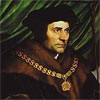
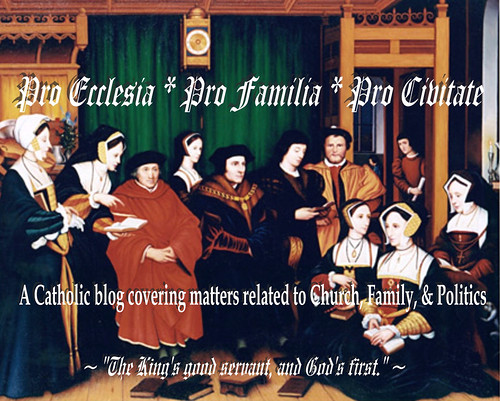
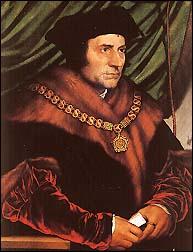
Tomorrow, 22 June, is the feast day of St. Thomas More, martyr and patron of lawyers, civil servants, politicians, statesmen, "difficult marriages", and this blog.
As he went to his death, ordered beheaded by Henry VIII for refusing to swear the Oath of Supremacy declaring the King head of the Church in England, More humbly stated that he would die "the King's good servant, and God's first."
Profile: Studied at London and Oxford. Page for the Archbishop of Canterbury. Lawyer. Twice married, father of one son and three daughters, and a devoted family man. Writer. Friend of King Henry VIII. Lord Chancellor of England, a position of power second only to the king. Opposed the king on the matter of royal divorce, and refused to swear the Oath of Supremacy which declared the king the head of the Church in England. Resigned the Chancellorship, and was imprisoned in the Tower of London. Martyred for his refusal to bend his religious beliefs to the king's political needs.
Born: 1478 at London, England
Died: beheaded in 1535; head kept in the Roper Vault, Saint Dunstan's church, Canterbury, England; body at Saint Peter ad Vincula, Tower of London, England
Canonized: 1935 by Pope Pius XI
Patronage: adopted children, diocese of Arlington Virginia, civil servants, court clerks, difficult marriages, large families, lawyers, diocese of Pensacola-Tallahassee Florida, politicians, politicos, statesmen, step-parents, widowers
Thomas More, counselor of law and patron of statesmen, merry martyr and most human of saints:
Pray that, for the glory of God and in the pursuit of His justice, I may be able in argument, accurate in analysis, keen in study, correct in conclusion, loyal to clients, honest with all, courteous to adversaries, trustworthy with confidences, courageous in court. Sit with me at my desk and listen with me to my clients' tales. Read with me in my library and stand always beside me so that today I shall not, to win a point, lose my soul.
Pray that my family may find in me what yours found in you: friendship and courage, cheerfulness and charity, diligence in duties, counsel in adversity, patience in pain -- their good servant, and God's first.
Amen.
Quotes:
"The ordinary acts we practice every day at home are of more importance to the soul than their simplicity might suggest."
"What does it avail to know that there is a God, which you not only believe by Faith, but also know by reason: what does it avail that you know Him if you think little of Him?"
"The things that we pray for, good Lord, give us grace to labour for."
(Against Martin Luther) "Come, do not rage so violently, good father; but if you have raved wildly enough, listen now, you pimp. You recall that you falsely complained above that the king has shown no passage in your whole book, even as an example, in which he said that you contradict yourself. You told this lie shortly before, although the king has demonstrated to you many examples of your inconsistency .... But meanwhile, for as long as your reverend paternity will be determined to tell these shameless lies, others will be permitted, on behalf of his English majesty, to throw back into your paternity's sh**ty mouth, truly the sh**-pool of all sh**, all the muck and sh** which your damnable rottenness has vomited up, and to empty out all the sewers and privies onto your crown divested of the dignity of the priestly crown, against which no less than against the kingly crown you have determined to play the buffoon. In your sense of fairness, honest reader, you will forgive me that the utterly filthy words of this scoundrel have forced me to answer such things, for which I should have begged your leave. Now I consider truer than truth that saying: 'He who touches pitch will be wholly defiled by it' (Sirach 13:1). For I am ashamed even of this necessity, that while I clean out the fellow's sh**-filled mouth I see my own fingers covered with sh**. But who can endure such a scoundrel who shows himself possessed by a thousand vices and tormented by a legion of demons, and yet stupidly boasts thus: 'The holy fathers have all erred. The whole church has often erred. My teaching cannot err, because I am most certain that my teaching is not my own but Christ's,' alluding of course to those words of Christ, 'My words are not my own but His who sent me, the Father's' (John 12:49)?
Thomas More, Knight, Lord Chancellor of England, author and martyr, Lay Franciscan Beheaded in 1535; head kept in the Roper Vault, Saint Dunstan's church, Canterbury, England; body at Saint Peter ad Vincula, Tower of London, England Beatified in 1886;
Canonized by Pope Pius XI in 1935 as the "Martyr of the Papacy"
Commemorated June 22, feast day formerly on July 6 (with fellow martyr, St. John Fisher)
In art: English Lord Chancellor carrying a book; English Lord Chancellor carrying an axe
SAINT THOMAS MORE, Martyr (1480-1535) Saint Thomas More, born in 1480, was the precocious and amiable son of an English magistrate. Very well educated and brilliant, when he was placed at the age of fifteen in the household of the Archbishop of Canterbury, he soon attracted the Archbishop's attention, and was sent by him to study at Oxford. He debated interiorly for a long time as to whether he should become a priest, but decided otherwise with the approbation of his director.
The practice of civil law was not enough to absorb all his time or energy. The author of the famous satire "Utopia," wrote poetry while still young, in both English and Latin. He had completely mastered Latin, as he had also the Greek tongue, "by an instinct of genius," as one of his preceptors said. Saint Thomas in 1505 married a virtuous and beloved wife who, after bearing four children, three daughters and a son, died six years later. His second wife, older than himself, took excellent care of the household and of the children; but it was said she could not grasp the sense of her husband's subtle humor, which was a characteristic trait of his cheerful disposition.
Saint Thomas came under suspicion by King Henry VII when he strove in the Parliament to reduce the burden of excessive taxes which the people bore, though he never spoke against the king. But his capacities were appreciated, and when Henry VII died, his 18-year-old son, who was to become Henry VIII in 1509, showed him great favor during the first twenty years of his reign. Saint Thomas was knighted in 1521, and was made Speaker of the House of Commons in 1523, High Steward of Cambridge University in 1525, and Chancellor of the Duchy of Lancaster in the same year. Nonetheless, the king's protege foresaw what could easily happen to anyone who did not agree with his sovereign; he said to his son-in-law in 1525, "If my head could win him a castle in France, it would not fail to go." In effect, when in 1530 the order was issued to the clergy to acknowledge Henry as "Supreme Head of the Church, insofar as the law of God would permit," Saint Thomas immediately resigned as Lord Chancellor.
His resignation was not accepted. Two years later, in May 1532, after he had lost the royal favor on several counts — his reticence concerning the king's divorce, his non-attendance at the king's illegal marriage, and his formal non-recognition of any future children of Henry and Anne Bolyn as rightful heirs to the throne — he was permitted to retire. The king, the apostate Archbishop Cranmer, and Anne Bolyn were all excommunicated in that year.
Saint Thomas lived in retirement from the age of 52, his revenues considerably diminished, and his health somewhat uncertain. When the king decided to require of the laity, as well as of the clergy, the oath supporting his alleged "supremacy," he wanted to obtain first of all the signature of Thomas More, to make of him an example. The Saint declined to sign the oath and thereby brought upon himself a sentence of incarceration in the Tower of London, and a short time afterwards, of death. He was beheaded in 1535, after having said, with his ordinary humor, that "he did not consider the severing of his head from his body as a circumstance that should produce any change in the disposition of his mind."
Saint Thomas while in retirement continued to write a number of religious treatises of great value, including an unfinished one on the Passion. He was beatified by Pope Leo XIII and canonized by Pius XI in 1935, with Cardinal John Fisher, who was martyred like himself in the same year and for the same reasons. That year was the 400th anniversary of their death.
"These things, good Lord, that we pray for, give us Thy grace to labor for." --Saint Thomas More.
-------------------------------- More on St. Thomas More at:
Prayer to St. Thomas More for Lawyers and Judges Dear Scholar and Martyr, it was not the King of England but you who were the true Defender of the Faith. Like Christ unjustly condemned, neither promises nor threats could make you accept a civil ruler as head of the Christian Church.
Perfect in your honesty and love of truth, grant that lawyers and judges may imitate you and achieve true justice for all people. AMEN.
*****
Lawyer's Prayer "Give me the Grace Good Lord, to set the world at naught; to set my mind fast upon Thee and not to hang upon the blast of men's mouths. To be content to be solitary. Not to long for worldly company but utterly to cast off the world and rid my mind of the business thereof."
V. St. Thomas More, Saint and Martyr, R. Pray for us (Repeat after each invocation) St. Thomas More, Patron of Statesmen, Politicians and Lawyers St. Thomas More, Patron of Justices, Judges and Magistrates St. Thomas More, Model of Integrity and Virtue in Public and Private Life St. Thomas More, Servant of the Word of God and the Body and Blood of Christ St. Thomas More, Model of Holiness in the Sacrament of Marriage St. Thomas More, Teacher of his Children in the Catholic Faith St. Thomas More, Defender of the Weak and the Poor St. Thomas More, Promoter of Human Life and Dignity
V.Lamb of God, you take away the sin of the world R.Spare us O Lord V.Lamb of God, you take away the sin of the world R.Graciously hear us O Lord V.Lamb of God, you take away the sin of the world R.Have mercy on us
Let us pray:
O Glorious St. Thomas More, Patron of Statesmen, Politicians, Judges and Lawyers, your life of prayer and penance and your zeal for justice, integrity and firm principle in public and family life led you to the path of martyrdom and sainthood. Intercede for our Statesmen, Politicians, Judges and Lawyers, that they may be courageous and effective in their defense and promotion of the sanctity of human life - the foundation of all other human rights. We ask this through Christ our Lord.
A Man For All Seasons: Feast Day of St. Thomas More, 22 June
___________________________________
“…it would be hard to find anyone who was more truly a man for all seasons and all men…”
~ Erasmus, 1521
___________________________________
The Execution of St. Thomas More - "A Man For All Seasons"
The Execution of St. Thomas More - "The Tudors"
Today, 22 June, is the feast day of St. Thomas More, martyr and patron of lawyers, civil servants, politicians, statesmen, "difficult marriages", and this blog.
As he went to his death, ordered beheaded by Henry VIII for refusing to swear the Oath of Supremacy declaring the King head of the Church in England, More humbly stated that he would die "the King's good servant, and God's first."
Profile: Studied at London and Oxford. Page for the Archbishop of Canterbury. Lawyer. Twice married, father of one son and three daughters, and a devoted family man. Writer. Friend of King Henry VIII. Lord Chancellor of England, a position of power second only to the king. Opposed the king on the matter of royal divorce, and refused to swear the Oath of Supremacy which declared the king the head of the Church in England. Resigned the Chancellorship, and was imprisoned in the Tower of London. Martyred for his refusal to bend his religious beliefs to the king's political needs.
Born: 1478 at London, England
Died: beheaded in 1535; head kept in the Roper Vault, Saint Dunstan's church, Canterbury, England; body at Saint Peter ad Vincula, Tower of London, England
Canonized: 1935 by Pope Pius XI
Patronage: adopted children, diocese of Arlington Virginia, civil servants, court clerks, difficult marriages, large families, lawyers, diocese of Pensacola-Tallahassee Florida, politicians, politicos, statesmen, step-parents, widowers
Thomas More, counselor of law and patron of statesmen, merry martyr and most human of saints:
Pray that, for the glory of God and in the pursuit of His justice, I may be able in argument, accurate in analysis, keen in study, correct in conclusion, loyal to clients, honest with all, courteous to adversaries, trustworthy with confidences, courageous in court. Sit with me at my desk and listen with me to my clients' tales. Read with me in my library and stand always beside me so that today I shall not, to win a point, lose my soul.
Pray that my family may find in me what yours found in you: friendship and courage, cheerfulness and charity, diligence in duties, counsel in adversity, patience in pain -- their good servant, and God's first.
Amen.
Quotes:
"The ordinary acts we practice every day at home are of more importance to the soul than their simplicity might suggest."
"What does it avail to know that there is a God, which you not only believe by Faith, but also know by reason: what does it avail that you know Him if you think little of Him?"
"The things that we pray for, good Lord, give us grace to labour for."
Thomas More, Knight, Lord Chancellor of England, author and martyr, Lay Franciscan Beheaded in 1535; head kept in the Roper Vault, Saint Dunstan's church, Canterbury, England; body at Saint Peter ad Vincula, Tower of London, England Beatified in 1886;
Canonized by Pope Pius XI in 1935 as the "Martyr of the Papacy"
Commemorated June 22, feast day formerly on July 6 (with fellow martyr, St. John Fisher)
In art: English Lord Chancellor carrying a book; English Lord Chancellor carrying an axe SAINT THOMAS MORE, Martyr (1480-1535)
Saint Thomas More, born in 1480, was the precocious and amiable son of an English magistrate. Very well educated and brilliant, when he was placed at the age of fifteen in the household of the Archbishop of Canterbury, he soon attracted the Archbishop's attention, and was sent by him to study at Oxford. He debated interiorly for a long time as to whether he should become a priest, but decided otherwise with the approbation of his director.
The practice of civil law was not enough to absorb all his time or energy. The author of the famous satire "Utopia," wrote poetry while still young, in both English and Latin. He had completely mastered Latin, as he had also the Greek tongue, "by an instinct of genius," as one of his preceptors said. Saint Thomas in 1505 married a virtuous and beloved wife who, after bearing four children, three daughters and a son, died six years later. His second wife, older than himself, took excellent care of the household and of the children; but it was said she could not grasp the sense of her husband's subtle humor, which was a characteristic trait of his cheerful disposition.
Saint Thomas came under suspicion by King Henry VII when he strove in the Parliament to reduce the burden of excessive taxes which the people bore, though he never spoke against the king. But his capacities were appreciated, and when Henry VII died, his 18-year-old son, who was to become Henry VIII in 1509, showed him great favor during the first twenty years of his reign. Saint Thomas was knighted in 1521, and was made Speaker of the House of Commons in 1523, High Steward of Cambridge University in 1525, and Chancellor of the Duchy of Lancaster in the same year. Nonetheless, the king's protege foresaw what could easily happen to anyone who did not agree with his sovereign; he said to his son-in-law in 1525, "If my head could win him a castle in France, it would not fail to go." In effect, when in 1530 the order was issued to the clergy to acknowledge Henry as "Supreme Head of the Church, insofar as the law of God would permit," Saint Thomas immediately resigned as Lord Chancellor.
His resignation was not accepted. Two years later, in May 1532, after he had lost the royal favor on several counts — his reticence concerning the king's divorce, his non-attendance at the king's illegal marriage, and his formal non-recognition of any future children of Henry and Anne Bolyn as rightful heirs to the throne — he was permitted to retire. The king, the apostate Archbishop Cranmer, and Anne Bolyn were all excommunicated in that year.
Saint Thomas lived in retirement from the age of 52, his revenues considerably diminished, and his health somewhat uncertain. When the king decided to require of the laity, as well as of the clergy, the oath supporting his alleged "supremacy," he wanted to obtain first of all the signature of Thomas More, to make of him an example. The Saint declined to sign the oath and thereby brought upon himself a sentence of incarceration in the Tower of London, and a short time afterwards, of death. He was beheaded in 1535, after having said, with his ordinary humor, that "he did not consider the severing of his head from his body as a circumstance that should produce any change in the disposition of his mind."
Saint Thomas while in retirement continued to write a number of religious treatises of great value, including an unfinished one on the Passion. He was beatified by Pope Leo XIII and canonized by Pius XI in 1935, with Cardinal John Fisher, who was martyred like himself in the same year and for the same reasons. That year was the 400th anniversary of their death.
"These things, good Lord, that we pray for, give us Thy grace to labor for." --Saint Thomas More.
Prayer to St. Thomas More for Lawyers and Judges Dear Scholar and Martyr, it was not the King of England but you who were the true Defender of the Faith. Like Christ unjustly condemned, neither promises nor threats could make you accept a civil ruler as head of the Christian Church.
Perfect in your honesty and love of truth, grant that lawyers and judges may imitate you and achieve true justice for all people. AMEN.
*****
Lawyer's Prayer "Give me the Grace Good Lord, to set the world at naught; to set my mind fast upon Thee and not to hang upon the blast of men's mouths. To be content to be solitary. Not to long for worldly company but utterly to cast off the world and rid my mind of the business thereof."
V. St. Thomas More, Saint and Martyr, R. Pray for us (Repeat after each invocation) St. Thomas More, Patron of Statesmen, Politicians and Lawyers St. Thomas More, Patron of Justices, Judges and Magistrates St. Thomas More, Model of Integrity and Virtue in Public and Private Life St. Thomas More, Servant of the Word of God and the Body and Blood of Christ St. Thomas More, Model of Holiness in the Sacrament of Marriage St. Thomas More, Teacher of his Children in the Catholic Faith St. Thomas More, Defender of the Weak and the Poor St. Thomas More, Promoter of Human Life and Dignity
V.Lamb of God, you take away the sin of the world R.Spare us O Lord V.Lamb of God, you take away the sin of the world R.Graciously hear us O Lord V.Lamb of God, you take away the sin of the world R.Have mercy on us
Let us pray:
O Glorious St. Thomas More, Patron of Statesmen, Politicians, Judges and Lawyers, your life of prayer and penance and your zeal for justice, integrity and firm principle in public and family life led you to the path of martyrdom and sainthood. Intercede for our Statesmen, Politicians, Judges and Lawyers, that they may be courageous and effective in their defense and promotion of the sanctity of human life - the foundation of all other human rights. We ask this through Christ our Lord.
... Obama has often mentioned Jesus’ Sermon on the Mount (including at Georgetown University) to make the case for his economic policies. In fact, the Politico ran a piece entitled "Barack Obama invokes Jesus more than George W. Bush."
So why is there no worry about Obama infusing religion into his politics? Ah, that's easy. Because the media believes that Obama's Christianity is only used to advance his politics while they fear that Perry's politics are actually informed by his Christianity. In short, he means it. And that scares the heck out of them.
A Man For All Seasons: Feast Day of St. Thomas More, 22 June
___________________________________
“…it would be hard to find anyone who was more truly a man for all seasons and all men…”
~ Erasmus, 1521
___________________________________
The Execution of St. Thomas More - "A Man For All Seasons"
The Execution of St. Thomas More - "The Tudors"
Today, 22 June, is the feast day of St. Thomas More, martyr and patron of lawyers, civil servants, politicians, statesmen, "difficult marriages", and this blog.
As he went to his death, ordered beheaded by Henry VIII for refusing to swear the Oath of Supremacy declaring the King head of the Church in England, More humbly stated that he would die "the King's good servant, and God's first."
Profile: Studied at London and Oxford. Page for the Archbishop of Canterbury. Lawyer. Twice married, father of one son and three daughters, and a devoted family man. Writer. Friend of King Henry VIII. Lord Chancellor of England, a position of power second only to the king. Opposed the king on the matter of royal divorce, and refused to swear the Oath of Supremacy which declared the king the head of the Church in England. Resigned the Chancellorship, and was imprisoned in the Tower of London. Martyred for his refusal to bend his religious beliefs to the king's political needs.
Born: 1478 at London, England
Died: beheaded in 1535; head kept in the Roper Vault, Saint Dunstan's church, Canterbury, England; body at Saint Peter ad Vincula, Tower of London, England
Canonized: 1935 by Pope Pius XI
Patronage: adopted children, diocese of Arlington Virginia, civil servants, court clerks, difficult marriages, large families, lawyers, diocese of Pensacola-Tallahassee Florida, politicians, politicos, statesmen, step-parents, widowers
Thomas More, counselor of law and patron of statesmen, merry martyr and most human of saints:
Pray that, for the glory of God and in the pursuit of His justice, I may be able in argument, accurate in analysis, keen in study, correct in conclusion, loyal to clients, honest with all, courteous to adversaries, trustworthy with confidences, courageous in court. Sit with me at my desk and listen with me to my clients' tales. Read with me in my library and stand always beside me so that today I shall not, to win a point, lose my soul.
Pray that my family may find in me what yours found in you: friendship and courage, cheerfulness and charity, diligence in duties, counsel in adversity, patience in pain -- their good servant, and God's first.
Amen.
Quotes:
"The ordinary acts we practice every day at home are of more importance to the soul than their simplicity might suggest."
"What does it avail to know that there is a God, which you not only believe by Faith, but also know by reason: what does it avail that you know Him if you think little of Him?"
"The things that we pray for, good Lord, give us grace to labour for."
Thomas More, Knight, Lord Chancellor of England, author and martyr, Lay Franciscan
Beheaded in 1535; head kept in the Roper Vault, Saint Dunstan's church, Canterbury, England; body at Saint Peter ad Vincula, Tower of London, England Beatified in 1886;
Canonized by Pope Pius XI in 1935 as the "Martyr of the Papacy"
Commemorated June 22, feast day formerly on July 6 (with fellow martyr, St. John Fisher)
Saint Thomas More, born in 1480, was the precocious and amiable son of an English magistrate. Very well educated and brilliant, when he was placed at the age of fifteen in the household of the Archbishop of Canterbury, he soon attracted the Archbishop's attention, and was sent by him to study at Oxford. He debated interiorly for a long time as to whether he should become a priest, but decided otherwise with the approbation of his director.
The practice of civil law was not enough to absorb all his time or energy. The author of the famous satire "Utopia," wrote poetry while still young, in both English and Latin. He had completely mastered Latin, as he had also the Greek tongue, "by an instinct of genius," as one of his preceptors said. Saint Thomas in 1505 married a virtuous and beloved wife who, after bearing four children, three daughters and a son, died six years later. His second wife, older than himself, took excellent care of the household and of the children; but it was said she could not grasp the sense of her husband's subtle humor, which was a characteristic trait of his cheerful disposition.
Saint Thomas came under suspicion by King Henry VII when he strove in the Parliament to reduce the burden of excessive taxes which the people bore, though he never spoke against the king. But his capacities were appreciated, and when Henry VII died, his 18-year-old son, who was to become Henry VIII in 1509, showed him great favor during the first twenty years of his reign. Saint Thomas was knighted in 1521, and was made Speaker of the House of Commons in 1523, High Steward of Cambridge University in 1525, and Chancellor of the Duchy of Lancaster in the same year. Nonetheless, the king's protege foresaw what could easily happen to anyone who did not agree with his sovereign; he said to his son-in-law in 1525, "If my head could win him a castle in France, it would not fail to go." In effect, when in 1530 the order was issued to the clergy to acknowledge Henry as "Supreme Head of the Church, insofar as the law of God would permit," Saint Thomas immediately resigned as Lord Chancellor.
His resignation was not accepted. Two years later, in May 1532, after he had lost the royal favor on several counts — his reticence concerning the king's divorce, his non-attendance at the king's illegal marriage, and his formal non-recognition of any future children of Henry and Anne Bolyn as rightful heirs to the throne — he was permitted to retire. The king, the apostate Archbishop Cranmer, and Anne Bolyn were all excommunicated in that year.
Saint Thomas lived in retirement from the age of 52, his revenues considerably diminished, and his health somewhat uncertain. When the king decided to require of the laity, as well as of the clergy, the oath supporting his alleged "supremacy," he wanted to obtain first of all the signature of Thomas More, to make of him an example. The Saint declined to sign the oath and thereby brought upon himself a sentence of incarceration in the Tower of London, and a short time afterwards, of death. He was beheaded in 1535, after having said, with his ordinary humor, that "he did not consider the severing of his head from his body as a circumstance that should produce any change in the disposition of his mind."
Saint Thomas while in retirement continued to write a number of religious treatises of great value, including an unfinished one on the Passion. He was beatified by Pope Leo XIII and canonized by Pius XI in 1935, with Cardinal John Fisher, who was martyred like himself in the same year and for the same reasons. That year was the 400th anniversary of their death.
"These things, good Lord, that we pray for, give us Thy grace to labor for." --Saint Thomas More.
Prayer to St. Thomas More for Lawyers and Judges Dear Scholar and Martyr, it was not the King of England but you who were the true Defender of the Faith. Like Christ unjustly condemned, neither promises nor threats could make you accept a civil ruler as head of the Christian Church.
Perfect in your honesty and love of truth, grant that lawyers and judges may imitate you and achieve true justice for all people. AMEN.
*****
Lawyer's Prayer "Give me the Grace Good Lord, to set the world at naught; to set my mind fast upon Thee and not to hang upon the blast of men's mouths. To be content to be solitary. Not to long for worldly company but utterly to cast off the world and rid my mind of the business thereof."
V. St. Thomas More, Saint and Martyr, R. Pray for us (Repeat after each invocation) St. Thomas More, Patron of Statesmen, Politicians and Lawyers St. Thomas More, Patron of Justices, Judges and Magistrates St. Thomas More, Model of Integrity and Virtue in Public and Private Life St. Thomas More, Servant of the Word of God and the Body and Blood of Christ St. Thomas More, Model of Holiness in the Sacrament of Marriage St. Thomas More, Teacher of his Children in the Catholic Faith St. Thomas More, Defender of the Weak and the Poor St. Thomas More, Promoter of Human Life and Dignity
V.Lamb of God, you take away the sin of the world R.Spare us O Lord V.Lamb of God, you take away the sin of the world R.Graciously hear us O Lord V.Lamb of God, you take away the sin of the world R.Have mercy on us
Let us pray:
O Glorious St. Thomas More, Patron of Statesmen, Politicians, Judges and Lawyers, your life of prayer and penance and your zeal for justice, integrity and firm principle in public and family life led you to the path of martyrdom and sainthood. Intercede for our Statesmen, Politicians, Judges and Lawyers, that they may be courageous and effective in their defense and promotion of the sanctity of human life - the foundation of all other human rights. We ask this through Christ our Lord.
A convert to the Catholic Church who became Catholic because of a belief in and devotion to the Real Presence of Jesus Christ in the Eucharist. * A graduate of Baylor University and the University of Virginia School of Law. * Former Mayor of the Town of Columbia, Virginia. * Married with four children: two boys and two girls. * Primary interests include the Catholic Church, family, Early American History, and law/politics * Primary purpose of this blog is fostering enlightened discussion about the roles played by the institutions of religion, family, and state in our daily lives. * Under the protection of St. Thomas More, martyr, and patron of lawyers, judges, civil servants, politicians, statesmen, and large families (not to mention troubled marriages).
O Glorious St. Thomas More, Patron of Statesmen, Politicians, Judges and Lawyers, your life of prayer and penance and your zeal for justice, integrity and firm principle in public and family life led you to the path of martyrdom and sainthood. Intercede for our Statesmen, Politicians, Judges and Lawyers, that they may be courageous and effective in their defense and promotion of the sanctity of human life - the foundation of all other human rights. We ask this through Christ our Lord. AMEN.
Pray that, for the glory of God and in the pursuit of His justice, I may be able in argument, accurate in analysis, keen in study, correct in conclusion, loyal to clients, honest with all, courteous to adversaries, trustworthy with confidences, courageous in court. Sit with me at my desk and listen with me to my clients' tales. Read with me in my library and stand always beside me so that today I shall not, to win a point, lose my soul.
Pray that my family may find in me what yours found in you: friendship and courage, cheerfulness and charity, diligence in duties, counsel in adversity, patience in pain -- their good servant, and God's first. AMEN.
Dear Scholar and Martyr, it was not the King of England but you who were the true Defender of the Faith. Like Christ unjustly condemned, neither promises nor threats could make you accept a civil ruler as head of the Christian Church.
Perfect in your honesty and love of truth, grant that lawyers and judges may imitate you and achieve true justice for all people. AMEN.
"Give me the Grace Good Lord, to set the world at naught; to set my mind fast upon Thee and not to hang upon the blast of men's mouths. To be content to be solitary. Not to long for worldly company but utterly to cast off the world and rid my mind of the business thereof."
"The ordinary acts we practice every day at home are of more importance to the soul than their simplicity might suggest."
*****
"What does it avail to know that there is a God, which you not only believe by Faith, but also know by Reason: what does it avail that you know Him if you think little of Him?"
*****
"The things that we pray for, good Lord, give us grace to labour for."
Give me, good Lord, a full faith and a fervent charity, a love of you, good Lord, incomparable above the love of myself; and that I love nothing to your displeasure but everything in an order to you.
Take from me, good Lord, this lukewarm fashion, or rather cold manner of meditation and this dullness in praying to you. And give me warmth, delight and life in thinking about you.
And give me your grace to long for your holy sacraments and specially to rejoice in the presence of your blessed body, sweet Saviour Christ, in the holy sacrament of the altar, and duly to thank you for your gracious coming. AMEN.
"It is necessary to go back to seeing the family as the sanctuary of life... In the face of the so-called culture of death, the family is the heart of the culture of life" (Centesimus Annus, #39).









.jpg)