Friday, June 21, 2013

A Man For All Seasons: Feast Day of St. Thomas More, 22 June

___________________________________

“…it would be hard to find anyone who was more truly a man for all seasons and all men…”

~ Erasmus, 1521
___________________________________


The Execution of St. Thomas More - "A Man For All Seasons"
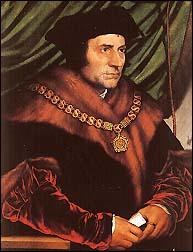


Tomorrow, 22 June, is the feast day of St. Thomas More, martyr and patron of lawyers, civil servants, politicians, statesmen, "difficult marriages", and this blog.

As he went to his death, ordered beheaded by Henry VIII for refusing to swear the Oath of Supremacy declaring the King head of the Church in England, More humbly stated that he would die "the King's good servant, and God's first."

From the Patron Saints Index:
Memorial: 22 June

Profile: Studied at London and Oxford. Page for the Archbishop of Canterbury. Lawyer. Twice married, father of one son and three daughters, and a devoted family man. Writer. Friend of King Henry VIII. Lord Chancellor of England, a position of power second only to the king. Opposed the king on the matter of royal divorce, and refused to swear the Oath of Supremacy which declared the king the head of the Church in England. Resigned the Chancellorship, and was imprisoned in the Tower of London. Martyred for his refusal to bend his religious beliefs to the king's political needs.

Born: 1478 at London, England

Died: beheaded in 1535; head kept in the Roper Vault, Saint Dunstan's church, Canterbury, England; body at Saint Peter ad Vincula, Tower of London, England

Canonized: 1935 by Pope Pius XI

Patronage: adopted children, diocese of Arlington Virginia, civil servants, court clerks, difficult marriages, large families, lawyers, diocese of Pensacola-Tallahassee Florida, politicians, politicos, statesmen, step-parents, widowers
A Prayer to St. Thomas More:
Thomas More, counselor of law and patron of statesmen, merry martyr and most human of saints:

Pray that, for the glory of God and in the pursuit of His justice, I may be able in argument, accurate in analysis, keen in study, correct in conclusion, loyal to clients, honest with all, courteous to adversaries, trustworthy with confidences, courageous in court. Sit with me at my desk and listen with me to my clients' tales. Read with me in my library and stand always beside me so that today I shall not, to win a point, lose my soul.

Pray that my family may find in me what yours found in you: friendship and courage, cheerfulness and charity, diligence in duties, counsel in adversity, patience in pain -- their good servant, and God's first.

Amen.
Quotes:
"The ordinary acts we practice every day at home are of more importance to the soul than their simplicity might suggest."

"What does it avail to know that there is a God, which you not only believe by Faith, but also know by reason: what does it avail that you know Him if you think little of Him?"


"The things that we pray for, good Lord, give us grace to labour for."

(Against Martin Luther) "Come, do not rage so violently, good father; but if you have raved wildly enough, listen now, you pimp. You recall that you falsely complained above that the king has shown no passage in your whole book, even as an example, in which he said that you contradict yourself. You told this lie shortly before, although the king has demonstrated to you many examples of your inconsistency .... But meanwhile, for as long as your reverend paternity will be determined to tell these shameless lies, others will be permitted, on behalf of his English majesty, to throw back into your paternity's sh**ty mouth, truly the sh**-pool of all sh**, all the muck and sh** which your damnable rottenness has vomited up, and to empty out all the sewers and privies onto your crown divested of the dignity of the priestly crown, against which no less than against the kingly crown you have determined to play the buffoon. In your sense of fairness, honest reader, you will forgive me that the utterly filthy words of this scoundrel have forced me to answer such things, for which I should have begged your leave. Now I consider truer than truth that saying: 'He who touches pitch will be wholly defiled by it' (Sirach 13:1). For I am ashamed even of this necessity, that while I clean out the fellow's sh**-filled mouth I see my own fingers covered with sh**. But who can endure such a scoundrel who shows himself possessed by a thousand vices and tormented by a legion of demons, and yet stupidly boasts thus: 'The holy fathers have all erred. The whole church has often erred. My teaching cannot err, because I am most certain that my teaching is not my own but Christ's,' alluding of course to those words of Christ, 'My words are not my own but His who sent me, the Father's' (John 12:49)?


From the Medieval Saints Yahoo Group:
Thomas More, Knight, Lord Chancellor of England, author and martyr, Lay Franciscan
Beheaded in 1535; head kept in the Roper Vault, Saint Dunstan's church, Canterbury, England; body at Saint Peter ad Vincula, Tower of London, England Beatified in 1886;

Canonized by Pope Pius XI in 1935 as the "Martyr of the Papacy"

Commemorated June 22, feast day formerly on July 6 (with fellow martyr, St. John Fisher)

Patronage: adopted children, civil servants, court clerks, difficult marriages, large families, lawyers, politicians, statesmen, step-parents, widowers

In art: English Lord Chancellor carrying a book; English Lord Chancellor carrying an axe


SAINT THOMAS MORE, Martyr (1480-1535)

Saint Thomas More, born in 1480, was the precocious and amiable son of an English magistrate. Very well educated and brilliant, when he was placed at the age of fifteen in the household of the Archbishop of Canterbury, he soon attracted the Archbishop's attention, and was sent by him to study at Oxford. He debated interiorly for a long time as to whether he should become a priest, but decided otherwise with the approbation of his director.

The practice of civil law was not enough to absorb all his time or energy. The author of the famous satire "Utopia," wrote poetry while still young, in both English and Latin. He had completely mastered Latin, as he had also the Greek tongue, "by an instinct of genius," as one of his preceptors said. Saint Thomas in 1505 married a virtuous and beloved wife who, after bearing four children, three daughters and a son, died six years later. His second wife, older than himself, took excellent care of the household and of the children; but it was said she could not grasp the sense of her husband's subtle humor, which was a characteristic trait of his cheerful disposition.

Saint Thomas came under suspicion by King Henry VII when he strove in the Parliament to reduce the burden of excessive taxes which the people bore, though he never spoke against the king. But his capacities were appreciated, and when Henry VII died, his 18-year-old son, who was to become Henry VIII in 1509, showed him great favor during the first twenty years of his reign. Saint Thomas was knighted in 1521, and was made Speaker of the House of Commons in 1523, High Steward of Cambridge University in 1525, and Chancellor of the Duchy of Lancaster in the same year. Nonetheless, the king's protege foresaw what could easily happen to anyone who did not agree with his sovereign; he said to his son-in-law in 1525, "If my head could win him a castle in France, it would not fail to go." In effect, when in 1530 the order was issued to the clergy to acknowledge Henry as "Supreme Head of the Church, insofar as the law of God would permit," Saint Thomas immediately resigned as Lord Chancellor.

His resignation was not accepted. Two years later, in May 1532, after he had lost the royal favor on several counts — his reticence concerning the king's divorce, his non-attendance at the king's illegal marriage, and his formal non-recognition of any future children of Henry and Anne Bolyn as rightful heirs to the throne — he was permitted to retire. The king, the apostate Archbishop Cranmer, and Anne Bolyn were all excommunicated in that year.

Saint Thomas lived in retirement from the age of 52, his revenues considerably diminished, and his health somewhat uncertain. When the king decided to require of the laity, as well as of the clergy, the oath supporting his alleged "supremacy," he wanted to obtain first of all the signature of Thomas More, to make of him an example. The Saint declined to sign the oath and thereby brought upon himself a sentence of incarceration in the Tower of London, and a short time afterwards, of death. He was beheaded in 1535, after having said, with his ordinary humor, that "he did not consider the severing of his head from his body as a circumstance that should produce any change in the disposition of his mind."

Saint Thomas while in retirement continued to write a number of religious treatises of great value, including an unfinished one on the Passion. He was beatified by Pope Leo XIII and canonized by Pius XI in 1935, with Cardinal John Fisher, who was martyred like himself in the same year and for the same reasons. That year was the 400th anniversary of their death.

"These things, good Lord, that we pray for, give us Thy grace to labor for." --Saint Thomas More.


--------------------------------
More on St. Thomas More at:

http://www.cin.org/farmor.html
http://magnificat.ca/cal/engl/07-06.htm


Fr. Robert Barron on St. Thomas More

Links: 
Apostolic Letter of Pope John Paul II, naming St. Thomas More the patron of politicians and statesmen
Saint Thomas More - Open Directory Project (links to practically everything you'd want to know about St. Thomas More)
 

Center for Thomas More Studies
Sir Thomas More (1478-1535) - Luminarium
St. Thomas More on The Franciscan Archive
St. Thomas More on the Patron Saints Index
The St. Thomas More Web Site
Sir Thomas More - Oregon State University Philosophy Dept.
Thomas More Law Center
Thomas More Society
The St. Thomas More Society
Amici Thomae Mori
The Life of St. Thomas More by William Roper
Saint Thomas More - The King's good servant but God's first! (The Angelus)
"Thomas More For Our Season" by Judge Robert Bork (First Things archives)
Saint Thomas More: A Father for All Seasons - Essay on Thomas More as a model Christian father
 
A Man For All Seasons (DVD available from Amazon.com)
Thomas More's England: A Guide Book (pdf file)
Chelsea Old Church - Sir Thomas More

Recommended Reading:
The Life of St. Thomas More by his son-in-law William Roper
Thomas More: A Portrait of Courage by Gerard B. Wegemer
The Life of Thomas More by Peter Ackroyd
A Thomas More Source Book ed. by Gerard B. Wegemer and Stephen W. Smith
Thomas More on Statesmanship by Gerard B. Wegemer
A Man for All Seasons by Robert Bolt
Sir Thomas More: A Play, Now First Printed by William Shakespeare, et al
Utopia by Thomas More
A Dialogue of Comfort Against Tribulation by Thomas More
The Sadness of Christ by Thomas More

Prayers:
 
Prayer to St. Thomas More for Conversion of Pro-Abortion Politicians
Litany of St. Thomas More, Martyr and Patron Saint of Statesmen, Politicians and Lawyers (pdf version here) 
Prayers of St. Thomas More (Psalm on Detachment; A Devout Prayer Before Dying)
Novena to St. Thomas More


Prayer to St. Thomas More for Lawyers and Judges
Dear Scholar and Martyr,
it was not the King of England
but you who were the true Defender of the Faith.
Like Christ unjustly condemned,
neither promises nor threats
could make you accept a civil ruler
as head of the Christian Church.

Perfect in your honesty and love of truth,
grant that lawyers and judges
may imitate you and achieve true justice for all people.
AMEN.


*****

Lawyer's Prayer
"Give me the Grace Good Lord,
to set the world at naught;
to set my mind fast upon Thee
and not to hang upon the blast of men's mouths.
To be content to be solitary.
Not to long for worldly company
but utterly to cast off the world
and rid my mind of the business thereof.
"

*****

Litany of St. Thomas More, Martyr and Patron Saint of Statesmen, Politicians and Lawyers
V. Lord, have mercy
R. Lord have mercy
V. Christ, have mercy
R. Christ have mercy
V. Lord, have mercy
R. Lord have mercy
V. Christ hear us
R. Christ, graciously hear us

V. St. Thomas More, Saint and Martyr,
R. Pray for us (Repeat after each invocation)
St. Thomas More, Patron of Statesmen, Politicians and Lawyers
St. Thomas More, Patron of Justices, Judges and Magistrates
St. Thomas More, Model of Integrity and Virtue in Public and Private Life
St. Thomas More, Servant of the Word of God and the Body and Blood of Christ
St. Thomas More, Model of Holiness in the Sacrament of Marriage
St. Thomas More, Teacher of his Children in the Catholic Faith
St. Thomas More, Defender of the Weak and the Poor
St. Thomas More, Promoter of Human Life and Dignity

V.Lamb of God, you take away the sin of the world
R.Spare us O Lord
V.Lamb of God, you take away the sin of the world
R.Graciously hear us O Lord
V.Lamb of God, you take away the sin of the world
R.Have mercy on us

Let us pray:

O Glorious St. Thomas More, Patron of Statesmen, Politicians, Judges and Lawyers, your life of prayer and penance and your zeal for justice, integrity and firm principle in public and family life led you to the path of martyrdom and sainthood. Intercede for our Statesmen, Politicians, Judges and Lawyers, that they may be courageous and effective in their defense and promotion of the sanctity of human life - the foundation of all other human rights. We ask this through Christ our Lord.

R. Amen.


Labels: , , , , , , , , , , , ,

Friday, June 22, 2012

A Man For All Seasons: Feast Day of St. Thomas More, 22 June


___________________________________

“…it would be hard to find anyone who was more truly a man for all seasons and all men…”

~ Erasmus, 1521
___________________________________


The Execution of St. Thomas More - "A Man For All Seasons"


The Execution of St. Thomas More - "The Tudors"


Today, 22 June, is the feast day of St. Thomas More, martyr and patron of lawyers, civil servants, politicians, statesmen, "difficult marriages", and this blog.

As he went to his death, ordered beheaded by Henry VIII for refusing to swear the Oath of Supremacy declaring the King head of the Church in England, More humbly stated that he would die "the King's good servant, and God's first."

From the Patron Saints Index:
Memorial: 22 June

Profile: Studied at London and Oxford. Page for the Archbishop of Canterbury. Lawyer. Twice married, father of one son and three daughters, and a devoted family man. Writer. Friend of King Henry VIII. Lord Chancellor of England, a position of power second only to the king. Opposed the king on the matter of royal divorce, and refused to swear the Oath of Supremacy which declared the king the head of the Church in England. Resigned the Chancellorship, and was imprisoned in the Tower of London. Martyred for his refusal to bend his religious beliefs to the king's political needs.

Born: 1478 at London, England

Died: beheaded in 1535; head kept in the Roper Vault, Saint Dunstan's church, Canterbury, England; body at Saint Peter ad Vincula, Tower of London, England

Canonized: 1935 by Pope Pius XI

Patronage: adopted children, diocese of Arlington Virginia, civil servants, court clerks, difficult marriages, large families, lawyers, diocese of Pensacola-Tallahassee Florida, politicians, politicos, statesmen, step-parents, widowers
A Prayer to St. Thomas More:
Thomas More, counselor of law and patron of statesmen, merry martyr and most human of saints:

Pray that, for the glory of God and in the pursuit of His justice, I may be able in argument, accurate in analysis, keen in study, correct in conclusion, loyal to clients, honest with all, courteous to adversaries, trustworthy with confidences, courageous in court. Sit with me at my desk and listen with me to my clients' tales. Read with me in my library and stand always beside me so that today I shall not, to win a point, lose my soul.

Pray that my family may find in me what yours found in you: friendship and courage, cheerfulness and charity, diligence in duties, counsel in adversity, patience in pain -- their good servant, and God's first.

Amen.
Quotes:
"The ordinary acts we practice every day at home are of more importance to the soul than their simplicity might suggest."

"What does it avail to know that there is a God, which you not only believe by Faith, but also know by reason: what does it avail that you know Him if you think little of Him?"


"The things that we pray for, good Lord, give us grace to labour for."

~ Saint Thomas More


From the Medieval Saints Yahoo Group:
Thomas More, Knight, Lord Chancellor of England, author and martyr, Lay Franciscan
Beheaded in 1535; head kept in the Roper Vault, Saint Dunstan's church, Canterbury, England; body at Saint Peter ad Vincula, Tower of London, England Beatified in 1886;

Canonized by Pope Pius XI in 1935 as the "Martyr of the Papacy"

Commemorated June 22, feast day formerly on July 6 (with fellow martyr, St. John Fisher)

Patronage: adopted children, civil servants, court clerks, difficult marriages, large families, lawyers, politicians, statesmen, step-parents, widowers

In art: English Lord Chancellor carrying a book; English Lord Chancellor carrying an axe

SAINT THOMAS MORE, Martyr (1480-1535)


Saint Thomas More, born in 1480, was the precocious and amiable son of an English magistrate. Very well educated and brilliant, when he was placed at the age of fifteen in the household of the Archbishop of Canterbury, he soon attracted the Archbishop's attention, and was sent by him to study at Oxford. He debated interiorly for a long time as to whether he should become a priest, but decided otherwise with the approbation of his director.

The practice of civil law was not enough to absorb all his time or energy. The author of the famous satire "Utopia," wrote poetry while still young, in both English and Latin. He had completely mastered Latin, as he had also the Greek tongue, "by an instinct of genius," as one of his preceptors said. Saint Thomas in 1505 married a virtuous and beloved wife who, after bearing four children, three daughters and a son, died six years later. His second wife, older than himself, took excellent care of the household and of the children; but it was said she could not grasp the sense of her husband's subtle humor, which was a characteristic trait of his cheerful disposition.

Saint Thomas came under suspicion by King Henry VII when he strove in the Parliament to reduce the burden of excessive taxes which the people bore, though he never spoke against the king. But his capacities were appreciated, and when Henry VII died, his 18-year-old son, who was to become Henry VIII in 1509, showed him great favor during the first twenty years of his reign. Saint Thomas was knighted in 1521, and was made Speaker of the House of Commons in 1523, High Steward of Cambridge University in 1525, and Chancellor of the Duchy of Lancaster in the same year. Nonetheless, the king's protege foresaw what could easily happen to anyone who did not agree with his sovereign; he said to his son-in-law in 1525, "If my head could win him a castle in France, it would not fail to go." In effect, when in 1530 the order was issued to the clergy to acknowledge Henry as "Supreme Head of the Church, insofar as the law of God would permit," Saint Thomas immediately resigned as Lord Chancellor.

His resignation was not accepted. Two years later, in May 1532, after he had lost the royal favor on several counts — his reticence concerning the king's divorce, his non-attendance at the king's illegal marriage, and his formal non-recognition of any future children of Henry and Anne Bolyn as rightful heirs to the throne — he was permitted to retire. The king, the apostate Archbishop Cranmer, and Anne Bolyn were all excommunicated in that year.

Saint Thomas lived in retirement from the age of 52, his revenues considerably diminished, and his health somewhat uncertain. When the king decided to require of the laity, as well as of the clergy, the oath supporting his alleged "supremacy," he wanted to obtain first of all the signature of Thomas More, to make of him an example. The Saint declined to sign the oath and thereby brought upon himself a sentence of incarceration in the Tower of London, and a short time afterwards, of death. He was beheaded in 1535, after having said, with his ordinary humor, that "he did not consider the severing of his head from his body as a circumstance that should produce any change in the disposition of his mind."

Saint Thomas while in retirement continued to write a number of religious treatises of great value, including an unfinished one on the Passion. He was beatified by Pope Leo XIII and canonized by Pius XI in 1935, with Cardinal John Fisher, who was martyred like himself in the same year and for the same reasons. That year was the 400th anniversary of their death.

"These things, good Lord, that we pray for, give us Thy grace to labor for." --Saint Thomas More.


--------------------------------
More on St. Thomas More at:

http://www.cin.org/farmor.htmlhttp://www.newadvent.org/cathen/14689c.htmhttp://magnificat.ca/cal/engl/07-06.htm


Links:Apostolic Letter of Pope John Paul II, naming St. Thomas More the patron of politicians and statesmen

Saint Thomas More - Open Directory Project (links to practically everything you'd want to know about St. Thomas More)
Center for Thomas More Studies
Sir Thomas More (1478-1535) - Luminarium
St. Thomas More on The Franciscan Archive
St. Thomas More on the Patron Saints Index
The St. Thomas More Web Site
Thomas More Online
Sir Thomas More - Oregon State University Philosophy Dept.
Thomas More Law Center
Thomas More Society
The St. Thomas More Society
Amici Thomae Mori
The Life of St. Thomas More by William Roper
Saint Thomas More - The King's good servant but God's first! (The Angelus)
"Thomas More For Our Season" by Judge Robert Bork (First Things archives - subscription required)
Saint Thomas More: A Father for All Seasons - Essay on Thomas More as a model Christian father
A Man For All Seasons (DVD available from Amazon.com)
A Man For All Seasons Study Site
Thomas More's England: A Guide Book (pdf file)
Chelsea Old Church - Sir Thomas More

Recommended Reading:
The Life of St. Thomas More by his son-in-law William Roper
Thomas More: A Portrait of Courage by Gerard B. Wegemer
The Life of Thomas More by Peter Ackroyd
A Thomas More Source Book ed. by Gerard B. Wegemer and Stephen W. Smith
Thomas More on Statesmanship by Gerard B. Wegemer
A Man for All Seasons by Robert Bolt
Sir Thomas More: A Play, Now First Printed by William Shakespeare, et al
Utopia by Thomas More
A Dialogue of Comfort Against Tribulation by Thomas More
The Sadness of Christ by Thomas More

Prayers:
Prayer to St. Thomas More for Conversion of Pro-Abortion Politicians
Litany of St. Thomas More, Martyr and Patron Saint of Statesmen, Politicians and Lawyers (pdf version here)Prayers of St. Thomas More (Psalm on Detachment; A Devout Prayer Before Dying)
Novena to St. Thomas More


Prayer to St. Thomas More for Lawyers and Judges
Dear Scholar and Martyr,
it was not the King of England
but you who were the true Defender of the Faith.
Like Christ unjustly condemned,
neither promises nor threats
could make you accept a civil ruler
as head of the Christian Church.

Perfect in your honesty and love of truth,
grant that lawyers and judges
may imitate you and achieve true justice for all people.
AMEN.


*****

Lawyer's Prayer
"Give me the Grace Good Lord,
to set the world at naught;
to set my mind fast upon Thee
and not to hang upon the blast of men's mouths.
To be content to be solitary.
Not to long for worldly company
but utterly to cast off the world
and rid my mind of the business thereof.
"

*****

Litany of St. Thomas More, Martyr and Patron Saint of Statesmen, Politicians and Lawyers
V. Lord, have mercy
R. Lord have mercy
V. Christ, have mercy
R. Christ have mercy
V. Lord, have mercy
R. Lord have mercy
V. Christ hear us
R. Christ, graciously hear us

V. St. Thomas More, Saint and Martyr,
R. Pray for us (Repeat after each invocation)
St. Thomas More, Patron of Statesmen, Politicians and Lawyers
St. Thomas More, Patron of Justices, Judges and Magistrates
St. Thomas More, Model of Integrity and Virtue in Public and Private Life
St. Thomas More, Servant of the Word of God and the Body and Blood of Christ
St. Thomas More, Model of Holiness in the Sacrament of Marriage
St. Thomas More, Teacher of his Children in the Catholic Faith
St. Thomas More, Defender of the Weak and the Poor
St. Thomas More, Promoter of Human Life and Dignity

V.Lamb of God, you take away the sin of the world
R.Spare us O Lord
V.Lamb of God, you take away the sin of the world
R.Graciously hear us O Lord
V.Lamb of God, you take away the sin of the world
R.Have mercy on us

Let us pray:

O Glorious St. Thomas More, Patron of Statesmen, Politicians, Judges and Lawyers, your life of prayer and penance and your zeal for justice, integrity and firm principle in public and family life led you to the path of martyrdom and sainthood. Intercede for our Statesmen, Politicians, Judges and Lawyers, that they may be courageous and effective in their defense and promotion of the sanctity of human life - the foundation of all other human rights. We ask this through Christ our Lord.

R. Amen.

Labels: , , , , , , , , , , , ,

Wednesday, June 22, 2011

"... we surely would have more Thomas Mores ...

... if we had more Bishop John Fishers."

~ William McGurn

Labels: , , , , , ,

A Man For All Seasons: Feast Day of St. Thomas More, 22 June

___________________________________

“…it would be hard to find anyone who was more truly a man for all seasons and all men…”
~ Erasmus, 1521
___________________________________


The Execution of St. Thomas More - "A Man For All Seasons"


The Execution of St. Thomas More - "The Tudors"


Today, 22 June, is the feast day of St. Thomas More, martyr and patron of lawyers, civil servants, politicians, statesmen, "difficult marriages", and this blog.

As he went to his death, ordered beheaded by Henry VIII for refusing to swear the Oath of Supremacy declaring the King head of the Church in England, More humbly stated that he would die "the King's good servant, and God's first."

From the Patron Saints Index:
Memorial: 22 June

Profile: Studied at London and Oxford. Page for the Archbishop of Canterbury. Lawyer. Twice married, father of one son and three daughters, and a devoted family man. Writer. Friend of King Henry VIII. Lord Chancellor of England, a position of power second only to the king. Opposed the king on the matter of royal divorce, and refused to swear the Oath of Supremacy which declared the king the head of the Church in England. Resigned the Chancellorship, and was imprisoned in the Tower of London. Martyred for his refusal to bend his religious beliefs to the king's political needs.

Born: 1478 at London, England

Died: beheaded in 1535; head kept in the Roper Vault, Saint Dunstan's church, Canterbury, England; body at Saint Peter ad Vincula, Tower of London, England

Canonized: 1935 by Pope Pius XI

Patronage: adopted children, diocese of Arlington Virginia, civil servants, court clerks, difficult marriages, large families, lawyers, diocese of Pensacola-Tallahassee Florida, politicians, politicos, statesmen, step-parents, widowers
A Prayer to St. Thomas More:
Thomas More, counselor of law and patron of statesmen, merry martyr and most human of saints:

Pray that, for the glory of God and in the pursuit of His justice, I may be able in argument, accurate in analysis, keen in study, correct in conclusion, loyal to clients, honest with all, courteous to adversaries, trustworthy with confidences, courageous in court. Sit with me at my desk and listen with me to my clients' tales. Read with me in my library and stand always beside me so that today I shall not, to win a point, lose my soul.

Pray that my family may find in me what yours found in you: friendship and courage, cheerfulness and charity, diligence in duties, counsel in adversity, patience in pain -- their good servant, and God's first.

Amen.
Quotes:
"The ordinary acts we practice every day at home are of more importance to the soul than their simplicity might suggest."

"What does it avail to know that there is a God, which you not only believe by Faith, but also know by reason: what does it avail that you know Him if you think little of Him?"


"The things that we pray for, good Lord, give us grace to labour for."

~ Saint Thomas More


From the Medieval Saints Yahoo Group:
Thomas More, Knight, Lord Chancellor of England, author and martyr, Lay Franciscan

Beheaded in 1535; head kept in the Roper Vault, Saint Dunstan's church, Canterbury, England; body at Saint Peter ad Vincula, Tower of London, England Beatified in 1886;

Canonized by Pope Pius XI in 1935 as the "Martyr of the Papacy"

Commemorated June 22, feast day formerly on July 6 (with fellow martyr, St. John Fisher)

Patronage: adopted children, civil servants, court clerks, difficult marriages, large families, lawyers, politicians, statesmen, step-parents, widowers

In art: English Lord Chancellor carrying a book; English Lord Chancellor carrying an axe

SAINT THOMAS MORE, Martyr (1480-1535)
http://magnificat.ca/cal/engl/07-06.htm

Saint Thomas More, born in 1480, was the precocious and amiable son of an English magistrate. Very well educated and brilliant, when he was placed at the age of fifteen in the household of the Archbishop of Canterbury, he soon attracted the Archbishop's attention, and was sent by him to study at Oxford. He debated interiorly for a long time as to whether he should become a priest, but decided otherwise with the approbation of his director.

The practice of civil law was not enough to absorb all his time or energy. The author of the famous satire "Utopia," wrote poetry while still young, in both English and Latin. He had completely mastered Latin, as he had also the Greek tongue, "by an instinct of genius," as one of his preceptors said. Saint Thomas in 1505 married a virtuous and beloved wife who, after bearing four children, three daughters and a son, died six years later. His second wife, older than himself, took excellent care of the household and of the children; but it was said she could not grasp the sense of her husband's subtle humor, which was a characteristic trait of his cheerful disposition.

Saint Thomas came under suspicion by King Henry VII when he strove in the Parliament to reduce the burden of excessive taxes which the people bore, though he never spoke against the king. But his capacities were appreciated, and when Henry VII died, his 18-year-old son, who was to become Henry VIII in 1509, showed him great favor during the first twenty years of his reign. Saint Thomas was knighted in 1521, and was made Speaker of the House of Commons in 1523, High Steward of Cambridge University in 1525, and Chancellor of the Duchy of Lancaster in the same year. Nonetheless, the king's protege foresaw what could easily happen to anyone who did not agree with his sovereign; he said to his son-in-law in 1525, "If my head could win him a castle in France, it would not fail to go." In effect, when in 1530 the order was issued to the clergy to acknowledge Henry as "Supreme Head of the Church, insofar as the law of God would permit," Saint Thomas immediately resigned as Lord Chancellor.

His resignation was not accepted. Two years later, in May 1532, after he had lost the royal favor on several counts — his reticence concerning the king's divorce, his non-attendance at the king's illegal marriage, and his formal non-recognition of any future children of Henry and Anne Bolyn as rightful heirs to the throne — he was permitted to retire. The king, the apostate Archbishop Cranmer, and Anne Bolyn were all excommunicated in that year.

Saint Thomas lived in retirement from the age of 52, his revenues considerably diminished, and his health somewhat uncertain. When the king decided to require of the laity, as well as of the clergy, the oath supporting his alleged "supremacy," he wanted to obtain first of all the signature of Thomas More, to make of him an example. The Saint declined to sign the oath and thereby brought upon himself a sentence of incarceration in the Tower of London, and a short time afterwards, of death. He was beheaded in 1535, after having said, with his ordinary humor, that "he did not consider the severing of his head from his body as a circumstance that should produce any change in the disposition of his mind."

Saint Thomas while in retirement continued to write a number of religious treatises of great value, including an unfinished one on the Passion. He was beatified by Pope Leo XIII and canonized by Pius XI in 1935, with Cardinal John Fisher, who was martyred like himself in the same year and for the same reasons. That year was the 400th anniversary of their death.

"These things, good Lord, that we pray for, give us Thy grace to labor for." --Saint Thomas More.


--------------------------------
More on St. Thomas More at:
http://www.newadvent.org/cathen/14689c.htm
http://www.cin.org/farmor.html


Links:
Apostolic Letter of Pope John Paul II, naming St. Thomas More the patron of politicians and statesmen

Saint Thomas More - Open Directory Project (links to practically everything you'd want to know about St. Thomas More)
Center for Thomas More Studies
Sir Thomas More (1478-1535) - Luminarium
St. Thomas More on The Franciscan Archive
St. Thomas More on the Patron Saints Index
The St. Thomas More Web Site
Thomas More Online
Sir Thomas More - Oregon State University Philosophy Dept.
Thomas More Law Center
Thomas More Society
The St. Thomas More Society
Amici Thomae Mori
The Life of St. Thomas More by William Roper
Saint Thomas More - The King's good servant but God's first! (The Angelus)
"Thomas More For Our Season" by Judge Robert Bork (First Things archives - subscription required)
Saint Thomas More: A Father for All Seasons - Essay on Thomas More as a model Christian father
A Man For All Seasons (DVD available from Amazon.com)
A Man For All Seasons Study Site
Thomas More's England: A Guide Book (pdf file)
Chelsea Old Church - Sir Thomas More

Recommended Reading:
The Life of St. Thomas More by his son-in-law William Roper
Thomas More: A Portrait of Courage by Gerard B. Wegemer
The Life of Thomas More by Peter Ackroyd
A Thomas More Source Book ed. by Gerard B. Wegemer and Stephen W. Smith
Thomas More on Statesmanship by Gerard B. Wegemer
A Man for All Seasons by Robert Bolt
Sir Thomas More: A Play, Now First Printed by William Shakespeare, et al
Utopia by Thomas More
A Dialogue of Comfort Against Tribulation by Thomas More
The Sadness of Christ by Thomas More

Prayers:
Prayer to St. Thomas More for Conversion of Pro-Abortion Politicians
Litany of St. Thomas More, Martyr and Patron Saint of Statesmen, Politicians and Lawyers (pdf version here)
Prayers of St. Thomas More (Psalm on Detachment; A Devout Prayer Before Dying)
Novena to St. Thomas More


Prayer to St. Thomas More for Lawyers and Judges
Dear Scholar and Martyr,
it was not the King of England
but you who were the true Defender of the Faith.
Like Christ unjustly condemned,
neither promises nor threats
could make you accept a civil ruler
as head of the Christian Church.

Perfect in your honesty and love of truth,
grant that lawyers and judges
may imitate you and achieve true justice for all people.
AMEN.


*****

Lawyer's Prayer
"Give me the Grace Good Lord,
to set the world at naught;
to set my mind fast upon Thee
and not to hang upon the blast of men's mouths.
To be content to be solitary.
Not to long for worldly company
but utterly to cast off the world
and rid my mind of the business thereof.
"

*****

Litany of St. Thomas More, Martyr and Patron Saint of Statesmen, Politicians and Lawyers
V. Lord, have mercy
R. Lord have mercy
V. Christ, have mercy
R. Christ have mercy
V. Lord, have mercy
R. Lord have mercy
V. Christ hear us
R. Christ, graciously hear us

V. St. Thomas More, Saint and Martyr,
R. Pray for us (Repeat after each invocation)
St. Thomas More, Patron of Statesmen, Politicians and Lawyers
St. Thomas More, Patron of Justices, Judges and Magistrates
St. Thomas More, Model of Integrity and Virtue in Public and Private Life
St. Thomas More, Servant of the Word of God and the Body and Blood of Christ
St. Thomas More, Model of Holiness in the Sacrament of Marriage
St. Thomas More, Teacher of his Children in the Catholic Faith
St. Thomas More, Defender of the Weak and the Poor
St. Thomas More, Promoter of Human Life and Dignity

V.Lamb of God, you take away the sin of the world
R.Spare us O Lord
V.Lamb of God, you take away the sin of the world
R.Graciously hear us O Lord
V.Lamb of God, you take away the sin of the world
R.Have mercy on us

Let us pray:

O Glorious St. Thomas More, Patron of Statesmen, Politicians, Judges and Lawyers, your life of prayer and penance and your zeal for justice, integrity and firm principle in public and family life led you to the path of martyrdom and sainthood. Intercede for our Statesmen, Politicians, Judges and Lawyers, that they may be courageous and effective in their defense and promotion of the sanctity of human life - the foundation of all other human rights. We ask this through Christ our Lord.

R. Amen.

Labels: , , , , , , , , , , , ,

Thursday, June 02, 2011

Quote of the Day from Bill McGurn

I wish I had written this:
"... we surely would have more Thomas Mores if we had more Bishop John Fishers."
[Source]

Labels: , , ,

Wednesday, June 01, 2011

New Book: Young Thomas More and the Arts of Liberty

Last weekend, I received the following announcement from the Center for Thomas More Studies:


Young Thomas More
and the Arts of Liberty


Gerard B. Wegemer
University of Dallas


What does it mean to be a free citizen in times of war and tyranny? What kind of education is needed to be a “fi rst” or leading citizen in a strife-fi lled country? And what does it mean to be free when freedom is forcibly opposed? These concerns pervade Thomas More’s earliest writings, writings mostly unknown, including his 280 poems, declamation on tyrannicide, coronation ode for Henry VIII, and his life of Pico della Mirandola, all written before Richard III and Utopia. This book analyzes those writings, guided especially by these questions: Faced with generations of civil war, what did young More see as the causes of that strife? What did he see as possible solutions? Why did More spend fourteen years after law school learning Greek and immersed in classical studies? Why do his early works use vocabulary devised by Cicero at the end of the Roman Republic?

To order this title at a 20% Discount, please ... order on-line at: www.cambridge.org/us/9780521196536
Enter discount code E11MORE when prompted at checkout.


CONTENTS :

1. Young Thomas More: why do peace and prosperity require arts of humanitas?; 2. Fashioning peace and prosperity: what are the necessary arts?; 3. Cicero’s and More’s ‘fi rst citizens’: how do they avoid faction and civil war?; 4. What were More’s earliest views of humanitas, libertas, and respublica, 1500–1506?; 5. More’s Life of Pico della Mirandola: a model of libertas and humanitas? (c.1504–1507); 6. More’s 1509 coronation ode: artful education of eighteen-year-old Henry VIII?; 7. Political poems of 1509–1516: proposing self-government by ‘sound deliberation’; 8. Richard III, c.1513: diagnosing the causes of England’s plague of war; 9. Utopia, 1516: a model respublica of peace, liberty, and self-government?; 10. The un-utopian Thomas More Family Portrait: an icon of Morean humanitas?; 11. The arts of liberty: can peace and prosperity be fashioned by ‘sound deliberation’?


20% DISCOUNT ORDER FORM
Discount Code: E11MORE
OFFER GOOD UNTIL JULY 31, 2011

____ ISBN Wegemer / Young Thomas More and the Arts of Liberty
HB: List: $85.00 Disc.: $68.00
Publication: April 2011 224 pp.


[See here for full order form]

Labels:

Friday, April 15, 2011

Prayers for a Friday of Lent


The following prayers appear in The Sadness of Christ, by St. Thomas More - the last book written by the martyred English saint while he awaited his execution in the Tower of London:
Psalm on Detachment

Give me thy grace, good Lord:
To set the world at nought;
To set my mind fast upon thee,
And not to hang upon the blast of men’s mouths;
To be content to be solitary,
Not to long for worldly company;
Little and little utterly to cast off the world,
And rid my mind of all the business thereof;
Not to long to hear of any worldly things,
But that the hearing of worldly phantasies may be to me displeasant;
Gladly to be thinking of God,
Piteously to call for his help;
To lean unto the comfort of God,
Busily to labor to love him;
To know mine own vility and wretchedness,
To humble and meeken myself under the mighty hand of God;
To bewail my sins passed,
For the purging of them patiently to suffer adversity;
Gladly to bear my purgatory here,
To be joyful of tribulations;
To walk the narrow way that leadeth to life,
To bear the cross with Christ;
To have the last thing in remembrance,
To have ever afore mine eye my death that is ever at hand;
To make death no stranger to me,
To foresee and consider the everlasting fire of hell;
To pray for pardon before the judge come,
To have continually in mind the passion that Christ suffered for me;
For his benefits uncessantly to give him thanks,
To buy the time again that I before have lost;
To abstain from vain confabulations,
To eschew light foolish mirth and gladness;
Recreations not necessary — to cut off;
Of worldly substance, friends, liberty, life and all, to set the loss
at right nought for the winning of Christ;
To think my most enemies my best friends,
For the brethren of Joseph could never have done him so much good
with their love and favor as they did him with their malice and hatred.

These minds are more to be desired of every man than all the treasure
of all the princes and kings, Christian and heathen, were it
gathered and laid together all upon one heap .

~ St. Thomas More, Written while imprisoned in the Tower of London, 1534


A Devout Prayer

O HOLY TRINITY, the Father, the Son, and the Holy Ghost, three equal and coeternal Persons, and one Almighty God, have mercy on me, vile, abject, abominable, sinful wretch: meekly knowledging before thine High Majesty my long-continued sinful life, even from my very childhood hitherto.

In my childhood, in this point and that point, etc. After my childhood in this point and that point, and so forth by every age, etc.

Now, good gracious Lord, as thou givest me thy grace to knowledge them, so give me thy grace, not in only word but in heart also with very sorrowful contrition to repent them and utterly to forsake them. And forgive me those sins also, in which by mine own default, through evil affections and evil custom, my reason is with sensuality so blinded that I cannot discern them for sin. And illumine, good Lord, mine heart, and give me thy grace to know them, and forgive me my sins negligently forgotten, and bring them to my mind with grace to be purely confessed of them.

Glorious God, give me from henceforth thy grace, with little respect unto the world, so to set and fix firmly mine heart upon thee, that I may say with thy blessed apostle St Paul: Mundus mihi crucifixus est et ego mundo. Mihi vivere Christus est, et mori lucrum. Cupio dissolvi et esse cum Christo. [The world is crucified to me and I to the world’ (Gal. 6, 14). ‘To me to live is Christ, and to die is gain’ (Phil. 1, 21 ). ‘I desire to be dissolved and to be with Christ’ (ibid. 23).]

Give me thy grace to amend my life, and to have an eye to mine end without grudge of death, which to them that die in thee, good Lord, is the gate of a wealthy life.

Almighty God, Doce me facere voluntatem tuam. Fac me currere in odore unguentorum tuorum. Apprehende manum meam dexteram, et deduc me in via recta propter inimicos meos. Trahe me post te. In chamo et freno maxillas meas constringe, quum non approximo ad te. [‘Teach me to do thy will’ (Ps. 143, 10). ‘Make me to run after thee to the odour of thy ointments’ (Cant. 1, 3). ‘Take thou my right hand and guide me in the straight path because of my enemies’ (Passages from the Psalms). ‘Draw me after thee’ (Cant. 1, 3 ). ‘With bit and bridle bind fast my jaws when I come not near unto thee’ (Ps. 31, 9).]

O glorious God, all sinful fear, all sinful sorrow and pensiveness, all sinful hope, all sinful mirth, and gladness take from me. And on the other side concerning such fear, such sorrow, such heaviness, such comfort, consolation and gladness as shall be profitable for my soul: Fac mecum secundum magnam bonitatem tuam Domine. [Deal with me according to thy great goodness, O Lord’ (cf. Ps. 118, 124).]

Good Lord, give me the grace, in all my fear and agony, to have recourse to that great fear and wonderful agony that thou, my sweet Saviour, hadst at the Mount of Olivet before thy most bitter passion, and in the meditation thereof, to conceive ghostly comfort and consolation profitable for my soul.

Almighty God, take from me all vainglorious minds, all appetites of mine own praise, all envy, covetise, gluttony, sloth, and lechery, all wrathful affections, all appetite of revenging, all desire or delight of other folks’ harm, all pleasure in provoking any person to wrath and anger, all delight of exprobation or insultation against any person in their affliction and calamity.

And give me, good Lord, an humble, lowly, quiet, peaceable, patient, charitable, kind, tender, and pitiful mind, with all my works, and all my words, and all my thoughts, to have a taste of thy holy, blessed Spirit.

Give me, good Lord, a full faith, a firm hope, and a fervent charity, a love to the good Lord incomparable above the love to myself; and that I love nothing to thy displeasure, but everything in an order to thee.

Give me, good Lord, a longing to be with thee, not for the avoiding of the calamities of this wretched world, nor so much for the avoiding of the pains of purgatory, nor of the pains of hell neither, nor so much for the attaining of the joys of heaven, in respect of mine own commodity, as even for a very love to thee.

And bear me, good Lord, thy love and favour, which thing my love to theeward (were it never so great) could not but of thy great goodness deserve.

And pardon me, good Lord, that I am so bold to ask so high petitions, being so vile a sin-ful wretch, and so unworthy to attain the lowest. But yet, good Lord, such they be, as I am bounden to wish and should be nearer the effectual desire of them, if my manifold sins were not the let. From which, O glorious Trinity, vouchsafe of thy goodness to wash me, with that blessed blood that issued out of thy tender body, O sweet Saviour Christ, in the divers torments of thy most bitter passion.

Take from me, good Lord, this lukewarm fashion, or rather key-cold manner of meditation and this dullness in praying unto thee. And give me warmth, delight and quickness in thinking upon thee. And give me thy grace to long for thine holy sacraments, and specially to rejoice in the presence of thy very blessed body Sweet Saviour Christ, in the holy sacrament of the altar, and duly to thank thee for thy gracious visitation therewith, and at that high memorial, with tender compassion, to remember and consider thy most bitter passion.

Make us all, good Lord, virtually participant of that holy sacrament this day, and every day make us all lively members, sweet Saviour Christ, of thine holy mystical body, thy Catholic Church.

Dignare, Domine, die isto sine peccato nos custodire. Miserere nostri, Domine, miserere nostri.
Fiat misericordia tua, Domine, super nos quemadmodum speravimus in te.
In te, Domine, speravi, non confundar in aeternum.
[‘Deign, O Lord, to keep us on that day without sin. Have mercy on us, O Lord, have mercy on us. Let thy mercy, O Lord, be upon us, as we have hoped in thee. In thee, O Lord, have I hoped, let me not be confounded for ever’ ( From the Te Deum ).]

V. Ora pro nobis, sancta Dei Genitrix.
R. Ut digni efficiamur promissionibus Christi.
[‘Pray for us, O holy mother of God. That we may be made worthy of the promises of Christ.’]

PRO AMICIS [For Friends]

ALMIGHTY GOD, have mercy on N. and N. (with special meditation and consideration of every friend, as godly affection and occasion requireth)

PRO INIMICIS [For Enemies]

ALMIGHTY GOD, have mercy on N. and N., and on all that bear me evil will, and would me harm, and their faults and mine together, by such easy, tender, merciful means, as thine infinite wisdom best can devise, vouch-safe to amend and redress, and make us saved souls in heaven together where we may ever live and love together with thee and thy blessed saints. O glorious Trinity, for the bitter passion of our sweet Saviour Christ. Amen.

Lord, give me patience in tribulation and grace in everything to conform my will to thine: that I may truly say: Fiat voluntas tua, sicut in coelo et in terra. [‘Thy will be done on earth, as it is in heaven.’]

The things, good Lord, that I pray for, give me thy grace to labour for. Amen.


~ St. Thomas More, "A Devout Prayer [before Dying]", July 1535


Labels: , , ,

Monday, September 27, 2010

2010 Thomas More Studies Conference: "Thomas More's Influence on Shakespeare's 1-3 Henry VI and Richard III"

THE CENTER FOR THOMAS MORE STUDIES
at the University of Dallas, www.udallas.edu

HOSTS

SHAKESPEARE & THOMAS MORE
ON LAW & CITIZENSHIP


OFFERED WITH THE GENEROUS ASSISTANCE OF THE APGAR FOUNDATION


Friday-Saturday, 5-6 November 2010


Major Focus
Thomas More and Shakespeare both began their literary careers wrestling with the “sickness” of civil war in England. Shakespeare knew well More’s History of Richard III, a history that is rich in allusions to Greeks and Romans who investigated the nature and causes of civil war. They, like the American Founders, all agreed that “faction” is a major cause. What solutions do More and Shakespeare suggest for those who are “first” or leading citizens in such trying conditions? What skills and virtues do these leading citizens need? What role does law play?

Texts
Thomas More’s English version of History of King Richard III (as it appeared in Holinshed’s Chronicle)
Shakespeare’s History of King Henry VI.3 (depicting the height of England’s civil war)
Shakespeare’s Tragedy of Richard III (still one of Shakespeare’s most popular and most frequently performed plays)
Shakespeare, Munday, et al’s Sir Thomas More (a collaborative work of 5 London playwrights)


Major Lecturer and Seminar Participant
Dr. Robert S. Miola, Professor of English and Professor of Classics at Loyola College in Maryland
Among his publications are Shakespeare’s Rome (Cambridge UP, 2004), Shakespeare’s Reading (Oxford UP, 2000), Shakespeare and Classical Comedy: The Influence of Plautus and Terence (1997), Shakespeare and Classical Tragedy: The Influence of Seneca (1992); and editor of Much Ado about Nothing (Barnes & Noble, 2007), Measure for Measure (Apprentice House, 2007), Macbeth (Norton Critical Edition, 2003), A Comedy of Errors: Critical Essays (1997).

Friday, November 5, 2010
4:00—5:30 Dr. Gerard Wegemer: Citizenship, Law, & Self-Government in Thomas More’s Richard III
7:30—9:00 p.m. Plenary Address. Dr. Robert Miola: Shakespeare and The Book of Sir Thomas More


Saturday, November 6, 2010
9:00 a.m.—10:30 Seminar for paper presenters: More’s History of Richard III and Shakespeare’s Use of It in His Richard III
11—12:30 p.m. Seminar for paper presenters: Shakespeare’s Henry VI and His Scenes in Sir Thomas More
2:30—4:00 p.m. Dr. John Alvis: Citizenship & Law in Shakespeare’s First Tetralogy & in Sir Thomas More
4:30—6:00 p.m. Final Panel and Discussion: How did Thomas More influence Shakespeare? What are the most fruitful ways to explore the question of "influence"? What work remains if we are to understand better the relation between More's writing and Shakespeare's?


For more information, go to www.thomasmorestudies.org/conference.html or call 972-265-5741.

CLE also available: www.thomasmorestudies.org/docs/2010TMProgramCLE.pdf.

Labels: , , , , ,

Wednesday, June 30, 2010

CLE Course Focusing on Thomas More's Trial

For lawyers in the Dallas/Fort Worth area:
A Review of Thomas More’s Trial

July 1, 2010 – the 475th Anniversary of Thomas More’s Trial
CLE credit: 4 Hours (0.5 Hours Ethics)Sponsored by the St. Thomas More Society for the Diocese of Dallas and the Center for Thomas More Studies

Register here

Labels: ,

Tuesday, June 22, 2010

A Man For All Seasons: Feast Day of St. Thomas More, 22 June

___________________________________

“…it would be hard to find anyone who was more truly a man for all seasons and all men…”
~ Erasmus, 1521
___________________________________


The Execution of St. Thomas More - "A Man For All Seasons"


The Execution of St. Thomas More - "The Tudors"


Today, 22 June, is the feast day of St. Thomas More, martyr and patron of lawyers, civil servants, politicians, statesmen, "difficult marriages", and this blog.

As he went to his death, ordered beheaded by Henry VIII for refusing to swear the Oath of Supremacy declaring the King head of the Church in England, More humbly stated that he would die "the King's good servant, and God's first."

From the Patron Saints Index:
Memorial: 22 June

Profile: Studied at London and Oxford. Page for the Archbishop of Canterbury. Lawyer. Twice married, father of one son and three daughters, and a devoted family man. Writer. Friend of King Henry VIII. Lord Chancellor of England, a position of power second only to the king. Opposed the king on the matter of royal divorce, and refused to swear the Oath of Supremacy which declared the king the head of the Church in England. Resigned the Chancellorship, and was imprisoned in the Tower of London. Martyred for his refusal to bend his religious beliefs to the king's political needs.

Born: 1478 at London, England

Died: beheaded in 1535; head kept in the Roper Vault, Saint Dunstan's church, Canterbury, England; body at Saint Peter ad Vincula, Tower of London, England

Canonized: 1935 by Pope Pius XI

Patronage: adopted children, diocese of Arlington Virginia, civil servants, court clerks, difficult marriages, large families, lawyers, diocese of Pensacola-Tallahassee Florida, politicians, politicos, statesmen, step-parents, widowers
A Prayer to St. Thomas More:
Thomas More, counselor of law and patron of statesmen, merry martyr and most human of saints:

Pray that, for the glory of God and in the pursuit of His justice, I may be able in argument, accurate in analysis, keen in study, correct in conclusion, loyal to clients, honest with all, courteous to adversaries, trustworthy with confidences, courageous in court. Sit with me at my desk and listen with me to my clients' tales. Read with me in my library and stand always beside me so that today I shall not, to win a point, lose my soul.

Pray that my family may find in me what yours found in you: friendship and courage, cheerfulness and charity, diligence in duties, counsel in adversity, patience in pain -- their good servant, and God's first.

Amen.
Quotes:
"The ordinary acts we practice every day at home are of more importance to the soul than their simplicity might suggest."

"What does it avail to know that there is a God, which you not only believe by Faith, but also know by reason: what does it avail that you know Him if you think little of Him?"


"The things that we pray for, good Lord, give us grace to labour for."

~ Saint Thomas More


From the Medieval Saints Yahoo Group:
Thomas More, Knight, Lord Chancellor of England, author and martyr, Lay Franciscan

Beheaded in 1535; head kept in the Roper Vault, Saint Dunstan's church, Canterbury, England; body at Saint Peter ad Vincula, Tower of London, England Beatified in 1886;

Canonized by Pope Pius XI in 1935 as the "Martyr of the Papacy"

Commemorated June 22, feast day formerly on July 6 (with fellow martyr, St. John Fisher)

Patronage: adopted children, civil servants, court clerks, difficult marriages, large families, lawyers, politicians, statesmen, step-parents, widowers

In art: English Lord Chancellor carrying a book; English Lord Chancellor carrying an axe

SAINT THOMAS MORE, Martyr (1480-1535)
http://magnificat.ca/cal/engl/07-06.htm

Saint Thomas More, born in 1480, was the precocious and amiable son of an English magistrate. Very well educated and brilliant, when he was placed at the age of fifteen in the household of the Archbishop of Canterbury, he soon attracted the Archbishop's attention, and was sent by him to study at Oxford. He debated interiorly for a long time as to whether he should become a priest, but decided otherwise with the approbation of his director.

The practice of civil law was not enough to absorb all his time or energy. The author of the famous satire "Utopia," wrote poetry while still young, in both English and Latin. He had completely mastered Latin, as he had also the Greek tongue, "by an instinct of genius," as one of his preceptors said. Saint Thomas in 1505 married a virtuous and beloved wife who, after bearing four children, three daughters and a son, died six years later. His second wife, older than himself, took excellent care of the household and of the children; but it was said she could not grasp the sense of her husband's subtle humor, which was a characteristic trait of his cheerful disposition.

Saint Thomas came under suspicion by King Henry VII when he strove in the Parliament to reduce the burden of excessive taxes which the people bore, though he never spoke against the king. But his capacities were appreciated, and when Henry VII died, his 18-year-old son, who was to become Henry VIII in 1509, showed him great favor during the first twenty years of his reign. Saint Thomas was knighted in 1521, and was made Speaker of the House of Commons in 1523, High Steward of Cambridge University in 1525, and Chancellor of the Duchy of Lancaster in the same year. Nonetheless, the king's protege foresaw what could easily happen to anyone who did not agree with his sovereign; he said to his son-in-law in 1525, "If my head could win him a castle in France, it would not fail to go." In effect, when in 1530 the order was issued to the clergy to acknowledge Henry as "Supreme Head of the Church, insofar as the law of God would permit," Saint Thomas immediately resigned as Lord Chancellor.

His resignation was not accepted. Two years later, in May 1532, after he had lost the royal favor on several counts — his reticence concerning the king's divorce, his non-attendance at the king's illegal marriage, and his formal non-recognition of any future children of Henry and Anne Bolyn as rightful heirs to the throne — he was permitted to retire. The king, the apostate Archbishop Cranmer, and Anne Bolyn were all excommunicated in that year.

Saint Thomas lived in retirement from the age of 52, his revenues considerably diminished, and his health somewhat uncertain. When the king decided to require of the laity, as well as of the clergy, the oath supporting his alleged "supremacy," he wanted to obtain first of all the signature of Thomas More, to make of him an example. The Saint declined to sign the oath and thereby brought upon himself a sentence of incarceration in the Tower of London, and a short time afterwards, of death. He was beheaded in 1535, after having said, with his ordinary humor, that "he did not consider the severing of his head from his body as a circumstance that should produce any change in the disposition of his mind."

Saint Thomas while in retirement continued to write a number of religious treatises of great value, including an unfinished one on the Passion. He was beatified by Pope Leo XIII and canonized by Pius XI in 1935, with Cardinal John Fisher, who was martyred like himself in the same year and for the same reasons. That year was the 400th anniversary of their death.

"These things, good Lord, that we pray for, give us Thy grace to labor for." --Saint Thomas More.


--------------------------------
More on St. Thomas More at:
http://www.newadvent.org/cathen/14689c.htm
http://www.cin.org/farmor.html


Links:
Apostolic Letter of Pope John Paul II, naming St. Thomas More the patron of politicians and statesmen

Saint Thomas More - Open Directory Project (links to practically everything you'd want to know about St. Thomas More)
Center for Thomas More Studies
Sir Thomas More (1478-1535) - Luminarium
St. Thomas More on The Franciscan Archive
St. Thomas More on the Patron Saints Index
The St. Thomas More Web Site
Thomas More Online
Sir Thomas More - Oregon State University Philosophy Dept.
Thomas More Law Center
Thomas More Society
The St. Thomas More Society
Amici Thomae Mori
The Life of St. Thomas More by William Roper
Saint Thomas More - The King's good servant but God's first! (The Angelus)
"Thomas More For Our Season" by Judge Robert Bork (First Things archives - subscription required)
Saint Thomas More: A Father for All Seasons - Essay on Thomas More as a model Christian father
A Man For All Seasons (DVD available from Amazon.com)
A Man For All Seasons Study Site
Thomas More's England: A Guide Book (pdf file)
Chelsea Old Church - Sir Thomas More

Recommended Reading:
The Life of St. Thomas More by his son-in-law William Roper
Thomas More: A Portrait of Courage by Gerard B. Wegemer
The Life of Thomas More by Peter Ackroyd
A Thomas More Source Book ed. by Gerard B. Wegemer and Stephen W. Smith
Thomas More on Statesmanship by Gerard B. Wegemer
A Man for All Seasons by Robert Bolt
Sir Thomas More: A Play, Now First Printed by William Shakespeare, et al
Utopia by Thomas More
A Dialogue of Comfort Against Tribulation by Thomas More
The Sadness of Christ by Thomas More

Prayers:
Prayer to St. Thomas More for Conversion of Pro-Abortion Politicians
Litany of St. Thomas More, Martyr and Patron Saint of Statesmen, Politicians and Lawyers (pdf version here)
Prayers of St. Thomas More (Psalm on Detachment; A Devout Prayer Before Dying)
Novena to St. Thomas More


Prayer to St. Thomas More for Lawyers and Judges
Dear Scholar and Martyr,
it was not the King of England
but you who were the true Defender of the Faith.
Like Christ unjustly condemned,
neither promises nor threats
could make you accept a civil ruler
as head of the Christian Church.

Perfect in your honesty and love of truth,
grant that lawyers and judges
may imitate you and achieve true justice for all people.
AMEN.


*****

Lawyer's Prayer
"Give me the Grace Good Lord,
to set the world at naught;
to set my mind fast upon Thee
and not to hang upon the blast of men's mouths.
To be content to be solitary.
Not to long for worldly company
but utterly to cast off the world
and rid my mind of the business thereof.
"

*****

Litany of St. Thomas More, Martyr and Patron Saint of Statesmen, Politicians and Lawyers
V. Lord, have mercy
R. Lord have mercy
V. Christ, have mercy
R. Christ have mercy
V. Lord, have mercy
R. Lord have mercy
V. Christ hear us
R. Christ, graciously hear us

V. St. Thomas More, Saint and Martyr,
R. Pray for us (Repeat after each invocation)
St. Thomas More, Patron of Statesmen, Politicians and Lawyers
St. Thomas More, Patron of Justices, Judges and Magistrates
St. Thomas More, Model of Integrity and Virtue in Public and Private Life
St. Thomas More, Servant of the Word of God and the Body and Blood of Christ
St. Thomas More, Model of Holiness in the Sacrament of Marriage
St. Thomas More, Teacher of his Children in the Catholic Faith
St. Thomas More, Defender of the Weak and the Poor
St. Thomas More, Promoter of Human Life and Dignity

V.Lamb of God, you take away the sin of the world
R.Spare us O Lord
V.Lamb of God, you take away the sin of the world
R.Graciously hear us O Lord
V.Lamb of God, you take away the sin of the world
R.Have mercy on us

Let us pray:

O Glorious St. Thomas More, Patron of Statesmen, Politicians, Judges and Lawyers, your life of prayer and penance and your zeal for justice, integrity and firm principle in public and family life led you to the path of martyrdom and sainthood. Intercede for our Statesmen, Politicians, Judges and Lawyers, that they may be courageous and effective in their defense and promotion of the sanctity of human life - the foundation of all other human rights. We ask this through Christ our Lord.

R. Amen.

Labels: , , , , , , , , , , , ,

hit counter for blogger