Tuesday, May 01, 2012

May Magnificat


The May Magnificat

May is Mary's month, and I
Muse at that and wonder why:
Her feasts follow reason,
Dated due to season --

Candlemas, Lady Day;
But the Lady Month, May,
Why fasten that upon her,
With a feasting in her honour

Is it only its being brighter
Than the most are must delight her?
Is it opportunest
And flowers finds soonest?

Ask of her, the mighty mother;
Her reply puts this other
Question: What is Spring? --
Growth in everything --

Flesh and fleece, fur and feather
Grass and green world all together;
Star-eyed strawberry breasted
Throstle above her nested

Cluster of bugle blue eggs thin
Forms and warms the life within;
And bird and blossom swell
In sod or sheath or shell.

All things rising, all things sizing
Mary sees, sympathising
With that world of good
Nature's motherhood.

Their magnifying of each its kind
With delight calls to mind
How she did in her stored
Magnify the Lord

Well but there was more than this:
Spring's universal bliss
Much, had much to say
To offering Mary May.

When drop-of-blood-and-foam-dapple
Bloom lights the orchard-apple
And thicket and thorp are merry
With silver-surféd cherry

And azuring-over greybell makes
Wood banks and brakes wash wet like lakes
And magic cuckoo call
Caps, clears, and clinches all --

This ecstasy all through mothering earth
Tells Mary her mirth till Christ's birth
To remember and exultation
In God who was her salvation.


~Gerard Manley Hopkins

Labels: , , ,

Friday, October 07, 2011

Our Lady of the Rosary


O GOD, whose only begotten Son, by His life, death, and resurrection, has purchased for us the rewards of eternal life, grant, we beseech Thee, that meditating upon these mysteries of the Most Holy Rosary of the Blessed Virgin Mary, we may imitate what they contain and obtain what they promise, through the same Christ Our Lord. Amen.


Cathedral of Our Lady, Queen of the Most Holy Rosary, Toledo, OH

Labels: , , , ,

Thursday, September 29, 2011

Michaelmas - Feast of St. Michael and All Angels, 29 September


Saint Michael the Archangel,
Defend us in battle.
Be our protection against the
Wickedness and snares of the devil.
May God rebuke him,
We humbly pray.
And do thou,
O Prince of the Heavenly Host,
By the Power of God,
Cast into Hell
Satan and all the evil spirits
which prowl about the world,
Seeking the ruin of souls.
Amen.


From the Medieval Saints Yahoo Group:

The Dedication of Saint Michael the Archangel, Michaelmas Day
Hebrew "Mikha El," (Who is like unto God?), Venerated by Jews, Christians and Muslims

Commemorated September 29: the dedication of the sanctuary which was built on Monte Gargano in honor of the apparition of Saint Michael the Archangel. This feast is very ancient.

Also commemorated on May 8th a lesser feast is observed to commemorate the appearance of St. Michael on the summit of Mount Gargano in Apulia during the time of Pope Gelasius (492-6).

Devotion to Michael was common in the East during the fourth century and the Western Church began to observe the feast sometime in the fifth century. In the offertory anthem of the mass for the dead, St. Michael is charged with the care of all departed souls, "holy standard bearer, introduce them to the holy light, which thou didst promise of old to Abraham and to his seed."

St. Michael's Day, or Michaelmas is one of the Medieval Quarter days. The celebration was marked by harvest festivals, hospitality, costumes, music and dancing. Many popular traditions grew up around the day, which coincided with the end of harvest and the end of the fiscal year.

Patronage: champion of the Jewish people, against temptations, ambulance drivers, artists, bakers, bankers, banking, battle, boatmen, coopers, danger at sea, dying people, emergency medical technicians, EMTs, England, fencing, Germany, greengrocers, grocers, haberdashers, hatmakers, hatters, holy death, knights, mariners, milleners, paramedics, paratroopers, police officers, radiologists, radiotherapists, sailors, security forces, security guards, sick people, soldiers, Spanish police officers, storms at sea, swordsmiths, watermen, protector of the Nile

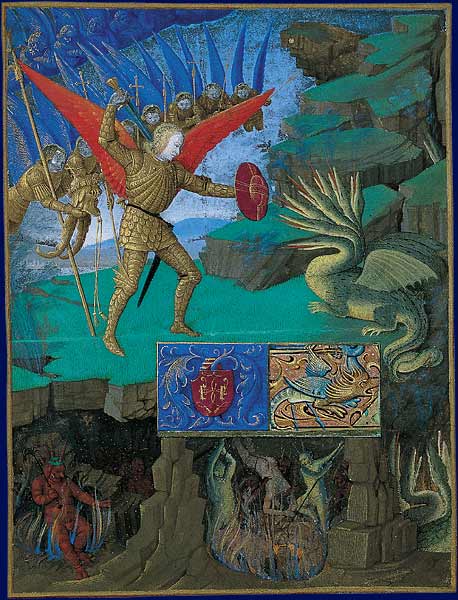
In art, he is shown as an angel with a sword raised, standing over the devil or a dragon; holding a balance, a pair of scales, which he uses to weigh the souls; "Quis ut Deus" is often inscribed on Saint Michael's shield.


St. Michael the Archangel
http://www.stthomasirondequoit.com/SaintsAlive/id183.htm

The Church has never canonized angels. If we pay liturgical honors to the archangels Michael, Gabriel and Raphael, we give them the title saint because they have always been in heaven.

All three archangels are now venerated in a common feast on September 29, which used to be St. Michael's feast alone. Because the new common feast seems to diminish his importance, let us consider him a little more at length in connection with his other feastday, the Apparition of St. Michael, formerly observed on May 8.

The name Michael means, of course, "Who is like God?" He is represented as perhaps the chief angel in both the Old Testament and the New Testament. Several early apocryphal writings do the same. While these writings are not accepted as scriptures by the Church, they nevertheless testify to popular devotion to the "generalissimo" of the heavenly hosts.

Michael was regarded as the protector of the Israelites, especially in the days of their captivity in Babylon. "Michael, the great prince," the Old Testament prophet Daniel calls him, "guardian of your people." (Dn,12:1). In the New Testament Book of Revelation, St. John speaks prophetically of the ultimate victory of Michael and his regiments against the army of the great dragon, Satan. After a mighty struggle, Michael casts the enemy down to earth. (Rev.,12:7-9). Thus St. Michael, protector of Israel, was also hailed as the protector of the New Testament's People of God.

Churches dedicated to St. Michael in the Mideast date from as early as the fourth century. In the West, the cult of Michael became widespread, particularly after his alleged apparition around AD 500 in a cave in Mount Gargano, southeast Italy. The archangel revealed to the local bishop, St. Lawrence of Siponto, that he should erect a shrine there in honor of the archangel himself and all other angels. This St. Lawrence did, and the "Mount Santangelo" soon became a noted place of pilgrimage.

St. Michael also figures in the annals of Pope St. Gregory the Great. During the pestilence that struck Rome in the year 590, Gregory organized a great penitential procession about the streets of the Eternal City to beg God to withdraw the plague. Tradition says that when the march passed by the massive tomb of Emperor Hadrian, St. Michael appeared on its summit sheathing his sword, and the epidemic ceased. Today Hadrian's fortified tomb is called the Castel SantAngelo - Castle of the Holy Angel - and for centuries it has been topped by a statue of St. Michael, dressed in the armor of a Roman soldier, returning sword to scabbard. In Rome, therefore, St. Michael is considered both healer and defender.

The other major Western shrine of the Archangel is the famous Mont St. Michel, a rocky outcropping off the coast of Normandy, France, where the bishop of Avranches established a Benedictine monastery in AD 708; again, we are told, on the advice of the Archangel Michael. In Cornwall, too, near the city of Penzance, there is a little offshore island resembling Mont St. Michel, which in medieval times was likewise the site of a Benedictine monastery that became an English place of pilgrimage.

Pope Leo XIII had the soldier-angel in mind when he ordered that a prayer to St. Michael and several other prayers be recited by priest and faithful at the end of every low Mass. The date of this order was 1884 - an era in which Germany was engaged in a stern persecution of the Catholic Church. Vatican II cancelled the rule, but the invocation to the Archangel is still appropriate - indeed, necessary in our troubled times:

"St. Michael the Archangel, defend us in battle. Be our protection against the malice and snares of the devil. May God rebuke him, we humbly pray; and do you, O prince of the heavenly host, by the divine power, thrust into hell Satan and the other evil spirits who roam through the world seeking the ruin of souls."


--Father Robert F. McNamara

-----------------------

Michaelmas(se)
http://www.camlann.org/michelmas.htm

In the middle ages, Michaelmas(se) celebrated the end of the harvest. It marked the official end of the farming and accounting year. This was an important time, when manor books were closed out, rents paid, a new reeve (the chief officer of the village) was chosen, and storehouses stocked for the winter ahead. Celebration of this holiday traditionally was symbolized with "glofe, gees, and gyngeuer." The glove represented the open-handedness and generosity of the lord of the village, goose eaten for good luck in the coming year ("If you eat goose on Michelmasse day, you will never want money all year"), and ginger, believed to provide protection against infection. The harvest feast paid the laborers for their boon work with meat, fish, ale and good bread.

------------------------

More on St. Michael at:
http://www.traditioninaction.org/SOD/j093sdMichael_9-29.htm


Links:
Patron Saints Index - St. Michael

Women for Faith & Family - St. Michael and All Angels

Variations of St. Michael Prayer

Pictures of St. Michael

Recipe - Michaelmas Goose with Traditional Potato & Apple Stuffing

St. Michael's Mount, Cornwall

Mont-Saint-Michel, Normandy

Skellig Michael, Ireland

Labels: , , ,

Thursday, June 09, 2011

More on St. Columba of Iona (a.k.a. Columcille)

See also my previous post: "Feast of St. Columba of Iona - 9 June"


  • Videos about St. Columba:


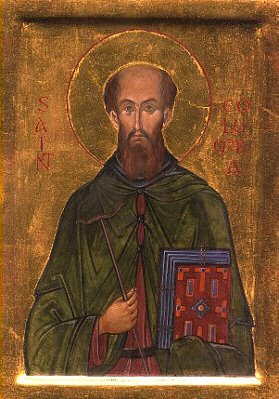
  • An icon of St. Columba:


  • (Hat tip for the icon: Sisters of the Gospel of Life)


  • The prayer of the feast day:

  • O God, you called your servant Columba
    from among the princes of Ireland
    to be a herald and evangelist of your kingdom to the Scottish people:
    Grant that your Church,
    remembering his faith and courage,
    may so proclaim the gospel,
    that all men will come to know your Son as their Saviour,
    and serve him as their King;
    who lives and reigns with you and the Holy Spirit,
    one God, now and for ever.
    Amen.
    (Hat tip for the prayer: Deacon Peter Simpson of St Columba's Roman Catholic Church in Culloden, Inverness)


  • Go here (see also this past issue of Dappled Things) for an absolutely beautiful piece of artwork by Daniel Mitsui, which depicts St. Columba in the mediaeval Irish style, using "a decorative vocabulary taken from the great Celtic illuminated manuscripts - especially the Lindisfarne Gospels, the Book of Kells and the Book of Durrow":
    St. Columba is pictured as an abbot, and holds the Cathach of St. Columba, an illuminated psalter attributed to the saint's own hand.

    At the bottom of the drawing are depicted three events from his life, as retold by Adamnan of Iona ...
    Definitely check it out. The artwork is available for purchase (NOTE TO SELF: add to Father's Day/Birthday/Christmas wish list).


  • Finally, finding a patron saint medal for St. Columba is danged nigh impossible. I've been looking for years, but have never been able to locate one. (If I have any readers in Ireland or Scotland who know how to obtain a patron saint medal depicting St. Columba - at a relatively affordable price, please contact me.)

    In the meantime, for those who are interested, the Ulster Heritage Magazine blog has information regarding a Saint Columba Medal designed by American-born Celtic metal worker and artist, Garth Duncan, who now lives on the Isle of Skye:


    For more information on the Saint Columba Medal, try Duncan's website.
  • Labels: , , , , ,

    Feast of St. Columba of Iona - 9 June


    My Druid is Christ, the son of God,
    Christ, Son of Mary, the Great Abbot,
    The Father, the Son and the Holy Ghost.


    ~ St. Columba of Iona

    O Columba spes Scotorum
    nos tuorum meritorum
    interventu beatorum
    fac consortes angelorum. Alleluia.

    O Columba, hope of Scots,
    By your merits' mediation.
    Make us companions
    of the blessed angels. Halleluia.


    ~ The Inchcolm Antiphoner, C13th


    St. Ephrem may get all the glory in the Roman Calendar, but in the Anderson household, the saint of the day on June 9 is St. Columba of Iona, also known as Columcille.

    Columba is my patron saint. Studying the life of this great saint (as well as honeymooning in Scotland, where we visited many sites associated with him) piqued my interest in the early Church and the spread of Christianity in the British Isles, and thus eventually led to my coming home to the Church. When Sarah and I entered the Church 7 years ago this month, I chose "Columba" as my Confirmation name.

    Among St. Columba's claims to fame - in addition to evangelizing the Picts in the land that eventually became Scotland, and creating on his monastic island of Iona a base of operation whereby Britain was re-evangelized after the native Celts were conquered by the pagan Anglo-Saxons - is that he is credited with the first recorded sighting of the Loch Ness Monster.

    The following history of St. Columba provides more insight into his colorful life (online source no longer available):
    Columba was born into Irish royalty on or around 521A.D.. It is told there was a dispute over the name he was to be given. His mother choosing to name him Columcille (dove), and his father, Crimthan (wolf). Columcille, or Columba as his name was latinized, went at a very young age to study in the monastery at Moville. There he was brought up in the traditional monastic life of the celts. While studying in the monastery, he gained an appreciation for the arts, music (psalters), poetry, and writing. He was said to have been one of the best scribes of his time, writing many Psalters and poems. In 546 Columba founded the monastery in Derry, and later the one in Durrow (556). Columba came into a dispute with his former master Finian in 561, over a dispute of ownership of a copy of the Gospel. Apparently Columba had made his own copy of Finian's original, and when he would no release ownership, the case was taken before king Diarmot. Diarmot was a local King, from a rival clan of Columba's. When the case went before him, Diarmot made the now famous quote "To every cow it's calf, and to every copy it's original". Shamed and insulted by this, Columba called upon his father to rally his clan for possession of the book. What followed was one of the most bloody battles in Irish history "the battle of the books". Three thousand died in Culdrevne, and Columba won the book, but it cost him dearly. As a result, he was exiled by the church from Ireland as a penance for a monk taking up arms.

    ***
    Columba leaving Ireland in 563, with twelve fellow monks, landed on the isle of IONA. It was there, out of sight of beloved Ireland that he established his monastery in which he based his evangelical missions. Having established his monastery and removing the druid priests that were on the Island, by performing a miracle of healing on a crippled girl, he purposed to begin evangelizing what is now known as Scotland. Leaving in 564 and travelling up through the great Scottish Loches towards Inverness, he spread the gospel to all that would hear. Working his way to Inverness to witness to the pictish King Brude, he was once again confronted by druadic priests. The priests demanding that Columba take his God and his twelve fellow monks back to Ireland, declared that theirs was the true religion, and that Christ conflicts with the nature cycle. Claiming that the druid was said to have drawn the life circle in the sand. Columba in response took his staff and drew an intersecting cross within the circle promptly stating that God does not conflict with nature, but being the creator of it, compliments it. Stumped by this and frustrated because they could not shake Columba's faith they departed.

    Saint Columba then proceeded through Loch Ness, where his successor St. Adoman wrote of him : “At another time, when the saint stayed for several days among the Picts, he came to the shores of the River Ness. Reaching the shore, he saw some locals in the midst of burying some unfortunate man. They told him that they had seen a water beast snatch the man and maul him as he was swimming. Some of the men had set out in a small boat to try to rescue the man, but they were too late. They used hooks to retrieve his corpse from the waters. Columba, after being told this story, amazed the crowd by telling his companion Luigne to swim across the water and bring back a boat that was on the far shore. Luigne obeyed the saint without hesitation, removed his clothes except for a tunic, and dove into the water. The beast was at the bottom of the water, its appetite merely whetted by its first victim. Sensing the water stirring above by Luigne’s swimming, it suddenly rushed towards the swimmer with a great roar, its wide mouth open to its prey. The crowd on the shore, both Columba’s men and the locals, watched in terror. The blessed Columba raised his hand and made the sign of the cross, and calling on the name of God, spoke to the monster: ‘Halt! Do not harm the man! Retreat at once!’ The sound of the saint’s voice caused terror in the beast, and it fled so swiftly that it appeared dragged under with ropes. It had been but the length of a pole away from Luigne. Columba’s companions were amazed when Luigne returned to them in the boat, unharmed and safe." This incidentally is the first report of Nessie.

    Columba eventually reached Inverness, and gained audience with the king, and while it was not recorded that king Brude was converted, he did institute Christianity over druidism. Columba gained a measure of favor with Brude, and involved himself to some extent in the politics of Scotland. Although exiled, Columba returned to Ireland many times to involve himself with the politics of home. Once returning to quench a suppressing of the bards by the Irish nobles. Columba died on his Island of IONA in [597]. Below is a prayer attributed to him.

    ***


    A traditional prayer for God's light

    O Lord, grant us that love which can never die, which will enkindle our lamps but not extinguish them, so that they may shine in us and bring light to others. Most dear Savior, enkindle our lamps that they may shine forever in your temple. May we receive unquenchable light from you so that our darkness will be illuminated and the darkness of the world will be made less. Amen.


    The Cathach of St. Columba

    Shrine of the Cathach

    Additional information from the Patron Saints Index:
    COLUMBA
    Also known as:
    Apostle of the Picts; Colmcille; Colum; Columbkille; Columbus; Columcille; Columkill; Combs

    Memorial:
    9 June

    Profile:
    Irish royalty, the son of Fedhlimidh and Eithne of the Ui Neill clan. Bard. Miracle worker. Monk at Moville. Spiritual student of Saint Finnian. Priest. Itinerant preacher and teacher throughout Ireland and Scotland. Spiritual teacher of Saint Corbmac, Saint Phelim, Saint Drostan, and Saint Fergna the White. Travelled to Scotland in 563. Exiled to Iona, he founded a monastic community there and served as its abbot for twelve years. He and the monks of Iona, including Saint Baithen of Iona and Saint Eochod, then evangelized the Picts, converting many, including King Brude. Attended the Council of Drumceat, 575. Legend says he wrote 300 books.

    Born:
    7 December 521 at Donegal, Ireland

    Died:
    9 June 597 at Iona, Scotland, and is buried there

    Canonized:
    Pre-Congregation

    Patronage:
    against floods; bookbinders; diocese of Derry, Ireland; diocese of Dunkeld, Scotland; floods; Ireland; Pembroke, Ontario; diocese of Raphoe, Ireland; poets; Scotland
    See also the quite extensive entry on the life of St. Columba of Iona at http://www.saintpatrickdc.org/ss/0609.shtml (scroll down to get to the entry):
    Ireland has many saints and three great ones: Patrick, Brigid, and Columba. Columba outshines the others for his pure Irishness. He loved Ireland with all his might and hated to leave it for Scotland. But he did leave it and laid the groundwork for the conversion of Britain. He had a quick temper but was very kind, especially to animals and children. He was a poet and an artist who did illumination, perhaps some of those in the Book of Kells itself. His skill as a scribe can be seen in the Cathach of Columba at the Irish Academy, which is the oldest surviving example of Irish majuscule writing. It was latter enshrined in silver and bronze and venerated in churches.

    About the time that Patrick was taken to Ireland as a slave, Columba was born. He came from a race of kings who had ruled in Ireland for six centuries, directly descended from Niall of the Nine Hostages, and was himself in close succession to the throne. From an early age he was destined for the priesthood; he was given in fosterage to a priest. After studying at Moville under Saint Finnian and then at Clonard with another Saint Finnian, he surrendered his princely claims, he became a monk at Glasnevin under Mobhi and was ordained.

    He spent the next 15 years preaching and teaching in Ireland. As was the custom in those days, he combined study and prayer with manual labor. By his own natural gifts as well as by the good fortune of his birth, he soon gained ascendancy as a monk of unusual distinction. By the time he was 25, he had founded no less than 27 Irish monasteries, including those at Derry (546), Durrow (c. 556), and probably Kells, as well as some 40 churches.

    Columba was a poet, who had learned Irish history and poetry from a bard named Gemman. He is believed to have penned the Latin poem Altus Prosator and two other extant poems. He also loved fine books and manuscripts. One of the famous books associated with Columbia is the Psaltair, which was traditionally the Battle Book of the O'Donnells, his kinsmen, who carried it into battle. The Psaltair is the basis for one of the most famous legends of Saint Columba.

    It is said that on one occasion, so anxious was Columba to have a copy of the Psalter that he shut himself up for a whole night in the church that contained it, transcribing it laboriously by hand. He was discovered by a monk who watched him through the keyhole and reported it to his superior, Finnian of Moville. The Scriptures were so scarce in those days that the abbot claimed the copy, refusing to allow it to leave the monastery. Columba refused to surrender it, until he was obliged to do so, under protest, on the abbot's appeal to the High King Diarmaid, who said: "Le gach buin a laogh" or "To every cow her own calf," meaning to every book its copy.

    An unfortunate period followed, during which, owing to Columba's protection of a refugee and his impassioned denunciation of an injustice by King Diarmaid, war broke out between the clans of Ireland, and Columba became an exile of his own accord. Filled with remorse on account of those who had been slain in the battle of Cooldrevne, and condemned by many of his own friends, he experienced a profound conversion and an irresistible call to preach to the heathen. Although there are questions regarding Columba's real motivation, in 563, at the age of 42, he crossed the Irish Sea with 12 companions in a coracle and landed on a desert island now known as Iona (Holy Island) on Whitsun Eve. Here on this desolate rock, only three miles long and two miles wide, in the grey northern sea off the southwest corner of Mull, he began his work; and, like Lindisfarne, Iona became a center of Christian enterprise. It was the heart of Celtic Christianity and the most potent factor in the conversion of the Picts, Scots, and Northern English.


    [More]


    Iona Abbey, Isle of Iona, Argyllshire, Scotland

    And finally, here is more on St. Columba from the Medieval Saints Yahoo Group:
    St. Columba of Iona, Abbot, missionary

    Also known as Colum, Columbus, Combs, Columkill, Columcille, Colmcille

    Died 597 at Iona, and is buried there

    Commemorated June 9
    ST. COLUMBA or COLUMCILLE 521-597

    St Columba is a saint who still, after fourteen hundred years, exerts an appeal upon our imaginations. Born in Ireland, in Donegal in the year 521, he was of the blood royal, and might indeed have become High King of Ireland had he not chosen to be a priest. His vital, vigorous personality has given rise to many legends, and it is a little hard to sift fact from what is more probably fiction. We do know that he was a man of tremendous energy, probably somewhat headstrong in his youth, but with his tendency to violence curbed by a gentle magnanimity.

    It seems certain that he left Ireland as an act of penance, although it is less certain how far this was connected with his quarrelling over a copy of the Gospels he had made, a dispute that led to a bloody battle. He came from Ireland to Scotland, to the colony of Dalriada founded on the west coast by his fellow Irish Scots who were at that time somewhat oppressed by the dominant Picts. With twelve companions he founded his monastery on Iona in the year 563. These Celtic monks lived in communities of separate cells, but Columba and his companions combined their contemplative life with extraordinary missionary activity. Amongst his many accomplishments, Columba was a splendid sailor. He sailed far amongst the islands and travelled deep inland, making converts and founding little churches. In Ireland he had already, it is said, founded a hundred churches.

    Of all the Celtic saints in Scotland, Columba's life is much the best documented, because manuscripts of his Life, written by St Adamnan, one of his early successors as abbot of Iona, have survived. Iona itself remains a place of the greatest beauty, a serene island set in seas that take on brilliant colors in the sunshine, recalling the life and background of this remarkable man whose mission led to the conversion of Scotland and of the north of England, and indeed carried its influence far further afield. It later became the site of a Benedictine Abbey and of a little cathedral. These were dismantled by the Scottish reformers in 1561, and part of Columba's prophecy was fulfilled:

    In Iona of my heart, Iona of my love,
    Instead of monks' voices shall be lowing of cattle,
    But ere the world come to an end
    Iona shall be as it was.

    When Dr Samuel Johnson visited the island in 1773 he observed, 'That man is little to be envied, whose patriotism would not gain force upon the plain of Marathon, or whose piety would not grow warmer among the ruins of Iona!'

    Columba was a poet as well as a man of action. Some of his poems in both Latin and Gaelic have come down to us, and they reveal him as a man very sensitive to the beauty of his surroundings, as well as always, in St Adamnan's phrase, 'gladdened in his inmost heart by the joy of the Holy Spirit.' He died in the year 597.
    ----------------

    More on St. Columba at:

  • http://www.newadvent.org/cathen/04136a.htm


  • http://islesproject.com/2009/01/13/563-597-saint-columba-the-loch-ness-monster-and-the-picts-the-written-word-and-celtic-christianity-spread-to-the-highlands/


  • http://www.allsaintsbrookline.org/celtic_saints/columba.html


  • Adomnan's Life of Columba is available elsewhere

  • in English
  • http://www.fordham.edu/halsall/basis/columba-e.html

  • and Latin
  • http://www.fordham.edu/halsall/basis/columba-l.html


    Columba's famous rule is also online


  • http://www.fordham.edu/halsall/source/columba-rule.html


  • And an article on the history of the island of Iona

  • http://www.knight.org/advent/cathen/08090a.htm


  • Iona Abbey

  • The Iona Community


  • Historic Scotland - Iona Abbey


  • Historic Scotland - Iona, St. Columba Centre


  • Saint Columba Novena and Litany

    ______________________


    The Monymusk Reliquary, or "Brecbennoch" as it was called, dates from c. 750, and purportedly enclosed the bones of St. Columba, the most popular saint in medieval Scotland. It was carried by the Scots into the Battle of Bannockburn in 1314.


    ______________________


    Recommended Reading:
    Life of Columba by Adamnan of Iona
    The Life of Colum Cille by Manus O'Donnell
    Colum Cille and the Columban Tradition by Brian Lacey
    The World of Colmcille, also known as Columba by Mairead Ashe FitzGerald

    The Illustrated Life of Columba
    by John Marsden
    Iona, Kells, and Derry: The History and Hagiography of the Monastic Familia of Columba by Maire Herbert
    The Legend of St. Columba by Padraic Colum
    Columba by Nigel Tranter
    The Magnificent Gael by Reginald B. Hale

    The Cathach of Colum Cille (available on CD-Rom)
    Patron Saints Index Entry for St. Columba

    How the Irish Saved Civilization by Thomas Cahill
    Wisdom of the Celtic Saints by Edward C. Sellner
    Sun Dancing by Geoffrey Moorhouse

    Children's Books About St. Columba:
    The Man Who Loved Books by Jean Fritz
    Across a Dark and Wild Sea by Don Brown
    Saint Colum and the Crane by Eva K. Betz

    Music:
    "Columba, Most Holy of Saints - Medieval Scottish Plainchant"
    ~ Performed by Capella Nova, Alan Tavener

    "In Praise of Saint Columba"
    ~ Performed by the Choir of Gonville & Caius College, Cambridge

    "The Pilgrim - A Celtic Suite for Orchestra, Soloists, Pipe Band and Choir"
    ~ Composed by Shaun Davey


    Labels: , , , , ,

    Monday, May 02, 2011

    The May Magnificat


    The May Magnificat

    May is Mary's month, and I
    Muse at that and wonder why:
    Her feasts follow reason,
    Dated due to season --

    Candlemas, Lady Day;
    But the Lady Month, May,
    Why fasten that upon her,
    With a feasting in her honour

    Is it only its being brighter
    Than the most are must delight her?
    Is it opportunest
    And flowers finds soonest?

    Ask of her, the mighty mother;
    Her reply puts this other
    Question: What is Spring? --
    Growth in everything --

    Flesh and fleece, fur and feather
    Grass and green world all together;
    Star-eyed strawberry breasted
    Throstle above her nested

    Cluster of bugle blue eggs thin
    Forms and warms the life within;
    And bird and blossom swell
    In sod or sheath or shell.

    All things rising, all things sizing
    Mary sees, sympathising
    With that world of good
    Nature's motherhood.

    Their magnifying of each its kind
    With delight calls to mind
    How she did in her stored
    Magnify the Lord

    Well but there was more than this:
    Spring's universal bliss
    Much, had much to say
    To offering Mary May.

    When drop-of-blood-and-foam-dapple
    Bloom lights the orchard-apple
    And thicket and thorp are merry
    With silver-surféd cherry

    And azuring-over greybell makes
    Wood banks and brakes wash wet like lakes
    And magic cuckoo call
    Caps, clears, and clinches all --

    This ecstasy all through mothering earth
    Tells Mary her mirth till Christ's birth
    To remember and exultation
    In God who was her salvation.


    ~Gerard Manley Hopkins

    Labels: , , ,

    Friday, April 01, 2011

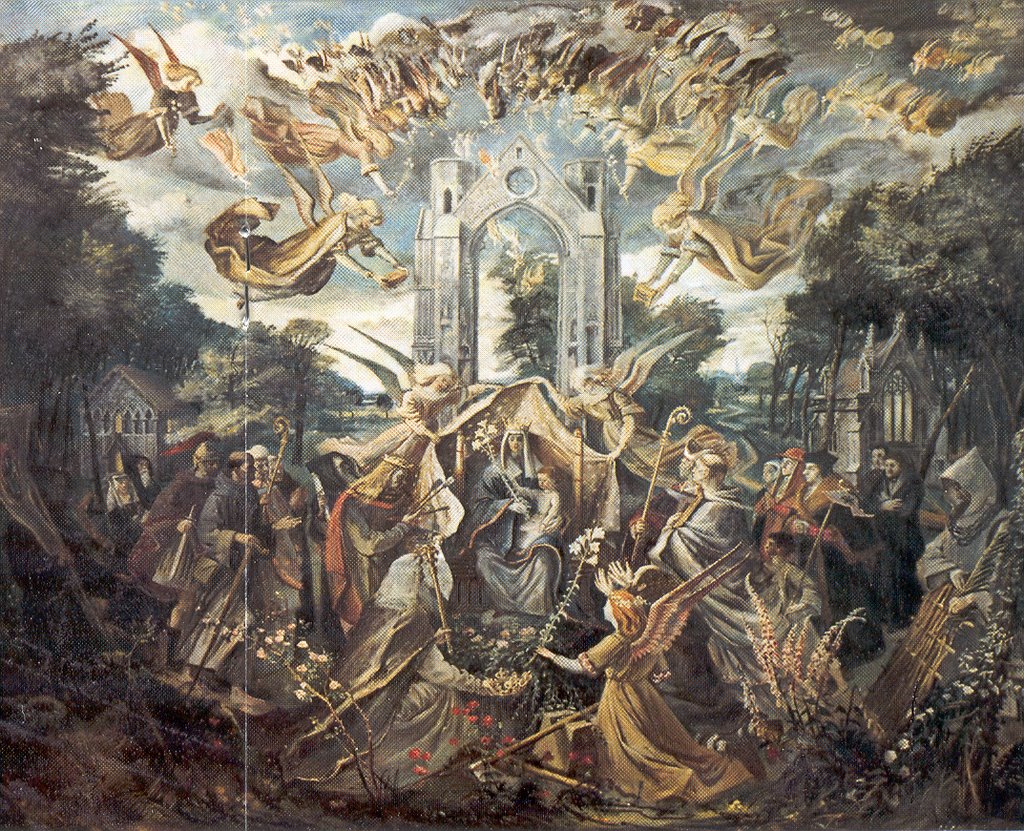
    Our Lady of Walsingham - 950th Anniversary [UPDATED]


    Stephanie Mann of the excellent English-Reformation-themed blog Supremacy and Survival reports that the 950th anniversary of the Shrine of Our Lady of Walsingham is being commemorated this year.

    Stephanie links to a blog post by John Whitehead on the same topic, in which he describes the Mass he attended at Westminster Cathedral that kicks off 6 months of celebration leading up to the feast day of Our Lady of Walsingham on September 24.

    Our Lady of Walsingham is the patroness of our family's household, and I have written extensively on the subject at this blog (including describing my pilgrimage to the Shrine for the feast of Our Lady of Walsingham 5-and-a-half years ago), and will be blogging on the topic even more this year during the 950th anniversary celebration. For my past writing on the topic, just click on the "Walsingham" label below.

    UPDATE More information on the 950th can be found at the Shrine's website, including a brochure of events and activities commemorating the anniversary.

    Labels: , , , , , , ,

    Thursday, March 17, 2011

    St. Patrick's Breastplate (The Deer's Cry)

    From "The Pilgrim" composed by Shaun Davey.

    This version of "The Deer's Cry" is sung by the artist Angelina and has appeared on EWTN:


    I arise today through the strength of heaven
    Light of sun, radiance of moon
    Splendor of fire, speed of lightning
    Swiftness of wind, depth of the sea
    Stability of earth, firmness of rock

    I arise today through God's strength to pilot me
    God's eye to look before me
    God's wisdom to guide me
    God's way to lie before me
    God's shield to protect me

    From all who shall wish me ill
    Afar and a-near
    Alone and in a multitude
    Against every cruel, merciless power
    That may oppose my body and soul

    Christ with me, Christ before me
    Christ behind me, Christ in me
    Christ beneath me, Christ above me
    Christ on my right, Christ on my left
    Christ when I lie down, Christ when I sit down
    Christ when I arise, Christ to shield me

    Christ in the heart of everyone who thinks of me
    Christ in the mouth of everyone who speaks of me

    I arise today

    Based on the Lorica of St. Patrick.

    Lisa Kelly of Celtic Woman also did a very lovely version of "The Deer's Cry".

    Labels: , , , , , ,

    Friday, December 10, 2010

    2000-Year-Old Glastonbury Thorn Cut Down by Vandals

    Before


    After


    The Holy Thorn of Glastonbury - a site of pilgrimage for 2000 years - has been cut down by what may be anti-Christian vandals:
    Standing proudly on the side of an English hill, its religious roots go back 2,000 years. But a single night of vandalism has left an ancient site of pilgrimage in splinters.

    The Holy Thorn Tree of Glastonbury has been chopped down in what is being seen by some as a deliberately anti-Christian act.

    A feature of the skyline surrounding the Somerset town, the tree has been visited by thousands retracing the steps said to have been taken by Joseph of Arimathea, who some say was Jesus’ great uncle

    According to legend, Saint Joseph travelled to the spot after Christ was crucified, taking with him the Holy Grail of Arthurian folklore.

    He is said to have stuck his wooden staff – which had belonged to Jesus – into the ground on Wearyall Hill before he went to sleep. When he awoke it had sprouted into a thorn tree, which became a natural shrine for Christians across Europe.

    To add to its sacred status, the tree ‘miraculously’ flowered twice a year – once at Christmas and once at Easter. It survived for hundreds of years before it was chopped down by puritans in the Civil War, but secret cuttings of the original were taken and planted around the town.

    It is from one of the new plants that a replacement tree was planted in the original spot over 50 years ago.

    Yesterday residents of Glastonbury wept as they surveyed the damage done to the tree on Wednesday night. Katherine Gorbing, curator of the town’s abbey, said: ‘The mindless vandals who have hacked down this tree have struck at the heart of Christianity.

    [More]
    (Hat tip: Creative Minority Report)

    My Comments:
    For additional background on this holy tree, I recommend The Flowering Hawthorn by Hugh Ross Williamson (published by Neumann Press). See also the links below.


    Previous Pro Ecclesia posts on this subject:
    Joanna Bogle on Glastonbury Tor

    Glastonbury, Once England's Foremost Pilgrim Shrine, Today Linked to New Age (Vatican Radio)

    Labels: , , , , ,

    Thursday, October 07, 2010

    Our Lady of the Rosary


    O GOD, whose only begotten Son, by His life, death, and resurrection, has purchased for us the rewards of eternal life, grant, we beseech Thee, that meditating upon these mysteries of the Most Holy Rosary of the Blessed Virgin Mary, we may imitate what they contain and obtain what they promise, through the same Christ Our Lord. Amen.


    Cathedral of Our Lady, Queen of the Most Holy Rosary, Toledo, OH

    Labels: , , ,

    Tuesday, October 05, 2010

    So, Joe, Will You Be Using Your Rosary Beads to Do That?

    Vice-President (and unintentional court jester) Joe Biden is so lame that even his idle, chest-thumping threats are somewhat recycled.

    If I hear one more Republican tell me about balancing the budget, I am going to strangle them.

    sounds an awful lot like

    The next Republican that tells me I'm not religious I'm going to shove my rosary beads down their throat.”

    It does lead one to wonder whether Joe is contemplating using his rosary beads to strangle his opponents before shoving said beads down their throats.

    It is the Month of the Rosary after all, and the Feast of Our Lady of the Rosary is coming up on Thursday. I mean, Joe's actions in vanquishing his opponents via rosarian asphyxiation could recall an important historic and spiritual event: but rather than using the rosary of Our Blessed Lady to defeat Islamic invaders when all hope seemed lost, Joe could use the rosary to defeat the evil Republicans now that all hope for the Democrats in the 2010 elections seems lost.


    Previous Pro Ecclesia posts on this subject:
    Dawn Eden to Sen. Biden: "Keep Your Rosaries Off My Uvula!"

    Biden: "I'm Going To Shove My Rosary Beads Down Their Throat"

    Labels: , , , ,

    Wednesday, September 29, 2010

    Michaelmas - Feast of St. Michael and All Angels, 29 September

    Saint Michael the Archangel,
    Defend us in battle.
    Be our protection against the
    Wickedness and snares of the devil.
    May God rebuke him,
    We humbly pray.
    And do thou,
    O Prince of the Heavenly Host,
    By the Power of God,
    Cast into Hell
    Satan and all the evil spirits
    which prowl about the world,
    Seeking the ruin of souls.
    Amen.


    From the Medieval Saints Yahoo Group:
    The Dedication of Saint Michael the Archangel, Michaelmas Day
    Hebrew "Mikha El," (Who is like unto God?), Venerated by Jews, Christians and Muslims

    Commemorated September 29: the dedication of the sanctuary which was built on Monte Gargano in honor of the apparition of Saint Michael the Archangel. This feast is very ancient.

    Also commemorated on May 8th a lesser feast is observed to commemorate the appearance of St. Michael on the summit of Mount Gargano in Apulia during the time of Pope Gelasius (492-6).

    Devotion to Michael was common in the East during the fourth century and the Western Church began to observe the feast sometime in the fifth century. In the offertory anthem of the mass for the dead, St. Michael is charged with the care of all departed souls, "holy standard bearer, introduce them to the holy light, which thou didst promise of old to Abraham and to his seed."

    St. Michael's Day, or Michaelmas is one of the Medieval Quarter days. The celebration was marked by harvest festivals, hospitality, costumes, music and dancing. Many popular traditions grew up around the day, which coincided with the end of harvest and the end of the fiscal year.

    Patronage: champion of the Jewish people, against temptations, ambulance drivers, artists, bakers, bankers, banking, battle, boatmen, coopers, danger at sea, dying people, emergency medical technicians, EMTs, England, fencing, Germany, greengrocers, grocers, haberdashers, hatmakers, hatters, holy death, knights, mariners, milleners, paramedics, paratroopers, police officers, radiologists, radiotherapists, sailors, security forces, security guards, sick people, soldiers, Spanish police officers, storms at sea, swordsmiths, watermen, protector of the Nile

    In art, he is shown as an angel with a sword raised, standing over the devil or a dragon; holding a balance, a pair of scales, which he uses to weigh the souls; "Quis ut Deus" is often inscribed on Saint Michael's shield.


    St. Michael the Archangel
    http://www.stthomasirondequoit.com/SaintsAlive/id183.htm

    The Church has never canonized angels. If we pay liturgical honors to the archangels Michael, Gabriel and Raphael, we give them the title saint because they have always been in heaven.

    All three archangels are now venerated in a common feast on September 29, which used to be St. Michael's feast alone. Because the new common feast seems to diminish his importance, let us consider him a little more at length in connection with his other feastday, the Apparition of St. Michael, formerly observed on May 8.

    The name Michael means, of course, "Who is like God?" He is represented as perhaps the chief angel in both the Old Testament and the New Testament. Several early apocryphal writings do the same. While these writings are not accepted as scriptures by the Church, they nevertheless testify to popular devotion to the "generalissimo" of the heavenly hosts.

    Michael was regarded as the protector of the Israelites, especially in the days of their captivity in Babylon. "Michael, the great prince," the Old Testament prophet Daniel calls him, "guardian of your people." (Dn,12:1). In the New Testament Book of Revelation, St. John speaks prophetically of the ultimate victory of Michael and his regiments against the army of the great dragon, Satan. After a mighty struggle, Michael casts the enemy down to earth. (Rev.,12:7-9). Thus St. Michael, protector of Israel, was also hailed as the protector of the New Testament's People of God.

    Churches dedicated to St. Michael in the Mideast date from as early as the fourth century. In the West, the cult of Michael became widespread, particularly after his alleged apparition around AD 500 in a cave in Mount Gargano, southeast Italy. The archangel revealed to the local bishop, St. Lawrence of Siponto, that he should erect a shrine there in honor of the archangel himself and all other angels. This St. Lawrence did, and the "Mount Santangelo" soon became a noted place of pilgrimage.

    St. Michael also figures in the annals of Pope St. Gregory the Great. During the pestilence that struck Rome in the year 590, Gregory organized a great penitential procession about the streets of the Eternal City to beg God to withdraw the plague. Tradition says that when the march passed by the massive tomb of Emperor Hadrian, St. Michael appeared on its summit sheathing his sword, and the epidemic ceased. Today Hadrian's fortified tomb is called the Castel SantAngelo - Castle of the Holy Angel - and for centuries it has been topped by a statue of St. Michael, dressed in the armor of a Roman soldier, returning sword to scabbard. In Rome, therefore, St. Michael is considered both healer and defender.

    The other major Western shrine of the Archangel is the famous Mont St. Michel, a rocky outcropping off the coast of Normandy, France, where the bishop of Avranches established a Benedictine monastery in AD 708; again, we are told, on the advice of the Archangel Michael. In Cornwall, too, near the city of Penzance, there is a little offshore island resembling Mont St. Michel, which in medieval times was likewise the site of a Benedictine monastery that became an English place of pilgrimage.

    Pope Leo XIII had the soldier-angel in mind when he ordered that a prayer to St. Michael and several other prayers be recited by priest and faithful at the end of every low Mass. The date of this order was 1884 - an era in which Germany was engaged in a stern persecution of the Catholic Church. Vatican II cancelled the rule, but the invocation to the Archangel is still appropriate - indeed, necessary in our troubled times:

    "St. Michael the Archangel, defend us in battle. Be our protection against the malice and snares of the devil. May God rebuke him, we humbly pray; and do you, O prince of the heavenly host, by the divine power, thrust into hell Satan and the other evil spirits who roam through the world seeking the ruin of souls."


    --Father Robert F. McNamara

    -----------------------

    Michaelmas(se)
    http://www.camlann.org/michelmas.htm

    In the middle ages, Michaelmas(se) celebrated the end of the harvest. It marked the official end of the farming and accounting year. This was an important time, when manor books were closed out, rents paid, a new reeve (the chief officer of the village) was chosen, and storehouses stocked for the winter ahead. Celebration of this holiday traditionally was symbolized with "glofe, gees, and gyngeuer." The glove represented the open-handedness and generosity of the lord of the village, goose eaten for good luck in the coming year ("If you eat goose on Michelmasse day, you will never want money all year"), and ginger, believed to provide protection against infection. The harvest feast paid the laborers for their boon work with meat, fish, ale and good bread.

    ------------------------

    More on St. Michael at:
    http://www.traditioninaction.org/SOD/j093sdMichael_9-29.htm


    Links:
    Patron Saints Index - St. Michael

    Women for Faith & Family - St. Michael and All Angels

    Variations of St. Michael Prayer

    Pictures of St. Michael

    Recipe - Michaelmas Goose with Traditional Potato & Apple Stuffing

    St. Michael's Mount, Cornwall

    Mont-Saint-Michel, Normandy

    Skellig Michael, Ireland

    Labels: , , ,

    Friday, September 24, 2010

    John Dowland: "As I Went to Walsingham"


    Labels: , , , , , , ,

    The Walsingham Ballads, Part 3: The Arundel Ballad ("The Wrecks of Walsingham")


    In the wrackes of Walsingam
    Whom should I chuse
    But the Queene of Walsingam
    To be guide to my muse?

    Then, thou Prince of Walsingam
    Graunt me to frame
    Bitter plaintes to rewe thy wronge
    Bitter wo for thy name.

    Bitter was it, oh to see
    The sely sheepe
    Murdred by the raveninge wolves
    While the sheepharde did sleep.

    Bitter was it, oh, to viewe
    The sacred vyne
    Whiles the gardiners plaied all close
    Rooted up by the swine.

    Bitter, bitter oh to behoulde
    The grasse to growe
    Where the walles of Walsingam
    So stately did shewe.

    Such were the worth of Walsingam
    While she did stand
    Such are the wrackes as now do shewe
    Of that (so) holy lande.

    Levell, levell with the ground
    The Towres doe lye
    Which with their golden, glitt'ring tops
    Pearsed oute to the skye.

    Where weare gates noe gates are nowe,
    The waies unknowen,
    Where the presse of freares did passe
    While her fame far was blowen.

    Oules do scrike where the sweetest himnes
    Lately wear songe,
    Toades and serpents hold their dennes
    Where the palmers did throng.

    Weep, weep O Walsingam,
    Whose dayes are nightes,
    Blessings turned to blasphemies,
    Holy deedes to dispites.

    Sinne is where our Ladye sate,
    Heaven turned is to helle;
    Sathan sitte where our Lord did swaye,
    Walsingam, oh, farewell!

    Labels: , , , , , , ,

    The Walsingham Ballads, Part 2: The Ralegh Ballad


    As you came from the holy land
    Of Walsinghame,
    Met you not with my true love
    By the way as you came ?

    How shall I know your true love,
    That have met many one,
    As I went to the holy land,
    That have come, that have gone ?

    She is neither white nor brown,
    But as the heavens fair ;
    There is none hath a form so divine
    In the earth or the air.

    Such a one did I meet, good sir,
    Such an angelic face,
    Who like a queen, like a nymph, did appear,
    By her gait, by her grace.

    She hath left me here all alone,
    All alone, as unknown,
    Who sometimes did me lead with herself,
    And me loved as her own.

    What's the cause that she leaves you alone,
    And a new way doth take,
    Who loved you once as her own,
    And her joy did you make ?

    I have loved her all my youth,
    But now old, as you see,
    Love likes not the falling fruit
    From the withered tree.

    Know that Love is a careless child,
    And forgets promise past ;
    He is blind, he is deaf when he list,
    And in faith never fast.

    His desire is a dureless content,
    And a trustless joy ;
    He is won with a world of despair,
    And is lost with a toy.

    Of womankind such indeed is the love,
    Or the word love abusèd,
    Under which many childish desires
    And conceits are excusèd.

    But true love is a durable fire,
    In the mind ever burning,
    Never sick, never old, never dead,
    From itself never turning.

    Labels: , , , , , , ,

    The Walsingham Ballads, Part 1: The Pynson Ballad


    Of this chapell se here the fundacyon,
    Bylded the yere of crystes incarnacyon,
    A thousande complete syxty and one,
    The tyme of sent Edward kyng of this region.

    Beholde and se, ye goostly folkes all,
    Which to this place have devocyon
    When ye to Our Lady askynge socoure call
    Desyrynge here hir helpe in your trybulacyon:
    Of this hir chapell ye may se the fundacyon.
    If ye wyll this table overse and rede
    Howe by myracle it was founded indede.

    A noble wydowe, somtyme lady of this towne,
    Called Rychold, in lyvynge full vertuous,
    Desyred of Oure Lady a petycyowne
    Hir to honoure with some werke bountyous,
    This blyssed Virgyn and Lady most gracyous
    Graunted hir petycyon, as I shall after tell,
    Unto hir worschyp to edefye this chapell.

    In spyryte Our Lady to Nazareth hir led
    And shewed hir the place where Gabryel hir grette:
    "Lo doughter, consyder" to hir Oure Lady sayde,
    " Of thys place take thou suerly the mette,
    Another lyke thys at Walsyngham thou sette
    Unto my laude and synguler honoure;
    All that me seke there shall fynde socoure,

    Where shall be hadde in a memoryall
    The great joy of my salutacyon.
    Fyrste of my joys grounde and orygynall
    Rote of mankyndes gracious redempcyon,
    When Gabryell gave to me relacyon
    To be a moder through humylyte.
    And goddys sonne conceyve in virgynyte"

    This visyon shewed thryse to this devout woman.
    In mynde well she marked both length and brede;
    She was full gladde and thanked Oure Lady than
    Of hir great grace never destytute in nede.
    This forsayd hous in haste she thought to spede,
    Called to hir artyfycers full wyse,
    This chapell to forge as Our Lady dyd devyse.

    All this, a medewe wete with dropes celestyall
    And with sylver dewe sent from hye adowne
    Excepte tho tweyne places chosen above all
    Where neyther moyster ne dewe myght be fowne.
    This was the fyrste pronostycacyowne
    Howe this our newe Nazareth here shold stande,
    Bylded lyke the fyrste in the Holy Lande.

    Whan it was al fourmed, than had she great doute
    Where it shold be sette and in what maner place,
    Inasmoche as tweyne places were founde oute
    Tokened with myracle of Our Ladyes grace;
    That is to say, tweyne quadrates of egall space
    As the flees of Gedeon in the wete beynge drye,
    Assygned by myracle of holy mayde Marye.

    The wydowe thought it most lykly of congruence
    This house on the fyrste soyle to bylde and arere.
    Of this who lyste to have experyence,
    A chapell of saynt Laurence standeth nowe there
    Faste by tweyne wells, experyence doth thus lere,
    There she thought to have set this chapell
    Which was begonne by Our Ladyes counsell.

    The carpenters began to set the fundamente
    This hevenly house to arere up on hye,
    But sone their werkes shewed inconvenyente.
    For no pece with oder wolde agre with geometrye;
    Than were they all sory and full of agonye
    That they could nat ken neither mesure ne marke
    To ioyne togyder their owne proper werke.

    They went to reste and layde all thynge on syde,
    As they on their maystresse had a commaundement;
    She thought Our Lady, that fyrste was hir gyde,
    Wold convey this worke aftyr hir owne entent;
    Hir meyny to reste as for that nyght she sente
    And prayed Our Lady with devoute exclamacyon,
    And as she had begonne, to perfowrme that habytacion.

    All nyghte the wydowe remayninge in this prayer,
    Oure blyssed Lady, with hevenly mynystrys,
    Hirsylfe beynge here chyef artyfycer,
    Arerid this sayd house with aungellys handys,
    And nat only reyrd it but set it there it is,
    That is, two hundred fote and more in dystaunce
    From the fyrste place bokes make remembraunce.

    Erly whan the artyfycers cam to their travayle
    Of this sayd chapell to have made an ende,
    They founde eche parte conjoyned sauns fayle
    Better than they coude conceyve it in mynde;
    Thus eche man home agayne dyd wynde,
    And this holy matrone thanked Oure Lady
    Of hir great grace shewyd here specyally.

    And syth here Our Lady hath shewyd many myracle
    Innumerable, nowe here for to expresse
    To suche as visyte thys hir habytacle.
    Ever lyke newe to them that call hir in dystrsse.
    Foure hundreth yere and more the cronacle to witnes
    Hath endured this notable pylgrymage,
    Where grace is dayly shewyd to men of every age.

    Many seke ben here cured by Our Ladyes myghte
    Dede agayne revyved, of this is no dought,
    Lame made hole and blynde restored to syghte,
    Maryners vexed with tempest safe to porte brought
    Defe, wounded and lunatyke that hyder have sought
    And also lepers here recovered have be
    By Oure Ladyes grace of their infyrmyte.

    Folke that of fendys have had acombraunce
    And of wycked spyrytes also moche vexacyon
    Have here be delyvered from every such chaunce,
    And soules greatly vexed with gostely temptacion,
    Lo. here the chyef solace agaynst all tribulacyon
    To all that be seke, bodely or goostly,
    Callynge to Oure Lady devoutly.

    Therfore every pylgryme gyve your attendaunce
    Our Lady here to serve with humble affeccyon.
    Your sylfe ye applye to do hir plesaunce.
    Remembrynge the great joye of hir Annunciacion.
    Therwyth concevynge this brief complacyon.
    Though it halte in meter and eloquence.
    It is here wryten to do hyr reverence.

    All lettred that wyll have more intellygence
    Of the fundacyon of this chapell here,
    If you wyll aske bokes shall you encence
    More clerely to undersclnde this forsayd matere;
    To you shall declare the cronyclere
    All cyrcumstaunce by a noble processe
    Howe olde cronyclers of thys bere wytnesse.

    O Englonde, great cause thou haste glad for to be,
    Compared to the londe of promys syon,
    Thou atteynest my grace to stande in that degre
    Through this gloryous Ladyes supportacyon,
    To be called in every realme and regyon
    The holy lande, Oure Ladyes dowre;
    Thus arte thou named of olde antyquyte.

    And this is the cause, as it apereth by lyklynesse,
    In the is belded newe Nazareth, a mancyon
    To the honoure of the hevenly empresse
    And of hir moste gloryous salutacyon,
    Chyef pryncypyll and grounde of oure salvacyon,
    Whan Gabryell sayd at olde Nazereth 'Ave',
    This joy here dayly remembred for to be.

    O gracyous Lady, glory of Jerusalem,
    Cypresse of Syon and Joye of Israel,
    Rose of Jeryco and Sterre of Bethleem,
    O gloryous Lady, our askynge nat repell,
    In mercy all wymen ever thou doste excell,
    Therfore, blissed Lady, graunt thou thy great grace
    To all that the devoutly visyte in this place.


    Labels: , , , , , , ,

    Feast of Our Lady of Walsingham - 24 September

    [Originally posted on 24 September 2006, and updated on 24 September 2007, 24 September 2008, and 24 September 2010]
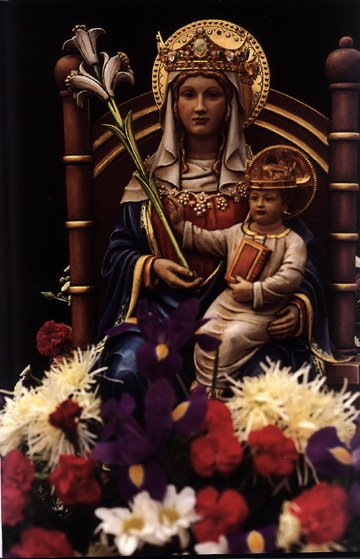


    Pilgrimage to the Land Known as "Our Lady's Dowry"


    O England great cause thou hast glad for to be
    Compared to the land of promise Sion
    To be called in every realm and region
    The Holy Land, Our Lady's Dowry ...


    Five years ago today - on the Feast of Our Lady of Walsingham, I was on pilgrimmage to the Shrine of Our Lady of Walsingham in the picturesque village of Little Walsingham in Norfolk, East Anglia, England.

    The Blessed Virgin Mary, under her title of Our Lady of Walsingham is the patroness of England (as well as the Anderson household).


    Historical Background

    Walsingham has been a place of pilgrimage since medieval times. At one time, it was ranked among the 3 most important pilgrimage sites in Europe, along with Santiago de Compostela and Rome.

    The original Shrine of Our Lady of Walsingham was founded in 1061 by Richeldis de Faverches, who was taken in spirit to Nazareth and asked by Our Lady to build a replica, in Norfolk, of the Holy House of the Annunciation. The Shrine of the Holy House stood for almost 500 years as a place of devotion to the Holy Virgin Mother of God and the Incarnation of Her Son, before it was destroyed by Henry VIII at the Reformation.
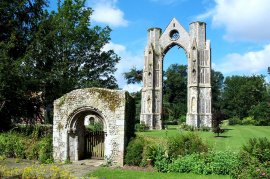
    "Many barren years passed until the Slipper Chapel, a 14th century wayside pilgrim chapel just outside the village of Little Walsingham, was restored and pilgrimage to Walsingham in honor of Our Blessed Lady began once more." Originally dedicated to St. Catherine of Alexandria, this wayside chapel had served medieval pilgrims on their way to England's Nazareth. Just as on Mount Sinai Moses took off his shoes because he was on holy ground, so pilgrims used to remove their shoes at the Slipper Chapel (hence, its name) and walk the Holy Mile into Walsingham barefoot.

    In 1934, the English Bishops named the Slipper Chapel the Roman Catholic National Shrine of Our Lady. The Slipper Chapel's first Mass since the Reformation was celebrated there on August 15, 1934, and on September 8, 1938, the Shrine was re-consecrated by the local Bishop.

    The most important image in the Chapel is the Statue of Our Lady of Walsingham.


    From the Women for Faith & Family website:
    Our Lady of Walsingham

    by Raven Wenner
    Our Lady of Walsingham Church
    Houston Texas


    In AD 2000, The Holy Father John Paul II decreed that the feast of Our Lady of Walsingham, mediaeval patroness of England, and in modern times patroness of all English-speaking peoples, is now celebrated on September 24th in England. It is a solemnity for all parishes in any part of the world named for Our Lady under this title.

    Our Lady of Walsingham was formerly celebrated on March 25th, "Lady Day" (Feast of the Annunciation), but for ecumenical considerations was moved to September 24th. (September 24 in England had been the feast of Our Lady of Ransom, who was entreated for the re-conversion of England, "Our Lady's Dowery".

    The feast of Our Lady of Walsingham was celebrated for the first time on the new date in 2001. The feast of the Annunciation is increasingly celebrated as a pro-life feast, considering children in the womb; Our Lady of Walsingham's feast asks us to contemplate the joy of the Incarnation in the simple family life of the Holy Family at Nazareth. The new date and emphasis on this feast is timely considering how family life is under attack in Western culture.


    ----------------------------------------------------------------------------

    Our Lady of Walsingham

    by Joanna Bogle
    Voices' Contributing Editor


    Walsingham is England’s national shrine to Our Lady, and a major place of pilgrimage and prayer. It is in Norfolk, a few miles from the North Sea, and is a small village set in the green countryside characteristic of this corner of Britain. The shrine dates back to the 12th century, when the local lady of the manor, Richeldis, had a vision of the Holy House – the home of the Holy family at Nazareth – on this spot. For centuries, pilgrims visited here and Our Lady of Walsingham was honoured with countless processions and prayers. Springs of water – they still exist today – were said to have healing powers. A great priory drew men who devoted themselves to the religious life. At the shrine itself, the image was always surrounded by candles, flowers, and gifts left by grateful pilgrims who had knelt there in prayer.

    In the early 16th century, among those who came were the young king Henry, and his wife Catherine. They were praying that God would grant them a son. England had seen terrifying wars in an earlier generation as the houses of Lancaster and York battled out their struggle for supremacy, and now stability was needed for the new ruling house of Tudor. It was not to be. Catherine bore several children, but all died in infancy except one daughter, Mary. Henry, angry and disappointed, decided to marry his mistress Anne Boleyn. He sought an annulment of his marriage through the Church, but failed to obtain it. Divorcing Catherine unilaterally, he married Anne – who by then was carrying his child – and announced himself head of the Church. The Lord Chancellor, Thomas More, and the Bishop of Rochester, John Fisher, were beheaded at the Tower of London in 1534 for refusing to affirm him in his claims, maintaining instead that only the Pope, the successor of Saint Peter, could hold that office. . Needing funds, Henry turned on the Church and crushed monasteries and priories. On the excuse of its being idolatrous, the shrine at Walsingham was destroyed and the statue burned. For some 400 years, there were no more pilgrimages, processions, or signs of devotion to Mary in this quiet village.

    The shrine was revived in the early 20th century – an Anglican vicar researched the history and re-created the Holy House in a new shrine, and a Catholic lady obtained the old “Slipper Chapel” just outside the village and this became the revived Catholic centre of devotion. Today, there are pilgrimages throughout the summer and the Catholic shrine has its own large church built of attractive local stone. Pilgrims pray and sing as they walk the “Holy Mile” – traditionally barefoot – from the village. Schools, parish groups, Catholic organisations – all come with their banners and their choirs, their sandwiches and their children, to greet Our Lady at a place which combines the pleasures of unusually beautiful countryside with an atmosphere of real devotion and joy. Some groups stay for days – a local farmer rents out fields in which large groups of young pilgrims and families can camp – and in recent years Walsingham has seen a revival of Eucharistic adoration and confession, promoted by “Youth 2000”, a major initiative of the “John Paul 11 generation”.

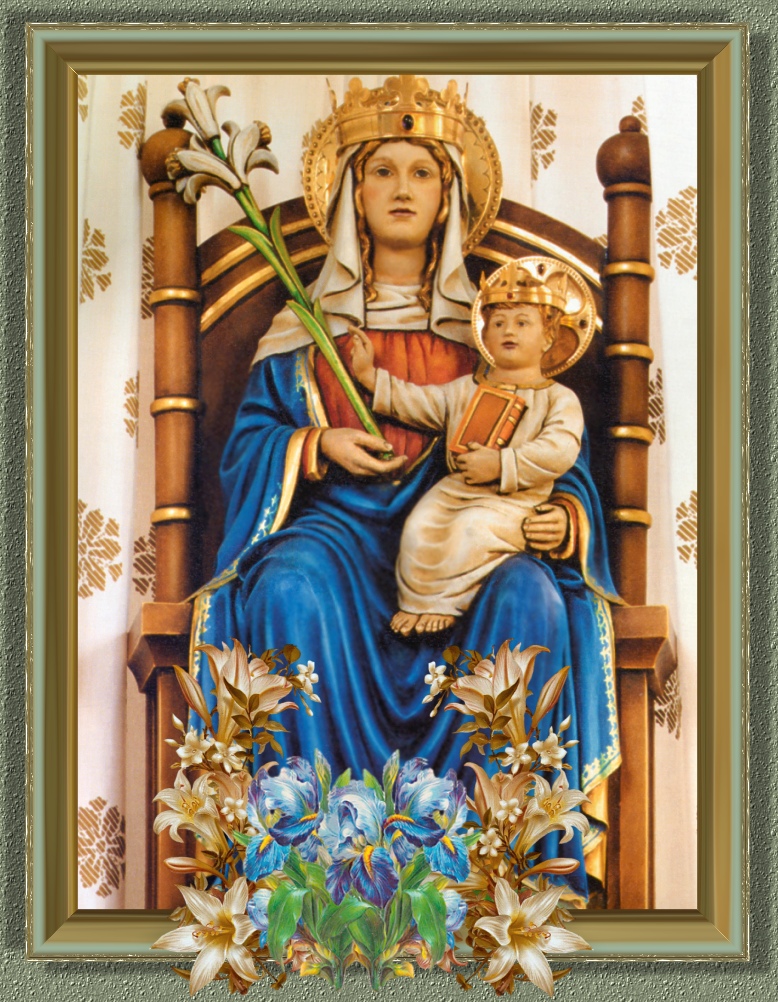
    When Pope John Paul visited Britain in 1982 the image of Our Lady of Walsingham was brought to London where it was the centrepiece of a major rally attended by the Holy Father. Many Catholic families, churches and schools, have copies of the image: it is an unusual one in which Mary is seen seated, as a dignified queen wearing a simple Saxon-style crown and carrying the Christ-child seated upright on her lap. Honour to Our Lady of Walsingham is linked to prayer that the people of England may once again return to the practice of the Catholic Faith: Our Lady of Walsinghan, pray for us!

    From the September 2007 issue of the Walsingham Newletter:
    ... The message of Walsingham, from the very beginning, has been the message of the Incarnation. "The Word was made Flesh and dwelt amongst us." Pilgrimage is a great way of expressing the idea that God came to share our human life, it is a sign that we are journeying ever closer to God and in this way it is sacramental. It reminds us that we can meet God in our everyday lives and not only in church. Mary, who attended to the human needs of her Son and walked with him on his journey from Galilee to Jerusalem and the cross, will join us on our journey. In relating Mary to the Eucharist Pope Benedict finishes by saying "She is the Immaculata, who receives God's gift unconditionally and is thus associated with his work of salvation. Mary of Nazareth, icon of the nascent Church, is the model for each of us, called to receive the gift that Jesus makes of himself in the Eucharist."

    ~ Noel Wynn S.M.

    From the Medieval Saints Yahoo Group:
    Feast of Our Lady of Walsingham

    Also known as Virgin by the Sea, site also known as England's Nazareth

    Shrine established in 1061, priory in 1150

    Commemorated September 24

    "Let all who are in any way distressed or in need seek me there in that small house that you maintain for me at Walsingham. To all that seek me there shall be given succour."

    Until the martyrdom of St. Thomas a Becket at Canterbury in 1170, Walsingham was England's most celebrated and visited shrine. Many miracles were attributed to Our Lady of Walsingham, including one in which Kind Edward I was saved from a piece of falling masonry. There constructed shrine was recently voted England's favourite spiritual place in a poll of BBC Radio 4 listeners.


    Our Lady of Walsingham
    http://www.catholic-forum.com/saints/mary0018.htm

    In 1061 Lady Richeldis de Faverches, lady of the manor near the village of Walsingham, Norfolk, England, was taken in spirit to Nazareth. There Our Lady asked her to build a replica, in Norfolk, of the Holy House where she had been born, grew up, and received the Annunciation of Christ's impending birth. She immediately did, constructing a house 23'6" by 12'10" according to the plan given her. Its fame slowly spread, and in 1150 a group of Augustinian Canons built a priory beside it. Its fame continued to grow, and for centuries it was a point of pilgrimage for all classes, the recipient of many expensive gifts.

    In 1534 Walsingham became one of the first houses to sign the Oath of Supremacy, recognizing Henry VIII as head of the Church in England. Dissenters were executed, and in 1538 the House was stripped of its valuables, its statue of the Virgin taken to London to be burned, its buildings used as farm sheds for the next three centuries.

    In 1896 Charlotte Boyd purchased the Slipper Chapel and donated it to Downside Abbey. In 1897 Pope Leo XIII re-founded the ancient shrine of Our Lady of Walsingham, and pilgrimages are permitted to resume. The statue of Our Lady is enshrined in 1922 beginning an era of cooperation at the shrine between Catholics and Anglicans. In 1981 construction began on the Chapel of Reconciliation, a cooperative effort between the two confessions, and located near the shrine. The feast of Our Lady of Walsingham was reinstated in 2000.


    -----------------

    Walsingham Priory
    http://www.newadvent.org/cathen/15543a.htm

    Walsingham Priory stood a few miles from the sea in the northern part of Norfolk, England. Founded in the time of Edward the Confessor, the chapel of Our Lady of Walsingham was confirmed to the Augustinian Canons a century later and enclosed within the priory. From the first this shrine of Our Lady was a famous place of pilgrimage. Hither came the faithful from all parts of England and from the continent until the destruction of the priory by Henry VIII in 1538. To this day the main road of the pilgrims through Newmarket, Brandon, and Fakenham is still called the Palmers' Way.

    Many were the gifts of lands, rents, and churches to the canons of Walsingham, and many the miracles wrought at Our Lady's shrine. Henry III came on a pilgrimage to Walsingham in 1241, Edward I in 1280 and 1296, Edward II in 1315, Henry VI in 1455, Henry VII in 1487, and Henry VIII in 1513. Erasmus in fulfilment of a vow made a pilgrimage from Cambridge in 1511, and left as his offering a set of Greek verses expressive of his piety. Thirteen years later he wrote his colloquy on pilgrimages, wherein the wealth and magnificence of Walsingham are set forth, and some of the reputed miracles rationalized.

    In 1537 while the last prior, Richard Vowell, was paying obsequious respect to Cromwell, the sub-prior Nicholas Milcham was charged with conspiring to rebel against the suppression of the lesser monasteries, and on flimsy evidence was convicted of high treason and hanged outside the priory walls. In July, 1538, Prior Vowell assented to the destruction of Walsingham Priory and assisted the king's commissioners in the removal of the figure of Our Lady, of many of the gold and silver ornaments and in the general spoliation of the shrine. For his ready compliance the prior received a pension of 100 pounds a year, a large sum in those days, while fifteen of the canons received pensions varying from 4 pounds to 6 pounds. The shrine dismantled, and the priory destroyed, its site was sold by order of Henry VIII to one Thomas Sidney for 90 pounds, and a private mansion was subsequently erected on the spot.

    The Elizabethan ballad, "A Lament for Walsingham," expresses something of what the Norfolk people felt at the loss of their glorious shrine of Our Lady of Walsingham.

    ------------------

    More on Our Lady of Walsingham at:http://www.udayton.edu/mary/resources/walsh.html
    http://www.walsingham-church.org/
    http://www.walsingham.org.uk/

    The Prayer of the Feast: Lord God, in the mystery of the Incarnation, Mary conceived your Son in her heart before she conceived Him in her womb. As we, your pilgrim people, rejoice in her patronage, grant that we also may welcome Him into our hearts, and so, like her, be made a holy house fit for His eternal dwelling. We ask this through Our Lord Jesus Christ, your Son, who lives and reigns with you in the unity of the Holy Spirit, one God for ever and ever. Amen.


    Our Lady of Walsingham,
    pray for us.


    Links:Official Shrine Site
    The Virgin by the Sea; Our Lady of Walsingham (University of Dayton)
    Patron Saints Index: Our Lady of Walsingham
    Our Lady of Walsingham (MaryPages.com)
    Our Lady of Walsingham Catholic Church (Anglican Use) - Houston, TX
    Orthodox Christian Society of Our Lady of Walsingham
    Fr. Finigan's Walsingham posts at The Hermeneutic of Continuity
    (NB: I happened to meet Fr. Finigan while on my pilgrimage 5 years ago, although at the time I didn't know who he was. It was only later, after he started his blog and I saw his photo, that I recognized him as the priest with whom I had shared a laugh over Cardinal Ratzinger having put "the smackdown on heresy" and his recent election as Pope meaning that "the cafeteria is now closed".)


    Previous Pro Ecclesia posts on this subject:
    The Wrecks of Walsingham
    Novena in Honor of Our Lady of Walsingham - Day 1
    Novena in Honor of Our Lady of Walsingham - Day 2
    Novena in Honor of Our Lady of Walsingham - Day 3
    Novena in Honor of Our Lady of Walsingham - Day 4
    Novena in Honor of Our Lady of Walsingham - Day 5
    Novena in Honor of Our Lady of Walsingham - Day 6
    Novena in Honor of Our Lady of Walsingham - Day 7
    Novena in Honor of Our Lady of Walsingham - Day 8

    Novena in Honor of Our Lady of Walsingham - Day 9
    National Catholic Register on "Our Lady's England"

    London: Plans Unveiled for Memorial to Pre-Reformation Shrines [UPDATED]

    EWTN Documentary 2008 - "Walsingham: England's Nazareth"

    A Memorial in Chelsea to the Marian Shrines Destroyed in the English Reformation

    Fr. Finigan's Day Trip to Walsingham

    Feast of Our Lady of Walsingham - 24 September

    Our Sacred Spaces
    Catholic Cultural Heritage Images - Recta Ratio Features Shrine of Our Lady of Walsingham
    A Couple More Walsingham-Related Posts By Fr. Finigan at The Hermeneutic of Continuity
    "Sinne is Where Our Ladye Sate"
    Morris Dancing at Walsingham
    Our Lady of Walsingham - 24 September
    Photos, Postcards, and Mementos of My 2005 Pilgrimage to Walsingham
    Some Walsingham Pilgrims Causing Consternation for Residents of Medieval Village
    Impressions of England

    Pilgrimage to the Shrine of Our Lady of Walsingham in Norfolk, England

    Labels: , , , , , , ,

    hit counter for blogger