Friday, April 01, 2011

Our Lady of Walsingham - 950th Anniversary [UPDATED]


Stephanie Mann of the excellent English-Reformation-themed blog Supremacy and Survival reports that the 950th anniversary of the Shrine of Our Lady of Walsingham is being commemorated this year.

Stephanie links to a blog post by John Whitehead on the same topic, in which he describes the Mass he attended at Westminster Cathedral that kicks off 6 months of celebration leading up to the feast day of Our Lady of Walsingham on September 24.

Our Lady of Walsingham is the patroness of our family's household, and I have written extensively on the subject at this blog (including describing my pilgrimage to the Shrine for the feast of Our Lady of Walsingham 5-and-a-half years ago), and will be blogging on the topic even more this year during the 950th anniversary celebration. For my past writing on the topic, just click on the "Walsingham" label below.

UPDATE More information on the 950th can be found at the Shrine's website, including a brochure of events and activities commemorating the anniversary.

Labels: , , , , , , ,

Friday, September 24, 2010

John Dowland: "As I Went to Walsingham"


Labels: , , , , , , ,

The Walsingham Ballads, Part 3: The Arundel Ballad ("The Wrecks of Walsingham")


In the wrackes of Walsingam
Whom should I chuse
But the Queene of Walsingam
To be guide to my muse?

Then, thou Prince of Walsingam
Graunt me to frame
Bitter plaintes to rewe thy wronge
Bitter wo for thy name.

Bitter was it, oh to see
The sely sheepe
Murdred by the raveninge wolves
While the sheepharde did sleep.

Bitter was it, oh, to viewe
The sacred vyne
Whiles the gardiners plaied all close
Rooted up by the swine.

Bitter, bitter oh to behoulde
The grasse to growe
Where the walles of Walsingam
So stately did shewe.

Such were the worth of Walsingam
While she did stand
Such are the wrackes as now do shewe
Of that (so) holy lande.

Levell, levell with the ground
The Towres doe lye
Which with their golden, glitt'ring tops
Pearsed oute to the skye.

Where weare gates noe gates are nowe,
The waies unknowen,
Where the presse of freares did passe
While her fame far was blowen.

Oules do scrike where the sweetest himnes
Lately wear songe,
Toades and serpents hold their dennes
Where the palmers did throng.

Weep, weep O Walsingam,
Whose dayes are nightes,
Blessings turned to blasphemies,
Holy deedes to dispites.

Sinne is where our Ladye sate,
Heaven turned is to helle;
Sathan sitte where our Lord did swaye,
Walsingam, oh, farewell!

Labels: , , , , , , ,

The Walsingham Ballads, Part 2: The Ralegh Ballad


As you came from the holy land
Of Walsinghame,
Met you not with my true love
By the way as you came ?

How shall I know your true love,
That have met many one,
As I went to the holy land,
That have come, that have gone ?

She is neither white nor brown,
But as the heavens fair ;
There is none hath a form so divine
In the earth or the air.

Such a one did I meet, good sir,
Such an angelic face,
Who like a queen, like a nymph, did appear,
By her gait, by her grace.

She hath left me here all alone,
All alone, as unknown,
Who sometimes did me lead with herself,
And me loved as her own.

What's the cause that she leaves you alone,
And a new way doth take,
Who loved you once as her own,
And her joy did you make ?

I have loved her all my youth,
But now old, as you see,
Love likes not the falling fruit
From the withered tree.

Know that Love is a careless child,
And forgets promise past ;
He is blind, he is deaf when he list,
And in faith never fast.

His desire is a dureless content,
And a trustless joy ;
He is won with a world of despair,
And is lost with a toy.

Of womankind such indeed is the love,
Or the word love abusèd,
Under which many childish desires
And conceits are excusèd.

But true love is a durable fire,
In the mind ever burning,
Never sick, never old, never dead,
From itself never turning.

Labels: , , , , , , ,

The Walsingham Ballads, Part 1: The Pynson Ballad


Of this chapell se here the fundacyon,
Bylded the yere of crystes incarnacyon,
A thousande complete syxty and one,
The tyme of sent Edward kyng of this region.

Beholde and se, ye goostly folkes all,
Which to this place have devocyon
When ye to Our Lady askynge socoure call
Desyrynge here hir helpe in your trybulacyon:
Of this hir chapell ye may se the fundacyon.
If ye wyll this table overse and rede
Howe by myracle it was founded indede.

A noble wydowe, somtyme lady of this towne,
Called Rychold, in lyvynge full vertuous,
Desyred of Oure Lady a petycyowne
Hir to honoure with some werke bountyous,
This blyssed Virgyn and Lady most gracyous
Graunted hir petycyon, as I shall after tell,
Unto hir worschyp to edefye this chapell.

In spyryte Our Lady to Nazareth hir led
And shewed hir the place where Gabryel hir grette:
"Lo doughter, consyder" to hir Oure Lady sayde,
" Of thys place take thou suerly the mette,
Another lyke thys at Walsyngham thou sette
Unto my laude and synguler honoure;
All that me seke there shall fynde socoure,

Where shall be hadde in a memoryall
The great joy of my salutacyon.
Fyrste of my joys grounde and orygynall
Rote of mankyndes gracious redempcyon,
When Gabryell gave to me relacyon
To be a moder through humylyte.
And goddys sonne conceyve in virgynyte"

This visyon shewed thryse to this devout woman.
In mynde well she marked both length and brede;
She was full gladde and thanked Oure Lady than
Of hir great grace never destytute in nede.
This forsayd hous in haste she thought to spede,
Called to hir artyfycers full wyse,
This chapell to forge as Our Lady dyd devyse.

All this, a medewe wete with dropes celestyall
And with sylver dewe sent from hye adowne
Excepte tho tweyne places chosen above all
Where neyther moyster ne dewe myght be fowne.
This was the fyrste pronostycacyowne
Howe this our newe Nazareth here shold stande,
Bylded lyke the fyrste in the Holy Lande.

Whan it was al fourmed, than had she great doute
Where it shold be sette and in what maner place,
Inasmoche as tweyne places were founde oute
Tokened with myracle of Our Ladyes grace;
That is to say, tweyne quadrates of egall space
As the flees of Gedeon in the wete beynge drye,
Assygned by myracle of holy mayde Marye.

The wydowe thought it most lykly of congruence
This house on the fyrste soyle to bylde and arere.
Of this who lyste to have experyence,
A chapell of saynt Laurence standeth nowe there
Faste by tweyne wells, experyence doth thus lere,
There she thought to have set this chapell
Which was begonne by Our Ladyes counsell.

The carpenters began to set the fundamente
This hevenly house to arere up on hye,
But sone their werkes shewed inconvenyente.
For no pece with oder wolde agre with geometrye;
Than were they all sory and full of agonye
That they could nat ken neither mesure ne marke
To ioyne togyder their owne proper werke.

They went to reste and layde all thynge on syde,
As they on their maystresse had a commaundement;
She thought Our Lady, that fyrste was hir gyde,
Wold convey this worke aftyr hir owne entent;
Hir meyny to reste as for that nyght she sente
And prayed Our Lady with devoute exclamacyon,
And as she had begonne, to perfowrme that habytacion.

All nyghte the wydowe remayninge in this prayer,
Oure blyssed Lady, with hevenly mynystrys,
Hirsylfe beynge here chyef artyfycer,
Arerid this sayd house with aungellys handys,
And nat only reyrd it but set it there it is,
That is, two hundred fote and more in dystaunce
From the fyrste place bokes make remembraunce.

Erly whan the artyfycers cam to their travayle
Of this sayd chapell to have made an ende,
They founde eche parte conjoyned sauns fayle
Better than they coude conceyve it in mynde;
Thus eche man home agayne dyd wynde,
And this holy matrone thanked Oure Lady
Of hir great grace shewyd here specyally.

And syth here Our Lady hath shewyd many myracle
Innumerable, nowe here for to expresse
To suche as visyte thys hir habytacle.
Ever lyke newe to them that call hir in dystrsse.
Foure hundreth yere and more the cronacle to witnes
Hath endured this notable pylgrymage,
Where grace is dayly shewyd to men of every age.

Many seke ben here cured by Our Ladyes myghte
Dede agayne revyved, of this is no dought,
Lame made hole and blynde restored to syghte,
Maryners vexed with tempest safe to porte brought
Defe, wounded and lunatyke that hyder have sought
And also lepers here recovered have be
By Oure Ladyes grace of their infyrmyte.

Folke that of fendys have had acombraunce
And of wycked spyrytes also moche vexacyon
Have here be delyvered from every such chaunce,
And soules greatly vexed with gostely temptacion,
Lo. here the chyef solace agaynst all tribulacyon
To all that be seke, bodely or goostly,
Callynge to Oure Lady devoutly.

Therfore every pylgryme gyve your attendaunce
Our Lady here to serve with humble affeccyon.
Your sylfe ye applye to do hir plesaunce.
Remembrynge the great joye of hir Annunciacion.
Therwyth concevynge this brief complacyon.
Though it halte in meter and eloquence.
It is here wryten to do hyr reverence.

All lettred that wyll have more intellygence
Of the fundacyon of this chapell here,
If you wyll aske bokes shall you encence
More clerely to undersclnde this forsayd matere;
To you shall declare the cronyclere
All cyrcumstaunce by a noble processe
Howe olde cronyclers of thys bere wytnesse.

O Englonde, great cause thou haste glad for to be,
Compared to the londe of promys syon,
Thou atteynest my grace to stande in that degre
Through this gloryous Ladyes supportacyon,
To be called in every realme and regyon
The holy lande, Oure Ladyes dowre;
Thus arte thou named of olde antyquyte.

And this is the cause, as it apereth by lyklynesse,
In the is belded newe Nazareth, a mancyon
To the honoure of the hevenly empresse
And of hir moste gloryous salutacyon,
Chyef pryncypyll and grounde of oure salvacyon,
Whan Gabryell sayd at olde Nazereth 'Ave',
This joy here dayly remembred for to be.

O gracyous Lady, glory of Jerusalem,
Cypresse of Syon and Joye of Israel,
Rose of Jeryco and Sterre of Bethleem,
O gloryous Lady, our askynge nat repell,
In mercy all wymen ever thou doste excell,
Therfore, blissed Lady, graunt thou thy great grace
To all that the devoutly visyte in this place.


Labels: , , , , , , ,

Feast of Our Lady of Walsingham - 24 September

[Originally posted on 24 September 2006, and updated on 24 September 2007, 24 September 2008, and 24 September 2010]
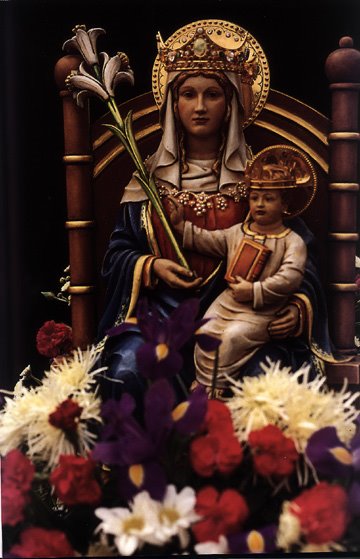


Pilgrimage to the Land Known as "Our Lady's Dowry"


O England great cause thou hast glad for to be
Compared to the land of promise Sion
To be called in every realm and region
The Holy Land, Our Lady's Dowry ...


Five years ago today - on the Feast of Our Lady of Walsingham, I was on pilgrimmage to the Shrine of Our Lady of Walsingham in the picturesque village of Little Walsingham in Norfolk, East Anglia, England.

The Blessed Virgin Mary, under her title of Our Lady of Walsingham is the patroness of England (as well as the Anderson household).


Historical Background

Walsingham has been a place of pilgrimage since medieval times. At one time, it was ranked among the 3 most important pilgrimage sites in Europe, along with Santiago de Compostela and Rome.

The original Shrine of Our Lady of Walsingham was founded in 1061 by Richeldis de Faverches, who was taken in spirit to Nazareth and asked by Our Lady to build a replica, in Norfolk, of the Holy House of the Annunciation. The Shrine of the Holy House stood for almost 500 years as a place of devotion to the Holy Virgin Mother of God and the Incarnation of Her Son, before it was destroyed by Henry VIII at the Reformation.
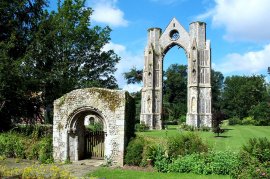
"Many barren years passed until the Slipper Chapel, a 14th century wayside pilgrim chapel just outside the village of Little Walsingham, was restored and pilgrimage to Walsingham in honor of Our Blessed Lady began once more." Originally dedicated to St. Catherine of Alexandria, this wayside chapel had served medieval pilgrims on their way to England's Nazareth. Just as on Mount Sinai Moses took off his shoes because he was on holy ground, so pilgrims used to remove their shoes at the Slipper Chapel (hence, its name) and walk the Holy Mile into Walsingham barefoot.

In 1934, the English Bishops named the Slipper Chapel the Roman Catholic National Shrine of Our Lady. The Slipper Chapel's first Mass since the Reformation was celebrated there on August 15, 1934, and on September 8, 1938, the Shrine was re-consecrated by the local Bishop.

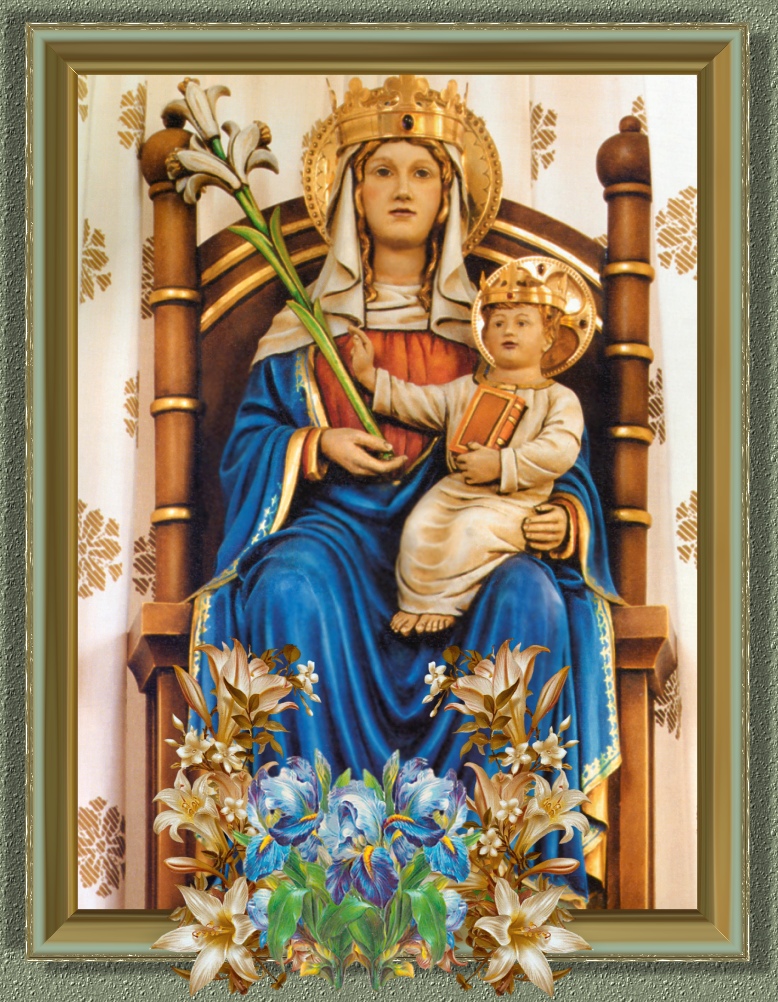
The most important image in the Chapel is the Statue of Our Lady of Walsingham.


From the Women for Faith & Family website:
Our Lady of Walsingham

by Raven Wenner
Our Lady of Walsingham Church
Houston Texas


In AD 2000, The Holy Father John Paul II decreed that the feast of Our Lady of Walsingham, mediaeval patroness of England, and in modern times patroness of all English-speaking peoples, is now celebrated on September 24th in England. It is a solemnity for all parishes in any part of the world named for Our Lady under this title.

Our Lady of Walsingham was formerly celebrated on March 25th, "Lady Day" (Feast of the Annunciation), but for ecumenical considerations was moved to September 24th. (September 24 in England had been the feast of Our Lady of Ransom, who was entreated for the re-conversion of England, "Our Lady's Dowery".

The feast of Our Lady of Walsingham was celebrated for the first time on the new date in 2001. The feast of the Annunciation is increasingly celebrated as a pro-life feast, considering children in the womb; Our Lady of Walsingham's feast asks us to contemplate the joy of the Incarnation in the simple family life of the Holy Family at Nazareth. The new date and emphasis on this feast is timely considering how family life is under attack in Western culture.


----------------------------------------------------------------------------

Our Lady of Walsingham

by Joanna Bogle
Voices' Contributing Editor


Walsingham is England’s national shrine to Our Lady, and a major place of pilgrimage and prayer. It is in Norfolk, a few miles from the North Sea, and is a small village set in the green countryside characteristic of this corner of Britain. The shrine dates back to the 12th century, when the local lady of the manor, Richeldis, had a vision of the Holy House – the home of the Holy family at Nazareth – on this spot. For centuries, pilgrims visited here and Our Lady of Walsingham was honoured with countless processions and prayers. Springs of water – they still exist today – were said to have healing powers. A great priory drew men who devoted themselves to the religious life. At the shrine itself, the image was always surrounded by candles, flowers, and gifts left by grateful pilgrims who had knelt there in prayer.

In the early 16th century, among those who came were the young king Henry, and his wife Catherine. They were praying that God would grant them a son. England had seen terrifying wars in an earlier generation as the houses of Lancaster and York battled out their struggle for supremacy, and now stability was needed for the new ruling house of Tudor. It was not to be. Catherine bore several children, but all died in infancy except one daughter, Mary. Henry, angry and disappointed, decided to marry his mistress Anne Boleyn. He sought an annulment of his marriage through the Church, but failed to obtain it. Divorcing Catherine unilaterally, he married Anne – who by then was carrying his child – and announced himself head of the Church. The Lord Chancellor, Thomas More, and the Bishop of Rochester, John Fisher, were beheaded at the Tower of London in 1534 for refusing to affirm him in his claims, maintaining instead that only the Pope, the successor of Saint Peter, could hold that office. . Needing funds, Henry turned on the Church and crushed monasteries and priories. On the excuse of its being idolatrous, the shrine at Walsingham was destroyed and the statue burned. For some 400 years, there were no more pilgrimages, processions, or signs of devotion to Mary in this quiet village.

The shrine was revived in the early 20th century – an Anglican vicar researched the history and re-created the Holy House in a new shrine, and a Catholic lady obtained the old “Slipper Chapel” just outside the village and this became the revived Catholic centre of devotion. Today, there are pilgrimages throughout the summer and the Catholic shrine has its own large church built of attractive local stone. Pilgrims pray and sing as they walk the “Holy Mile” – traditionally barefoot – from the village. Schools, parish groups, Catholic organisations – all come with their banners and their choirs, their sandwiches and their children, to greet Our Lady at a place which combines the pleasures of unusually beautiful countryside with an atmosphere of real devotion and joy. Some groups stay for days – a local farmer rents out fields in which large groups of young pilgrims and families can camp – and in recent years Walsingham has seen a revival of Eucharistic adoration and confession, promoted by “Youth 2000”, a major initiative of the “John Paul 11 generation”.

When Pope John Paul visited Britain in 1982 the image of Our Lady of Walsingham was brought to London where it was the centrepiece of a major rally attended by the Holy Father. Many Catholic families, churches and schools, have copies of the image: it is an unusual one in which Mary is seen seated, as a dignified queen wearing a simple Saxon-style crown and carrying the Christ-child seated upright on her lap. Honour to Our Lady of Walsingham is linked to prayer that the people of England may once again return to the practice of the Catholic Faith: Our Lady of Walsinghan, pray for us!

From the September 2007 issue of the Walsingham Newletter:
... The message of Walsingham, from the very beginning, has been the message of the Incarnation. "The Word was made Flesh and dwelt amongst us." Pilgrimage is a great way of expressing the idea that God came to share our human life, it is a sign that we are journeying ever closer to God and in this way it is sacramental. It reminds us that we can meet God in our everyday lives and not only in church. Mary, who attended to the human needs of her Son and walked with him on his journey from Galilee to Jerusalem and the cross, will join us on our journey. In relating Mary to the Eucharist Pope Benedict finishes by saying "She is the Immaculata, who receives God's gift unconditionally and is thus associated with his work of salvation. Mary of Nazareth, icon of the nascent Church, is the model for each of us, called to receive the gift that Jesus makes of himself in the Eucharist."

~ Noel Wynn S.M.

From the Medieval Saints Yahoo Group:
Feast of Our Lady of Walsingham

Also known as Virgin by the Sea, site also known as England's Nazareth

Shrine established in 1061, priory in 1150

Commemorated September 24

"Let all who are in any way distressed or in need seek me there in that small house that you maintain for me at Walsingham. To all that seek me there shall be given succour."

Until the martyrdom of St. Thomas a Becket at Canterbury in 1170, Walsingham was England's most celebrated and visited shrine. Many miracles were attributed to Our Lady of Walsingham, including one in which Kind Edward I was saved from a piece of falling masonry. There constructed shrine was recently voted England's favourite spiritual place in a poll of BBC Radio 4 listeners.


Our Lady of Walsingham
http://www.catholic-forum.com/saints/mary0018.htm

In 1061 Lady Richeldis de Faverches, lady of the manor near the village of Walsingham, Norfolk, England, was taken in spirit to Nazareth. There Our Lady asked her to build a replica, in Norfolk, of the Holy House where she had been born, grew up, and received the Annunciation of Christ's impending birth. She immediately did, constructing a house 23'6" by 12'10" according to the plan given her. Its fame slowly spread, and in 1150 a group of Augustinian Canons built a priory beside it. Its fame continued to grow, and for centuries it was a point of pilgrimage for all classes, the recipient of many expensive gifts.

In 1534 Walsingham became one of the first houses to sign the Oath of Supremacy, recognizing Henry VIII as head of the Church in England. Dissenters were executed, and in 1538 the House was stripped of its valuables, its statue of the Virgin taken to London to be burned, its buildings used as farm sheds for the next three centuries.

In 1896 Charlotte Boyd purchased the Slipper Chapel and donated it to Downside Abbey. In 1897 Pope Leo XIII re-founded the ancient shrine of Our Lady of Walsingham, and pilgrimages are permitted to resume. The statue of Our Lady is enshrined in 1922 beginning an era of cooperation at the shrine between Catholics and Anglicans. In 1981 construction began on the Chapel of Reconciliation, a cooperative effort between the two confessions, and located near the shrine. The feast of Our Lady of Walsingham was reinstated in 2000.


-----------------

Walsingham Priory
http://www.newadvent.org/cathen/15543a.htm

Walsingham Priory stood a few miles from the sea in the northern part of Norfolk, England. Founded in the time of Edward the Confessor, the chapel of Our Lady of Walsingham was confirmed to the Augustinian Canons a century later and enclosed within the priory. From the first this shrine of Our Lady was a famous place of pilgrimage. Hither came the faithful from all parts of England and from the continent until the destruction of the priory by Henry VIII in 1538. To this day the main road of the pilgrims through Newmarket, Brandon, and Fakenham is still called the Palmers' Way.

Many were the gifts of lands, rents, and churches to the canons of Walsingham, and many the miracles wrought at Our Lady's shrine. Henry III came on a pilgrimage to Walsingham in 1241, Edward I in 1280 and 1296, Edward II in 1315, Henry VI in 1455, Henry VII in 1487, and Henry VIII in 1513. Erasmus in fulfilment of a vow made a pilgrimage from Cambridge in 1511, and left as his offering a set of Greek verses expressive of his piety. Thirteen years later he wrote his colloquy on pilgrimages, wherein the wealth and magnificence of Walsingham are set forth, and some of the reputed miracles rationalized.

In 1537 while the last prior, Richard Vowell, was paying obsequious respect to Cromwell, the sub-prior Nicholas Milcham was charged with conspiring to rebel against the suppression of the lesser monasteries, and on flimsy evidence was convicted of high treason and hanged outside the priory walls. In July, 1538, Prior Vowell assented to the destruction of Walsingham Priory and assisted the king's commissioners in the removal of the figure of Our Lady, of many of the gold and silver ornaments and in the general spoliation of the shrine. For his ready compliance the prior received a pension of 100 pounds a year, a large sum in those days, while fifteen of the canons received pensions varying from 4 pounds to 6 pounds. The shrine dismantled, and the priory destroyed, its site was sold by order of Henry VIII to one Thomas Sidney for 90 pounds, and a private mansion was subsequently erected on the spot.

The Elizabethan ballad, "A Lament for Walsingham," expresses something of what the Norfolk people felt at the loss of their glorious shrine of Our Lady of Walsingham.

------------------

More on Our Lady of Walsingham at:http://www.udayton.edu/mary/resources/walsh.html
http://www.walsingham-church.org/
http://www.walsingham.org.uk/

The Prayer of the Feast: Lord God, in the mystery of the Incarnation, Mary conceived your Son in her heart before she conceived Him in her womb. As we, your pilgrim people, rejoice in her patronage, grant that we also may welcome Him into our hearts, and so, like her, be made a holy house fit for His eternal dwelling. We ask this through Our Lord Jesus Christ, your Son, who lives and reigns with you in the unity of the Holy Spirit, one God for ever and ever. Amen.


Our Lady of Walsingham,
pray for us.


Links:Official Shrine Site
The Virgin by the Sea; Our Lady of Walsingham (University of Dayton)
Patron Saints Index: Our Lady of Walsingham
Our Lady of Walsingham (MaryPages.com)
Our Lady of Walsingham Catholic Church (Anglican Use) - Houston, TX
Orthodox Christian Society of Our Lady of Walsingham
Fr. Finigan's Walsingham posts at The Hermeneutic of Continuity
(NB: I happened to meet Fr. Finigan while on my pilgrimage 5 years ago, although at the time I didn't know who he was. It was only later, after he started his blog and I saw his photo, that I recognized him as the priest with whom I had shared a laugh over Cardinal Ratzinger having put "the smackdown on heresy" and his recent election as Pope meaning that "the cafeteria is now closed".)


Previous Pro Ecclesia posts on this subject:
The Wrecks of Walsingham
Novena in Honor of Our Lady of Walsingham - Day 1
Novena in Honor of Our Lady of Walsingham - Day 2
Novena in Honor of Our Lady of Walsingham - Day 3
Novena in Honor of Our Lady of Walsingham - Day 4
Novena in Honor of Our Lady of Walsingham - Day 5
Novena in Honor of Our Lady of Walsingham - Day 6
Novena in Honor of Our Lady of Walsingham - Day 7
Novena in Honor of Our Lady of Walsingham - Day 8

Novena in Honor of Our Lady of Walsingham - Day 9
National Catholic Register on "Our Lady's England"

London: Plans Unveiled for Memorial to Pre-Reformation Shrines [UPDATED]

EWTN Documentary 2008 - "Walsingham: England's Nazareth"

A Memorial in Chelsea to the Marian Shrines Destroyed in the English Reformation

Fr. Finigan's Day Trip to Walsingham

Feast of Our Lady of Walsingham - 24 September

Our Sacred Spaces
Catholic Cultural Heritage Images - Recta Ratio Features Shrine of Our Lady of Walsingham
A Couple More Walsingham-Related Posts By Fr. Finigan at The Hermeneutic of Continuity
"Sinne is Where Our Ladye Sate"
Morris Dancing at Walsingham
Our Lady of Walsingham - 24 September
Photos, Postcards, and Mementos of My 2005 Pilgrimage to Walsingham
Some Walsingham Pilgrims Causing Consternation for Residents of Medieval Village
Impressions of England

Pilgrimage to the Shrine of Our Lady of Walsingham in Norfolk, England

Labels: , , , , , , ,

Thursday, September 23, 2010

Novena in Honor of Our Lady of Walsingham - Day 9

Today is the ninth day of the Novena in Honor of Our Lady of Walshingham.

Over the past 9 days, I have been praying the Novena, just as I did 5 years ago as I began my pilgrimmage to the Shrine of Our Lady of Walsingham. I invite you to pray with me during this time leading up to tomorrow's Feast of Our Lady of Walsingham.


Day 9: The Coronation of Our Lady

Intention: For the conversion of England, the Dowry of Mary, and the celebration of the Feast of Our Lady of Walsingham

Thoughts: "I confer a kingdom on you, just as my Father conferred one on me: you will eat and drink at my table in my kingdom, and you will sit on thrones to judge the twelve tribes of Israel" (Lk. 22:30). Thy kingdom come, thy will be done on earth, as it is in heaven. Let us pray for the conversion of England, that through the reconciling prayers of Our Lady of Walsingham it may once again be worthy of the title "The Dowry of Mary".

The Prayer of the Feast: Lord God, in the mystery of the Incarnation, Mary conceived your Son in her heart before she conceived Him in her womb. As we, your pilgrim people, rejoice in her patronage, grant that we also may welcome Him into our hearts, and so, like her, be made a holy house fit for His eternal dwelling. We ask this through Our Lord Jesus Christ, your Son, who lives and reigns with you in the unity of the Holy Spirit, one God for ever and ever. Amen.

A selection of daily prayers for the Novena:

The Angel of the Lord declared unto Mary.
And she conceived by the Holy Spirit.
Hail Mary ...
Behold the handmaid of the Lord.
Be it done unto me according to Thy Word.
Hail Mary ...
And the Word was made flesh,
And dwelt among us.
Hail Mary ...
Pray for us O holy Mother of God, that we may be made worthy of the promises of Christ.
Pour forth, we beseech thee, O Lord, thy grace into our hearts, that we, to whom the Incarnation of Christ thy Son was made known by the message of an angel, may by His Passion and Cross be brought to the glory of His Resurrection, by the same Christ our Lord. Amen. (The Angelus)


All holy and ever-living God, in giving us Jesus Christ to be our Savior and Brother, you gave us Mary, His Mother, to be our Mother also; grant us, we pray you, that we may be worthy of so great a Brother and so dear a Mother. May we come at last to You the Father of us all through Jesus Christ Your Son, who lives and reigns with You and the Holy Spirit for ever and ever. Amen. (Roman Catholic Pilgrim Handbook)

O God, our Father, through the Holy Spirit You prepared the body and soul of the glorious Virgin Mother, Mary, to be a fit dwelling place for Your Son. As we recall with joy her appearing at Walsingham, grant that through her motherly intercession we may be preserved from evil and given health of soul and body. This we ask through Christ our Lord. Amen.

O Mary, recall the solemn moment when Jesus, your Divine Son, dying on the cross, confided us to your maternal care. You are our Mother, we desire ever to remain your devout children. Let us therefore feel the effects of your powerful intercession with Jesus Christ. make your name again glorious in the place once renowned throughout England by your visits, favours and many miracles. Pray O holy Mother of God for the conversion of England, restoration of the sick, consolation for the afflicted, repentance of sinners, peace to the departed. O Blessed Mary, Mother of God, Our Lady of Walsingham, intercede for us. Amen. (Anglican Pilgrim Manual)

O Blessed Virgin Mary, Mother of God, and our most gentle Queen and Mother, look down in mercy upon England, thy Dowry, and upon us all who greatly hope and trust in thee. By thee, it was that Jesus, our Savior and our hope, was given unto the world; and he has given thee to us that we might hope still more. Plead for us thy children, whom thou didst receive and accept at the foot of the Cross, O sorrowful Mother, intercede for our separated brethren, that with us in the one true fold they may be united to the Chief Shepherd, the Vicar of thy Son. Pray for us all, dear Mother, that by faith, fruitful in good works, we may all deserve to see and praise God, together with thee in our heavenly home. Amen. (Prayer for England)

O gracious Lady, glory of Jerusalem, Cypress of Sion and Joy of Israel, Rose of Jericho and Star of Bethlehem, O gracious Lady, our asking do not repel, in mercy all women ever thou dost excel. Therefore, Blessed Lady, grant then thy great grace, to all that thee devoutly visit in this place. Amen. (15th century Prayer to Our Lady of Walsingham)

Our Lady of Walsingham, pray for us.

Previous Pro Ecclesia posts on this subject:
Novena in Honor of Our Lady of Walsingham - Day 1

Novena in Honor of Our Lady of Walsingham - Day 2

Novena in Honor of Our Lady of Walsingham - Day 3

Novena in Honor of Our Lady of Walsingham - Day 4

Novena in Honor of Our Lady of Walsingham - Day 5

Novena in Honor of Our Lady of Walsingham - Day 6

Novena in Honor of Our Lady of Walsingham - Day 7

Novena in Honor of Our Lady of Walsingham - Day 8

Labels: , , , , ,

Tuesday, February 02, 2010

Our Lady of Purity - 2 February

Today is Candlemas. On this day, the few remaining items of the Anderson family Christmas decorations (candles in the window, outside Christmas lights and wreaths, some greenery left on the inside walls) will come down.


The snowdrop, in purest white arraie, First rears her hedde on Candlemas daie.
~ From an early church calendar of English flowers, c. 1500.


Candlemas Day is a Christian Feast kept on 2nd February to commemorate the purification of the Virgin after the birth of Christ. On this day the image of the Virgin Mary is taken down and snowdrops spread in its place.


From the University of Dayton's "Mary Page":
The alabaster white snowdrop became a symbol of Mary's purity and was called the Flower of Purification because it bloomed on February 2, the Feast of the Purification of Mary. In Italy and other countries in Europe the statue of Mary was removed from the altar on that day and snowdrops were strewn in its place. This day was also the feast of the Presentation of Jesus in the Temple. The flowers were called Candlemas Bells after the ceremony of blessing the candles began late in the eighth century and February 2 also became known as Candlemas Day.

From the BBC's website:
The snowdrop (Galanthus nivalis) is one of the most eagerly-awaited flowers, heralding the end of the British wintertime. Indeed, it is said to be the first flower of spring, symbolising purity and the cleansing of the earth after winter.

It is an early-flowering bulb plant of the daffodil family, which grows in damp regions of Europe and southwest Asia; and it is widely cultivated in gardens. Snowdrops will grow on any soil type, but prefer rich, moist soils.

The snowdrop grows from a small bulb, producing slender leaves about 6 inches long, and flower stalks ending in a solitary white flower with three spreading outer petals which are larger and more convex than the three inner ones. The flower is milky-white, as indicated by its scientific name, Galanthus (Greek, gala = milk, anthos = flower). There are green markings on the inner petals, which experts are able to use as a means of identification. Some cultivated forms have double flowers. Snowdrops always look particularly attractive when growing in grass or under trees.

The grounds of Walsingham Priory (now known as Walsingham Abbey), site of extensive Medieval and modern-day Marian pilgrimage and devotion, are famous for the snowdrops in honour of the Blessed Virgin that appear this time of year.


From the Medieval Saints Yahoo Group:
Feast of the Purification of the Blessed Virgin

Also called Feast of Simon the Elder, Presentation of Our Lord at the Temple, Our Lady of Good Success; In Greek it is known as the "Feast of the Meeting"; commonly called "Candlemas" in the West

Liturgical Color: Purple

Theme and Motives: sacrifice and dedication

Commemorated February 2

Instituted: 350 in Jerusalem; In the 5th century it began to be celebrated in Rome. The earliest account of the feast is described by a fourth century pilgrim from Spain named Egeria . She visited Jerusalem around the year 380 and wrote about this feast day in her diary, recording that a solemn and magnificent celebration of the Holy Sacrament was held at the Basilica of the Tomb of Christ. In 542, the Emperor Justinian ordered that it be observed at Constantinople as an act of thanksgiving for the ending of the plague in that city and from there it spread throughout the East. Syriac Pope Sergius I (687-701) established a procession for this feast and it took on a penitential character until the 1960s.


Candlemas
http://www.newadvent.org/cathen/03245b.htm

According to the Mosaic law a mother who had given birth to a man-child was considered unclean for seven days; moreover she was to remain three and thirty days "in the blood of her purification"; for a maid-child the time which excluded the mother from sanctuary was even doubled. When the time (forty or eighty days) was over the mother was to "bring to the temple a lamb for a holocaust and a young pigeon or turtle dove for sin"; if she was not able to offer a lamb, she was to take two turtle doves or two pigeons; the priest prayed for her and so she was cleansed. (Leviticus 12:2-8)

Forty days after the birth of Christ Mary complied with this precept of the law, she redeemed her first-born from the temple (Numbers 18:15), and was purified by the prayer of Simeon the just, in the presence of Anna the prophetess (Luke 2:22 sqq.). No doubt this event, the first solemn introduction of Christ into the house of God, was in the earliest times celebrated in the Church of Jerusalem. We find it attested for the first half of the fourth century by the pilgrim of Bordeaux, Egeria or Silvia. The day (14 February) was solemnly kept by a procession to the Constantinian basilica of the Resurrection, a homily on Luke 2:22 sqq., and the Holy Sacrifice. But the feast then had no proper name; it was simply called the fortieth day after Epiphany. This latter circumstance proves that in Jerusalem Epiphany was then the feast of Christ's birth.

From Jerusalem the feast of the fortieth day spread over the entire Church, and later on was kept on the 2nd of February, since within the last twenty-five years of the fourth century the Roman feast of Christ's nativity (25 December) was introduced. In Antioch it is attested in 526 (Cedrenue); in the entire Eastern Empire it was introduced by the Emperor Justinian I (542) in thanksgiving for the cessation of the great pestilence which had depopulated the city of Constantinople. In the Greek Church it was called Hypapante tou Kyriou, the meeting (occursus) of the Lord and His mother with Simeon and Anna. The Armenians call it: "The Coming of the Son of God into the Temple" and still keep it on the 14th of February (Tondini di Quaracchi, Calendrier de la Nation Arménienne, 1906, 48); the Copts term it "presentation of the Lord in the Temple" (Nilles, Kal. man., II 571, 643). Perhaps the decree of Justinian gave occasion also to the Roman Church (to Gregory I?) to introduce this feast, but definite information is wanting on this point. The feast appears in the Gelasianum (manuscript tradition of the seventh century) under the new title of Purification of the Blessed Virgin Mary. The precession is not mentioned. Pope Sergius I (687-701) introduced a precession for this day. The Gregorianum (tradition of the eighth century) does not speak of this procession, which fact proves that the procession of Sergius was the ordinary "station", not the liturgical act of today.

The feast was certainly not introduced by Pope Gelasius to suppress the excesses of the Lupercalia (Migne, Missale Gothicum, 691), and it spread slowly in the West; it is not found in the "Lectionary" of Silos (650) nor in the "Calendar" (731-741) of Sainte-Genevieve of Paris. In the East it was celebrated as a feast of the Lord; in the West as a feast of Mary; although the "Invitatorium" (Gaude et lætare, Jerusalem, occurrens Deo tuo), the antiphons and responsories remind us of its original conception as a feast of the Lord. The blessing of the candles did not enter into common use before the eleventh century; it has nothing in common with the procession of the Pupercalia. In the Latin Church this feast (Purificatio B.M.V.) is a double of the second class. In the Middle Ages it had an octave in the larger number of dioceses; also today the religious orders whose special object is the veneration of the Mother of God (Carmelites, Servites) and many dioceses (Loreto, the Province of Siena, etc.) celebrate the octave.

Blessing of Candles and Procession

According to the Roman Missal the celebrant after Tierce, in stole and cope of purple colour, standing at the epistle side of the altar, blesses the candles (which must be of beeswax). Having sung or recited the five orations prescribed, he sprinkles and incenses the candles. Then he distributes them to the clergy and laity, whilst the choir sings the canticle of Simeon, "Nunc dimittis". The antiphon "Lumen ad revelationem gentium et gloriam plebis tuæ Israel" is repeated after every verse, according to the medieval custom of singing the antiphons. During the procession which now follows, and at which all the partakers carry lighted candles in their hands, the choir sings the antiphon "Adorna thalamum tuum, Sion", composed by St. John of Damascus, one of the few pieces which, text and music, have been borrowed by the Roman Church from the Greeks. The other antiphons are of Roman origin. The solemn procession represents the entry of Christ, who is the Light of the World, into the Temple of Jerusalem. It forms an essential part of the liturgical services of the day, and must be held in every parochial church where the required ministers can be had. The procession is always kept on 2 February even when the office and Mass of the feast is transferred to 3 February. Before the reform of the Latin liturgy by St. Pius V (1568), in the churches north and west of the Alps this ceremony was more solemn. After the fifth oration a preface was sung.

The "Adorna" was preceded by the antiphon "Ave Maria". While now the procession in held inside the church, during the Middle Ages the clergy left the church and visited the cemetery surrounding it. Upon the return of the procession a priest, carrying an image of the Holy Child, met it at the door and entered the church with the clergy, who sang the canticle of Zachary, "Benedictus Dominus Deus Israel". At the conclusion, entering the sanctuary, the choir sang the responsory, "Gaude Maria Virgo" or the prose, "Inviolata" or some other antiphon in honour of the Blessed Virgin.


--------------------------

Canticle of Simon (Luke 2:25-32 DRV):

And behold there was a man in Jerusalem named Simeon: and this man was just and devout, waiting for the consolation of Israel. And the Holy Ghost was in him. And he had received an answer from the Holy Ghost, that he should not see death before he had seen the Christ of the Lord. And he came by the Spirit into the temple. And when his parents brought in the child Jesus, to do for him according to the custom of the law, He also took him into his arms and blessed God and said:

Now thou dost dismiss thy servant, O Lord, according to thy word in peace: Because my eyes have seen thy salvation, Which thou hast prepared before the face of all peoples: A light to the revelation of the Gentiles and the glory of thy people Israel.


---------------------------

More on the Feast of the Purification of the Virgin at:
http://www.traditioninaction.org/SOD/j059sdPurificationOLGS2-2.htm

A couple of years ago, Fr. Nicholas Schofield at Roman Miscellany had a nice post about the Purification of Our Lady, noting that "according to tradition, Christmas only really comes to an end today - Candlemas, the Feast of Mary’s Purification and Christ’s Presentation in the Temple, the Fourth Joyful Mystery of the Holy Rosary":

The Feast reminds us of a number of mysteries. We recall how the Virgin Mary, the Mother of God and Spouse of the Holy Spirit, came to the Temple to be purified, in obedience to the Law of Moses. A woman had to stay at home for forty days after giving birth to a son. It must have been a blessing to be obliged to stay quietly at home and care for her newborn baby in these important early days of infancy. Then, after the prescribed period was over, the parents would bring offerings to the door of the Temple: in the case of poor families, like Jesus, Mary and Joseph, two pigeons or turtle doves. And so Our Blessed Lady, the purest of virgins, came like any other mother for this ceremony of ‘purification.’ She offered her Son to God and the God-made-man entered His Temple as a helpless baby. Yet hardly anyone noticed the great event.

Hardly anyone, that is, with the exception of that just man, Simeon, and the prophetess, Anna. They symbolize for us the many generations that had been waiting for the coming of the Messiah. In them, the Old Dispensation meets the New. Filled with the Holy Spirit, Simeon tells Mary two important truths – one concerning Jesus and one concerning herself. The Child will be a ‘sign of contradiction’; He will be the cause of the fall and resurrection of many – the fall of those who reject His message and the resurrection of those who accept it. Furthermore, Mary’s own soul will be pierced by a sword – the sword first enters her at that moment and it goes ever deeper, as her Son is rejected by His own people and opposed by the Scribes and Pharisees. It eventually transfixes her soul at the foot of the cross, just as the Centurion’s lance transfixes the heart of her Son. You can see how the Feast of the Presentation brings an end to the Christmas Season and directs our gaze towards Lent and Holy Week.


[More]

More Links:
All About Candlemas (Presentation of the Lord)

History Of Candlemas & The Connection To Groundhog Day

Labels: , , ,

Thursday, September 24, 2009

The Wrecks of Walsingham

(Hat tip: Fr. Z)

Fr. Ray Blake of St. Mary Magdalen in Brighton, UK, posts the text of the poem (attributed to Sir Phillip Howard) "The Wrecks of Walsingham":

In the wrecks of Walsingham
Whom should I choose
But the Queen of Walsingham
to be my guide and muse !

Then, the Prince of Walsingham,
Grant me to frame
Bitter plaints to rue thy wrong,
Bitter woe for thy name.

Bitter was it, O to see
The silly sheep
Murdered by the ravenous wolves
While the shepherd did sleep.

Bitter was it, O to view
The sacred vine,
Whilst the gardeners played all close,
Rooted up by the swine.

Bitter, bitter, O to behold
The grass to grow
Where the walls of Walsingham
So stately did show.

Such were the worth of Walsingham
While she did stand,
Such are the wrecks as now do show
Of that Holy Land.

Level, level, with the ground
The towers do lie,
Which, with their golden glittering tops,
Pierced out to the sky.

Where were gates are no gates now,
The ways unknown
Where the press of friars did pass
While her fame was blown.

Owls do screech where the sweetest hymns
Lately were sung,
Toads and serpents hold their dens Where the
palmers did throng.

Weep, weep O Walsingham,
Whose days are nights,
Blessings turned to blasphemies,
Holy deeds to despites.

Sin is where Our Lady sat,
Heaven is turned to hell,
Satan sits where Our Lady did sway --
Walsingham, O farewell!

Fr. Blake concludes:
No other act symbolises the end of Catholic England than the destruction of the Shrine of Our Lady of Walsingham, and the burning of her statue at Chelsea. It marked the rejection of the Catholic idea of Grace. The model of the fragility of the Christ child in the arms of the fragile Virgin, was replaced by the state in its might imposing its will on the Christians of England.

Labels: , , , , , ,

Feast of Our Lady of Walsingham - 24 September

[Originally posted on 24 September 2006, and updated on 24 September 2007 and 24 September 2008]


Pilgrimage to the Land Known as "Our Lady's Dowry"


O England great cause thou hast glad for to be
Compared to the land of promise Sion
To be called in every realm and region
The Holy Land, Our Lady's Dowry ...


Four years ago today - on the Feast of Our Lady of Walsingham, I was on pilgrimmage to the Shrine of Our Lady of Walsingham in the picturesque village of Little Walsingham in Norfolk, East Anglia, England.

The Blessed Virgin Mary, under her title of Our Lady of Walsingham is the patroness of England (as well as the Anderson household).


Historical Background

Walsingham has been a place of pilgrimage since medieval times. At one time, it was ranked among the 3 most important pilgrimage sites in Europe, along with Santiago de Compostela and Rome.

The original Shrine of Our Lady of Walsingham was founded in 1061 by Richeldis de Faverches, who was taken in spirit to Nazareth and asked by Our Lady to build a replica, in Norfolk, of the Holy House of the Annunciation. The Shrine of the Holy House stood for almost 500 years as a place of devotion to the Holy Virgin Mother of God and the Incarnation of Her Son, before it was destroyed by Henry VIII at the Reformation.

Many barren years passed until the Slipper Chapel, a 14th century wayside pilgrim chapel just outside the village of Little Walsingham, was restored and pilgrimage to Walsingham in honor of Our Blessed Lady began once more. Originally dedicated to St. Catherine of Alexandria, this wayside chapel had served medieval pilgrims on their way to England's Nazareth. Just as on Mount Sinai Moses took off his shoes because he was on holy ground, so pilgrims used to remove their shoes at the Slipper Chapel (hence, its name) and walk the Holy Mile into Walsingham barefoot.

In 1934, the English Bishops named the Slipper Chapel the Roman Catholic National Shrine of Our Lady. The Slipper Chapel's first Mass since the Reformation was celebrated there on August 15, 1934, and on September 8, 1938, the Shrine was re-consecrated by the local Bishop.

The most important image in the Chapel is the Statue of Our Lady of Walsingham.


From the Women for Faith & Family website:
Our Lady of Walsingham

by Raven Wenner
Our Lady of Walsingham Church
Houston Texas


In AD 2000, The Holy Father John Paul II decreed that the feast of Our Lady of Walsingham, mediaeval patroness of England, and in modern times patroness of all English-speaking peoples, is now celebrated on September 24th in England. It is a solemnity for all parishes in any part of the world named for Our Lady under this title.

Our Lady of Walsingham was formerly celebrated on March 25th, "Lady Day" (Feast of the Annunciation), but for ecumenical considerations was moved to September 24th. (September 24 in England had been the feast of Our Lady of Ransom, who was entreated for the re-conversion of England, "Our Lady's Dowery".

The feast of Our Lady of Walsingham was celebrated for the first time on the new date in 2001. The feast of the Annunciation is increasingly celebrated as a pro-life feast, considering children in the womb; Our Lady of Walsingham's feast asks us to contemplate the joy of the Incarnation in the simple family life of the Holy Family at Nazareth. The new date and emphasis on this feast is timely considering how family life is under attack in Western culture.


----------------------------------------------------------------------------

Our Lady of Walsingham

by Joanna Bogle
Voices' Contributing Editor


Walsingham is England’s national shrine to Our Lady, and a major place of pilgrimage and prayer. It is in Norfolk, a few miles from the North Sea, and is a small village set in the green countryside characteristic of this corner of Britain. The shrine dates back to the 12th century, when the local lady of the manor, Richeldis, had a vision of the Holy House – the home of the Holy family at Nazareth – on this spot. For centuries, pilgrims visited here and Our Lady of Walsingham was honoured with countless processions and prayers. Springs of water – they still exist today – were said to have healing powers. A great priory drew men who devoted themselves to the religious life. At the shrine itself, the image was always surrounded by candles, flowers, and gifts left by grateful pilgrims who had knelt there in prayer.

In the early 16th century, among those who came were the young king Henry, and his wife Catherine. They were praying that God would grant them a son. England had seen terrifying wars in an earlier generation as the houses of Lancaster and York battled out their struggle for supremacy, and now stability was needed for the new ruling house of Tudor. It was not to be. Catherine bore several children, but all died in infancy except one daughter, Mary. Henry, angry and disappointed, decided to marry his mistress Anne Boleyn. He sought an annulment of his marriage through the Church, but failed to obtain it. Divorcing Catherine unilaterally, he married Anne – who by then was carrying his child – and announced himself head of the Church. The Lord Chancellor, Thomas More, and the Bishop of Rochester, John Fisher, were beheaded at the Tower of London in 1534 for refusing to affirm him in his claims, maintaining instead that only the Pope, the successor of Saint Peter, could hold that office. . Needing funds, Henry turned on the Church and crushed monasteries and priories. On the excuse of its being idolatrous, the shrine at Walsingham was destroyed and the statue burned. For some 400 years, there were no more pilgrimages, processions, or signs of devotion to Mary in this quiet village.

The shrine was revived in the early 20th century – an Anglican vicar researched the history and re-created the Holy House in a new shrine, and a Catholic lady obtained the old “Slipper Chapel” just outside the village and this became the revived Catholic centre of devotion. Today, there are pilgrimages throughout the summer and the Catholic shrine has its own large church built of attractive local stone. Pilgrims pray and sing as they walk the “Holy Mile” – traditionally barefoot – from the village. Schools, parish groups, Catholic organisations – all come with their banners and their choirs, their sandwiches and their children, to greet Our Lady at a place which combines the pleasures of unusually beautiful countryside with an atmosphere of real devotion and joy. Some groups stay for days – a local farmer rents out fields in which large groups of young pilgrims and families can camp – and in recent years Walsingham has seen a revival of Eucharistic adoration and confession, promoted by “Youth 2000”, a major initiative of the “John Paul 11 generation”.

When Pope John Paul visited Britain in 1982 the image of Our Lady of Walsingham was brought to London where it was the centrepiece of a major rally attended by the Holy Father. Many Catholic families, churches and schools, have copies of the image: it is an unusual one in which Mary is seen seated, as a dignified queen wearing a simple Saxon-style crown and carrying the Christ-child seated upright on her lap. Honour to Our Lady of Walsingham is linked to prayer that the people of England may once again return to the practice of the Catholic Faith: Our Lady of Walsinghan, pray for us!

From the September 2007 issue of the Walsingham Newletter:
... The message of Walsingham, from the very beginning, has been the message of the Incarnation. "The Word was made Flesh and dwelt amongst us." Pilgrimage is a great way of expressing the idea that God came to share our human life, it is a sign that we are journeying ever closer to God and in this way it is sacramental. It reminds us that we can meet God in our everyday lives and not only in church. Mary, who attended to the human needs of her Son and walked with him on his journey from Galilee to Jerusalem and the cross, will join us on our journey. In relating Mary to the Eucharist Pope Benedict finishes by saying "She is the Immaculata, who receives God's gift unconditionally and is thus associated with his work of salvation. Mary of Nazareth, icon of the nascent Church, is the model for each of us, called to receive the gift that Jesus makes of himself in the Eucharist."

~ Noel Wynn S.M.

From the Medieval Saints Yahoo Group:
Feast of Our Lady of Walsingham

Also known as Virgin by the Sea, site also known as England's Nazareth

Shrine established in 1061, priory in 1150

Commemorated September 24

"Let all who are in any way distressed or in need seek me there in that small house that you maintain for me at Walsingham. To all that seek me there shall be given succour."

Until the martyrdom of St. Thomas a Becket at Canterbury in 1170, Walsingham was England's most celebrated and visited shrine. Many miracles were attributed to Our Lady of Walsingham, including one in which Kind Edward I was saved from a piece of falling masonry. There constructed shrine was recently voted England's favourite spiritual place in a poll of BBC Radio 4 listeners.


Our Lady of Walsingham
http://www.catholic-forum.com/saints/mary0018.htm

In 1061 Lady Richeldis de Faverches, lady of the manor near the village of Walsingham, Norfolk, England, was taken in spirit to Nazareth. There Our Lady asked her to build a replica, in Norfolk, of the Holy House where she had been born, grew up, and received the Annunciation of Christ's impending birth. She immediately did, constructing a house 23'6" by 12'10" according to the plan given her. Its fame slowly spread, and in 1150 a group of Augustinian Canons built a priory beside it. Its fame continued to grow, and for centuries it was a point of pilgrimage for all classes, the recipient of many expensive gifts.

In 1534 Walsingham became one of the first houses to sign the Oath of Supremacy, recognizing Henry VIII as head of the Church in England. Dissenters were executed, and in 1538 the House was stripped of its valuables, its statue of the Virgin taken to London to be burned, its buildings used as farm sheds for the next three centuries.

In 1896 Charlotte Boyd purchased the Slipper Chapel and donated it to Downside Abbey. In 1897 Pope Leo XIII re-founded the ancient shrine of Our Lady of Walsingham, and pilgrimages are permitted to resume. The statue of Our Lady is enshrined in 1922 beginning an era of cooperation at the shrine between Catholics and Anglicans. In 1981 construction began on the Chapel of Reconciliation, a cooperative effort between the two confessions, and located near the shrine. The feast of Our Lady of Walsingham was reinstated in 2000.


-----------------

Walsingham Priory
http://www.newadvent.org/cathen/15543a.htm

Walsingham Priory stood a few miles from the sea in the northern part of Norfolk, England. Founded in the time of Edward the Confessor, the chapel of Our Lady of Walsingham was confirmed to the Augustinian Canons a century later and enclosed within the priory. From the first this shrine of Our Lady was a famous place of pilgrimage. Hither came the faithful from all parts of England and from the continent until the destruction of the priory by Henry VIII in 1538. To this day the main road of the pilgrims through Newmarket, Brandon, and Fakenham is still called the Palmers' Way.

Many were the gifts of lands, rents, and churches to the canons of Walsingham, and many the miracles wrought at Our Lady's shrine. Henry III came on a pilgrimage to Walsingham in 1241, Edward I in 1280 and 1296, Edward II in 1315, Henry VI in 1455, Henry VII in 1487, and Henry VIII in 1513. Erasmus in fulfilment of a vow made a pilgrimage from Cambridge in 1511, and left as his offering a set of Greek verses expressive of his piety. Thirteen years later he wrote his colloquy on pilgrimages, wherein the wealth and magnificence of Walsingham are set forth, and some of the reputed miracles rationalized.

In 1537 while the last prior, Richard Vowell, was paying obsequious respect to Cromwell, the sub-prior Nicholas Milcham was charged with conspiring to rebel against the suppression of the lesser monasteries, and on flimsy evidence was convicted of high treason and hanged outside the priory walls. In July, 1538, Prior Vowell assented to the destruction of Walsingham Priory and assisted the king's commissioners in the removal of the figure of Our Lady, of many of the gold and silver ornaments and in the general spoliation of the shrine. For his ready compliance the prior received a pension of 100 pounds a year, a large sum in those days, while fifteen of the canons received pensions varying from 4 pounds to 6 pounds. The shrine dismantled, and the priory destroyed, its site was sold by order of Henry VIII to one Thomas Sidney for 90 pounds, and a private mansion was subsequently erected on the spot.

The Elizabethan ballad, "A Lament for Walsingham," expresses something of what the Norfolk people felt at the loss of their glorious shrine of Our Lady of Walsingham.

------------------

More on Our Lady of Walsingham at:
http://www.udayton.edu/mary/resources/walsh.html
http://www.walsingham-church.org/
http://www.walsingham.org.uk/

The Prayer of the Feast: Lord God, in the mystery of the Incarnation, Mary conceived your Son in her heart before she conceived Him in her womb. As we, your pilgrim people, rejoice in her patronage, grant that we also may welcome Him into our hearts, and so, like her, be made a holy house fit for His eternal dwelling. We ask this through Our Lord Jesus Christ, your Son, who lives and reigns with you in the unity of the Holy Spirit, one God for ever and ever. Amen.


Our Lady of Walsingham,
pray for us.


Links:
Official Shrine Site

The Virgin by the Sea; Our Lady of Walsingham (University of Dayton)

Patron Saints Index: Our Lady of Walsingham

Our Lady of Walsingham (MaryPages.com)

Our Lady of Walsingham Catholic Church (Anglican Use) - Houston, TX

Orthodox Christian Society of Our Lady of Walsingham

Fr. Finigan's Walsingham posts at The Hermeneutic of Continuity


Previous Pro Ecclesia posts on this subject:
Novena in Honor of Our Lady of Walsingham - Day 1

Novena in Honor of Our Lady of Walsingham - Day 2

Novena in Honor of Our Lady of Walsingham - Day 3

Novena in Honor of Our Lady of Walsingham - Day 4

Novena in Honor of Our Lady of Walsingham - Day 5

Novena in Honor of Our Lady of Walsingham - Day 6

Novena in Honor of Our Lady of Walsingham - Day 7

Novena in Honor of Our Lady of Walsingham - Day 8

Novena in Honor of Our Lady of Walsingham - Day 9

National Catholic Register on "Our Lady's England"

London: Plans Unveiled for Memorial to Pre-Reformation Shrines [UPDATED]

EWTN Documentary 2008 - "Walsingham: England's Nazareth"

A Memorial in Chelsea to the Marian Shrines Destroyed in the English Reformation

Fr. Finigan's Day Trip to Walsingham

Feast of Our Lady of Walsingham - 24 September

Our Sacred Spaces

Catholic Cultural Heritage Images - Recta Ratio Features Shrine of Our Lady of Walsingham

A Couple More Walsingham-Related Posts By Fr. Finigan at The Hermeneutic of Continuity

"Sinne is Where Our Ladye Sate"

Morris Dancing at Walsingham

Our Lady of Walsingham - 24 September

Photos, Postcards, and Mementos of My 2005 Pilgrimage to Walsingham

Some Walsingham Pilgrims Causing Consternation for Residents of Medieval Village

Impressions of England

Pilgrimage to the Shrine of Our Lady of Walsingham in Norfolk, England

Labels: , , , , , , ,

Wednesday, September 23, 2009

Novena in Honor of Our Lady of Walsingham - Day 9

Today is the ninth day of the Novena in Honor of Our Lady of Walshingham.

Over the past 9 days, I have been praying the Novena, just as I did 4 years ago as I began my pilgrimmage to the Shrine of Our Lady of Walsingham. I invite you to pray with me during this time leading up to tomorrow's Feast of Our Lady of Walsingham.


Day 9: The Coronation of Our Lady

Intention: For the conversion of England, the Dowry of Mary, and the celebration of the Feast of Our Lady of Walsingham

Thoughts: "I confer a kingdom on you, just as my Father conferred one on me: you will eat and drink at my table in my kingdom, and you will sit on thrones to judge the twelve tribes of Israel" (Lk. 22:30). Thy kingdom come, thy will be done on earth, as it is in heaven. Let us pray for the conversion of England, that through the reconciling prayers of Our Lady of Walsingham it may once again be worthy of the title "The Dowry of Mary".

The Prayer of the Feast: Lord God, in the mystery of the Incarnation, Mary conceived your Son in her heart before she conceived Him in her womb. As we, your pilgrim people, rejoice in her patronage, grant that we also may welcome Him into our hearts, and so, like her, be made a holy house fit for His eternal dwelling. We ask this through Our Lord Jesus Christ, your Son, who lives and reigns with you in the unity of the Holy Spirit, one God for ever and ever. Amen.

A selection of daily prayers for the Novena:

The Angel of the Lord declared unto Mary.
And she conceived by the Holy Spirit.
Hail Mary ...
Behold the handmaid of the Lord.
Be it done unto me according to Thy Word.
Hail Mary ...
And the Word was made flesh,
And dwelt among us.
Hail Mary ...
Pray for us O holy Mother of God, that we may be made worthy of the promises of Christ.
Pour forth, we beseech thee, O Lord, thy grace into our hearts, that we, to whom the Incarnation of Christ thy Son was made known by the message of an angel, may by His Passion and Cross be brought to the glory of His Resurrection, by the same Christ our Lord. Amen. (The Angelus)


All holy and ever-living God, in giving us Jesus Christ to be our Savior and Brother, you gave us Mary, His Mother, to be our Mother also; grant us, we pray you, that we may be worthy of so great a Brother and so dear a Mother. May we come at last to You the Father of us all through Jesus Christ Your Son, who lives and reigns with You and the Holy Spirit for ever and ever. Amen. (Roman Catholic Pilgrim Handbook)

O God, our Father, through the Holy Spirit You prepared the body and soul of the glorious Virgin Mother, Mary, to be a fit dwelling place for Your Son. As we recall with joy her appearing at Walsingham, grant that through her motherly intercession we may be preserved from evil and given health of soul and body. This we ask through Christ our Lord. Amen.

O Mary, recall the solemn moment when Jesus, your Divine Son, dying on the cross, confided us to your maternal care. You are our Mother, we desire ever to remain your devout children. Let us therefore feel the effects of your powerful intercession with Jesus Christ. make your name again glorious in the place once renowned throughout England by your visits, favours and many miracles. Pray O holy Mother of God for the conversion of England, restoration of the sick, consolation for the afflicted, repentance of sinners, peace to the departed. O Blessed Mary, Mother of God, Our Lady of Walsingham, intercede for us. Amen. (Anglican Pilgrim Manual)

O Blessed Virgin Mary, Mother of God, and our most gentle Queen and Mother, look down in mercy upon England, thy Dowry, and upon us all who greatly hope and trust in thee. By thee, it was that Jesus, our Savior and our hope, was given unto the world; and he has given thee to us that we might hope still more. Plead for us thy children, whom thou didst receive and accept at the foot of the Cross, O sorrowful Mother, intercede for our separated brethren, that with us in the one true fold they may be united to the Chief Shepherd, the Vicar of thy Son. Pray for us all, dear Mother, that by faith, fruitful in good works, we may all deserve to see and praise God, together with thee in our heavenly home. Amen. (Prayer for England)

O gracious Lady, glory of Jerusalem, Cypress of Sion and Joy of Israel, Rose of Jericho and Star of Bethlehem, O gracious Lady, our asking do not repel, in mercy all women ever thou dost excel. Therefore, Blessed Lady, grant then thy great grace, to all that thee devoutly visit in this place. Amen. (15th century Prayer to Our Lady of Walsingham)

Our Lady of Walsingham, pray for us.

Previous Pro Ecclesia posts on this subject:
Novena in Honor of Our Lady of Walsingham - Day 1

Novena in Honor of Our Lady of Walsingham - Day 2

Novena in Honor of Our Lady of Walsingham - Day 3

Novena in Honor of Our Lady of Walsingham - Day 4

Novena in Honor of Our Lady of Walsingham - Day 5

Novena in Honor of Our Lady of Walsingham - Day 6

Novena in Honor of Our Lady of Walsingham - Day 7

Novena in Honor of Our Lady of Walsingham - Day 8

Labels: , , , ,

hit counter for blogger