Tuesday, March 16, 2010

Oró Sé do Bheatha 'Bhaile


From Wikipedia:
Óró, Sé do Bheatha 'Bhaile (Irish pronunciation: [ˈɔɾˠoː ʃeː d̪ˠə ˈvʲahə ˈwalʲə]) is a traditional Irish song, that came to be known as an Irish rebel song in the early 20th century.

History
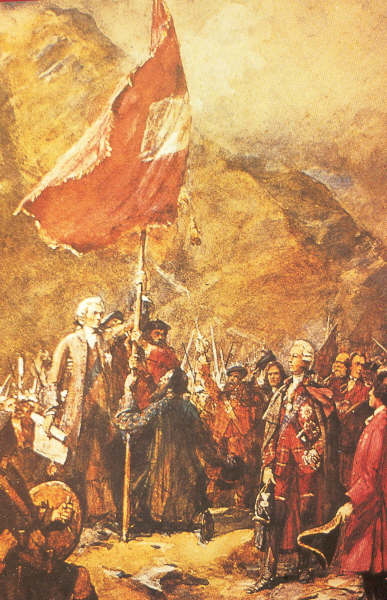
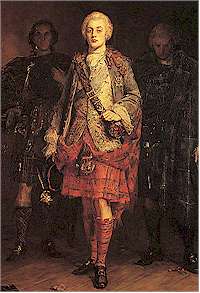
The song in its original form, Séarlas Óg (meaning "Young Charles" in Irish) refers to Bonnie Prince Charlie and dates back to the second Jacobite rising, during the reign of George II in 1745-6.

In the early 20th century it received new verses by the nationalist poet Padraig Pearse and was often sung by IRA members and sympathisers, during the Easter Rising. It was also sung as a fast march during the Irish War of Independence.

Since 1916 it has also been known under various other titles, notably Dord na bhFiann (Call of the Fighters) or An Dord Féinne. The latter title is associated with Padraig Pearse in particular. This version is dedicated to the pirate or "Great Sea Warrior" Gráinne Ní Mháille. She was a formidable power on the west coast of Ireland in the late 1500s...


Original Jacobite Version

(Chorus)

Óró, sé do bheatha abhaile,
B'fhearr liom tú ná céad bó bhainne,
Óró, sé do bheatha abhaile
Anois ar theacht an tsamhraidh.

A Shéarlais Óig, a mhic Rí Shéamais
'Sé mo mhór-chreach do thriall as Éirinn
Gan tuinnte bróig' ort, stoca nó leinidh
Ach do chascairt leis na Gallaibh


Chorus

'Sé mo léan géar nach bhfeicim
Mur mbéinn beo 'na dhiaidh ach seachtain
Séarlas Óg is míle gaiscidheach
Ag fógairt fáin ar Ghallaibh


Chorus

Tá Séarlas Óg ag traill thar sáile
Béidh siad leisean, Franncaigh is Spáinnigh
Óglaigh armtha leis mar gharda
'S bainfidh siad rinnce as éiricigh!


Chorus


English translation

(Chorus)

Oh-ro You're welcome home,
I'd rather you to a hundred milking cows,
Oh-ro You're welcome home...
Now that summer's coming!

Young Charles, son of King James
It's a great distress – your exile from Ireland
Without thread of shoe on you, socks or shirt
Overthrown by the foreigners


Chorus

Alas that I do not see
If I were alive afterwords only for a week
Young Charles and one thousand warriors
Banishing all the foreigners


Chorus

Young Charles is coming over the sea
They will be with him, French and Spanish
Armed Volunteers with him as a guard
And they'll make the heretics dance!


Chorus


Padraig Pearse Version

Chorus

Óró, sé do bheatha abhaile,
Óró, sé do bheatha abhaile
Anois ar theacht an tsamhraidh.

'Sé do bheatha, a bhean ba léanmhar,
Do b' é ár gcreach tú bheith i ngéibheann,
Do dhúiche bhreá i seilbh méirleach,
Is tú díolta leis na Gallaibh.

Chorus

Tá Gráinne Mhaol ag teacht thar sáile,
Óglaigh armtha léi mar gharda,
Gaeil iad féin is ní Gaill[4] ná Spáinnigh,
Is cuirfidh siad ruaig ar Ghallaibh.

Chorus

A bhuí le Rí na bhFeart go bhfeiceam,
Mura mbeam beo ina dhiaidh ach seachtain,
Gráinne Mhaol agus míle gaiscíoch,
Ag fógairt fáin ar Ghallaibh.


Chorus


English translation

(Chorus)

Oh-ro You're welcome home,
Oh-ro You're welcome home...
Now that summer's coming!

Welcome oh woman who was so afflicted,
It was our ruin that you were in bondage,
Our fine land in the possession of thieves...
And you sold to the foreigners!


Chorus

Gráinne O'Malley is coming over the sea,
Armed warriors along with her as her guard,
They are Irishmen, not foreigners nor Spanish...
And they will rout the foreigners!


Chorus

May it please the King of Miracles that I might see,
Although we may live for a week once after,
Gráinne Mhaol and a thousand warriors...
Dispersing the foreigners!


Chorus


As sung by The Wolf Tones:


And The Dubliners:


And the Clancy Brothers:

Labels: , , , , , , ,

Thursday, September 25, 2008

Brits Set to Lift 300-Year-Old Ban on Catholic Succession to the Throne

From The Daily Mail:
The 300-year-old rule excluding Catholics from the throne is set to be abolished under plans drawn up by Downing Street.

***
Legislation including the 1701 Act of Settlement bars all Catholics and anyone married to a Catholic from reigning and forces any monarch coming to the throne to reject Catholicism.

***
'To bring about changes to the law on succession would be a complex undertaking involving amendment or repeal of a number of items of related legislation, as well as requiring the consent of legislatures of member nations of the Commonwealth,' the spokesman said.


[More]

Previous Pro Ecclesia posts on this subject:
Joanna Bogle on "For God and Queen: The Quandary of the English Catholic"

British Prelates to Press for Repeal of Act of Settlement

Scottish Cardinal Denounces Great Britain's Official Anti-Catholicism

This Day in Jacobite History: The Acts of Union - 1 May 1707

This Day in Jacobite History: Death of Queen Anne; George, Elector of Hanover, Becomes King - 1 August 1714

Labels: , , , , , , , ,

Wednesday, April 23, 2008

"Outlawed Tunes on Outlawed Pipes"


The "yes-we're-relevant" busybodies in the European Union are, in effect, engaging in the sort of ethnic and cultural cleansing of the Scots that the English engaged in up through the 18th century.

Patrick Archbold has the details at Creative Minority Report.

Labels: , , , , , , ,

Monday, November 05, 2007

Lochaber No More: Why HRH Elizabeth II is the Legitimate Monarch

Roman Christendom on why Her Majesty, Queen Elizabeth II, is the legitimate monarch of the United Kingdom and all the Commonwealth Realms.

I'm sure I'm calling my own Jacobite credentials into question by posting this one.

;-)


Previous Pro Ecclesia posts on this subject:
An Honored Guest in The Old Dominion

Labels: , , , , , , , , ,

Saturday, September 22, 2007

Bicentenary Pontifical Requiem for the Cardinal Duke of York

Jamie Bogle reports on a special requiem Mass taking place today in London:


Henry Benedict Stuart
Prince and Duke of York
Cardinal-Bishop of Ostia and Velletri
Cardinal-Bishop of Frascati
Dean of the Sacred College of Cardinals
Vice-Chancellor of the Holy Roman Church
Head of the Royal House of Stuart

Solemn Pontifical Requiem
for the Bicentenary of his death

Noon
Saturday, 22nd September 2007


Conventual Church of the Sovereign Military and Hospitaller Order of St John of Jerusalem, Rhodes and Malta

[More]


UPDATE (23 September)
Jamie Bogle has a report of his attendance at the Requiem Mass.


Previous Pro Ecclesia posts on this subject:
This Day in Jacobite History: 200th Anniversary of Death of Henry Benedict Stuart, Cardinal Duke of York (13 July 1807)

Labels: , , , ,

Friday, September 21, 2007

This Day in Jacobite History: Charlie Stuart's Finest Hour, the Battle of Prestonpans - 21 September 1745

[Originally posted 21 September 2006]


Charles Edward Stuart at Prestonpans

On this day 262 years ago - 21 September 1745, Prince Charles Edward Stuart and the Jacobite army were victorious over the Hanoverian forces at the Battle of Prestonpans.

The Jacobite army of just over 3,000 under Bonnie Prince Charlie heavily defeated the English Hanoverian forces led by Sir John Cope. The Battle of Prestonpans has been called "Bonnie Prince Charlie's finest hour".

For more on the Battle of Prestonpans, see here and here.
Johnny Cope

Cope sent a challenge frae Dunbar,
Sayin "Charlie meet me an' ye daur;
An' I'll learn ye the airt o' war,
If ye'll meet me in the morning."

Refrain
O Hey! Johnnie Cope are ye waukin' [awake] yet?
Or are your drums a-beating yet?
If ye were waukin' I wad wait,
Tae gang tae the coals in the morning. *

When Charlie looked the letter upon,
He drew his sword and scabbard from,
Come, follow me, my merry men,
And we'll meet Johnnie Cope in the morning.

Refrain

Now Johnnie, be as good as your word,
Come, let us try baith fire and sword,
And dinna flee like a frichted bird,
That's chased frae its nest i' the morning.

Refrain

When Johnnie Cope he heard o' this,
He thocht it wouldna be amiss,
Tae hae a horse in readiness,
Tae flee awa in the morning.

Refrain

Fye now, Johnnie, get up an' rin,
The Highland bagpipes mak' a din,
It's better tae sleep in a hale skin,
For it will be a bluidie morning.

Refrain

When Johnnie Cope tae Dunbar cam,
They speired at him, "Where's a' your men"
"The de'il confound me gin I ken,
For I left them a' in the morning."

Refrain

Now Johnnie, troth ye werena blate,
Tae come wi' news o' your ain defeat,
And leave your men in sic a strait,
Sae early in the morning.

Refrain

In faith, quo Johnnie, I got sic flegs
Wi' their claymores an' philabegs,
Gin I face them again, de'il brak my legs,
So I wish you a' good morning.

Refrain
O Hey! Johnnie Cope are ye waukin' yet?
Or are your drums a-beating yet?
If ye were waukin' I wad wait,
Tae gang tae the coals in the morning.


(a version of this song with vocals can be heard here)


* Prestonpans had been the location of coal fields.

Previous Pro Ecclesia posts on this subject:
This Day in Jacobite History: Martyrdom of Mary, Queen of Scots - 8 February 1587

This Day in Jacobite History: The Acts of Union - 1 May 1707

This Day in Jacobite History: 200th Anniversary of Death of Henry Benedict Stuart, Cardinal Duke of York (13 July 1807)

This Day in Jacobite History: Mary Queen of Scots Deposed - 24 July 1567

This Day in Jacobite History: The Battle of Killiecrankie - 27 July 1689

This Day in Jacobite History: Death of Queen Anne; George, Elector of Hanover, Becomes King - 1 August 1714

This Day in Jacobite History: Proscription Act Introduced, Banning Tartan and Carrying of Weapons - 1 August 1747

This Day in Jacobite History: Latin Mass Outlawed in Scotland - 11 August 1560

This Day in Jacobite History: Raising of the Jacobite Standard at Glenfinnan - 19 August 1745

This Day in Jacobite History: Marriage Ceremony of James Francis Edward Stuart and Princess Maria Clementina Sobieska - 1 September 1719

This Day in Jacobite History: Death of King James II and VII - 16 September 1701

This Day in Jacobite History: Charles Edward Stuart Arrives in Edinburgh, Proclaims His Father Rightful King - 17 September 1745

This Day in Jacobite History: Lochaber No More - 20 September 1746

This Day in Jacobite History: Charlie Stuart's Finest Hour, the Battle of Prestonpans - 21 September 1745

This Day in Jacobite History: Birth of King James II and VII - 14 October 1633

This Day in Jacobite History: Charles Edward Stuart's Entry into Derby, England - 4 December 1745

This Day in Jacobite History: Jacobite Retreat from Derby - 6 December 1745

This Day in Jacobite History: Charles Edward Stuart Born in Rome - 31 December 1720

Labels: , , ,

Sunday, August 19, 2007

This Day in Jacobite History: Raising of the Jacobite Standard at Glenfinnan - 19 August 1745

(Originally posted 19 August 2006)


Wha'll be King but Charlie?

The news frae Moidart cam' yestreen
Will soon gar mony ferlie;
For ships o' war hae just come in,
And landit Royal Charlie!

Refrain:
Come thro' the heather, around him gather,
Ye're a' the welcomer early;
Around him cling wi' a' your kin;
For wha'll be king but Charlie?
Come thro' the heather, around him gather,
Come Ronald, come Donald, come a' thegither,
And crown your rightfu' lawfu' king!
For wha'll be king but Charlie?

The Hieland clans, wi sword in hand,
Frae John o' Groats' to Airlie,
Hae to a man declared to stand
Or fa' wi' Royal Charlie.

Refrain:
Come thro' the heather, etc.

The Lowlands a', baith great an' sma,
Wi' mony a lord and laird, hae
Declar'd for Scotia's king an' law,
An' speir ye wha but Charlie.

Refrain:
Come thro' the heather, etc.

There's ne'er a lass in a' the lan',
But vows baith late an' early,
She'll ne'er to man gie heart nor han'
Wha wadna fecht for Charlie.

Refrain:
Come thro' the heather, etc.

Then here's a health to Charlie's cause,
And be't complete an' early;
His very name out heart's blood warms;
To arms for Royal Charlie!

Refrain:
Come thro' the heather, around him gather,
Ye're a' the welcomer early;
Around him cling wi' a' your kin;
For what'll be king but Charlie?
Come thro' the heather, around him gather,
Come Ronald, come Donald, come a' thegither,
And crown your richtfu' lawfu' king!
For wha'll be king but Charlie?


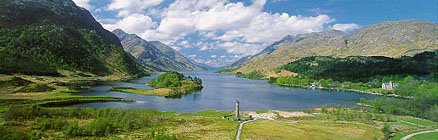
On 19 August 1745, having freshly arrived in Scotland from exile in Rome, bold Charles Edward Stuart - grandson of the last Stuart King to sit on the thrones of England and Scotland, James II and VII - raised the Jacobite standard on the shores of Loch Shiel at Glenfinnan. *

It was here, in this stunningly picturesque setting, that the Highland clans (most importantly, the Camerons under the leadership of Donald "the Gentle Lochiel" Cameron) rallied to the cause of "Bonnie Prince Charlie".

So began the Bliadhna Thearlaich ("Charlie's Year") - known throughout history as "The '45". Today, we remember the thrill those Highlanders must have felt, their blood stirring with the skirl of the pipes, as they witnessed their rightful King's return and call to arms.

For I hae' na' the heart to te' ye how it a' ended.


* NOTE: Sarah and I spent our honeymoon in Glenfinnan, staying at the Glenfinnan House Hotel (on the right-hand side of the photo above and the colored engraving below). The hotel overlooks Loch Shiel and the Glenfinnan Monument, with views to Ben Nevis, the tallest mountain in Britain.

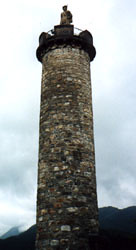
The scenery and atmosphere at Glenfinnan are breathtaking. It is easy to become so steeped in the spirit of the place that one can almost see those Highlanders descending from the surrounding hillsides to gather at the spot where the Bonnie Prince would raise his standard - on the site where the Glenfinnan Monument (lower center of the photo) now stands. Words cannot do it justice. It is a place that must be seen and experienced.

For you movie buffs, there's also a Glenfinnan connection to "Harry Potter" and "Highlander" ("I am Connor MacLeod of the Clan MacLeod. I was born in 1518, in the village of Glenfinnan, on the shores of Loch Shiel...").

Image courtesy of antiqueprints.com


Previous Pro Ecclesia posts on this subject:
This Day in Jacobite History: Martyrdom of Mary, Queen of Scots - 8 February 1587

This Day in Jacobite History: The Acts of Union - 1 May 1707

This Day in Jacobite History: 200th Anniversary of Death of Henry Benedict Stuart, Cardinal Duke of York (13 July 1807)

This Day in Jacobite History: Mary Queen of Scots Deposed - 24 July 1567

This Day in Jacobite History: The Battle of Killiecrankie - 27 July 1689

This Day in Jacobite History: Death of Queen Anne; George, Elector of Hanover, Becomes King - 1 August 1714

This Day in Jacobite History: Proscription Act Introduced, Banning Tartan and Carrying of Weapons - 1 August 1747

This Day in Jacobite History: Latin Mass Outlawed in Scotland - 11 August 1560

This Day in Jacobite History: Raising of the Jacobite Standard at Glenfinnan - 19 August 1745

This Day in Jacobite History: Marriage Ceremony of James Francis Edward Stuart and Princess Maria Clementina Sobieska - 1 September 1719

This Day in Jacobite History: Death of King James II and VII - 16 September 1701

This Day in Jacobite History: Charles Edward Stuart Arrives in Edinburgh, Proclaims His Father Rightful King - 17 September 1745

This Day in Jacobite History: Lochaber No More - 20 September 1746

This Day in Jacobite History: Charlie Stuart's Finest Hour, the Battle of Prestonpans - 21 September 1745

This Day in Jacobite History: Birth of King James II and VII - 14 October 1633

This Day in Jacobite History: Charles Edward Stuart's Entry into Derby, England - 4 December 1745

This Day in Jacobite History: Jacobite Retreat from Derby - 6 December 1745

This Day in Jacobite History: Charles Edward Stuart Born in Rome - 31 December 1720

Labels: , ,

Tuesday, August 07, 2007

"How can you call this a 'Lone Star' when you don't have any Texas beer?"

That would be Lone Star, Pearl, and/or Shiner Bock, none of which were available at an establishment purporting to call itself "Lone Star Steakhouse and Saloon".

The above question, posed to the lovely waitress (who actually did look like Cameron Diaz), is how the evening began. As for the rest of the evening, I think I'll let Dale's post speak for me.

Anything I might have to add likely wouldn't be fit to print in a Catholic blog.

Labels: , , , , , , , , , , , , , , , , , , ,

Friday, July 13, 2007

This Day in Jacobite History: 200th Anniversary of Death of Henry Benedict Stuart, Cardinal Duke of York (13 July 1807)

Henry IX and I
Henry Benedict Stuart,
Cardinal Duke of York

On this date 200 years ago - 13 July 1807, died Henry Benedict Cardinal Stuart, the last legitimate Stuart claimant to the thrones of England and Scotland.

Henry Benedict Stuart was the grandson of King James II and VII, and the second son of James Francis Edward Stuart (the Chevalier de St. George) and Maria Clementina Sobieska, daughter of Prince James Sobieski of Poland. His more famous brother was Charles Edward Stuart, known to history as "Bonnie Prince Charlie".

In addition to his royal lineage, Henry was also a Prince of the Church, taking holy orders at the age of 22 and becoming one of the longest-serving Cardinals in the history of the Catholic Church. He is perhaps best known by the title "the Cardinal Duke of York".

From his Wikipedia entry:
Henry Benedict Cardinal Stuart (March 11, 1725July 13, 1807) was the fourth and final Jacobite heir publicly to claim the thrones of England, Scotland, and Ireland. Unlike his father, James Francis Edward Stuart, and brother, Charles Edward Stuart, Henry made no effort to seize the throne. In January 1766 the Papacy recognised the Hanoverian dynasty as lawful rulers of England, Scotland and Ireland.

He spent his life in the Papal States serving as the Dean of the College of Cardinals of the Roman Catholic Church. At the time of his death he was (and still is) one of the longest serving Cardinals in the Church's history.

In his youth Henry's father made him Duke of York (in the Jacobite peerage), and it was by this title that he was best known. Upon the death of his brother in 1788 Henry became known by Jacobites, and within his personal entourage, as Henry IX & I, King of England, Scotland, France, and Ireland, although publicly he referred to himself as Cardinal-Duke of York nuncupatus.

Notwithstanding his claim to the throne, Henry was in general a peaceable man, attentive to his duties, well respected and a generous host in Rome to many English and Scottish visitors, both Roman Catholic and Protestant.

***
Henry Benedict, his brother, his father and his mother are buried in the crypt of St. Peter's Basilica in the Vatican. There is a monument to the Royal Stuarts designed by Antonio Canova in the basilica to their memory on one of the columns in the basilica proper. This was restored within living memory at the expense of Queen Elizabeth the Queen Mother.


[More]
Links:
Henry Benedict Maria Clement Stuart, Catholic Encyclopedia article
Henry IX and I, The Jacobite Heritage
Henry Benedict Stuart, English Monarchs - The Jacobite Succession
Heraldry for the Cardinal Duke of York, Andrew Cusack
'Henry IX' 1807-2007, Fr. Nicholas Schofield
Portraits of Henry Benedict Maria Clement Stuart, Cardinal York (1725-1807), National Portrait Gallery
The Last Stuart and Royal Hospital Chelsea Commemoration of the Bicentenary of the death of Henry Benedict Stuart, July 2007, Young Fogey


Tombstone of Henry Benedict Stuart
Now located in the Pontifical Scots College, Rome


Tomb of the Royal Stuarts
Crypt of St. Peter's Basilica, The Vatican, Rome


Royal Stuart Monument, The Vatican, Rome
Inscription translation:
To James III,
son of James II, King of Great Britain,
to Charles Edward,
and to Henry, Dean of the Cardinal Fathers,
sons of James III,
the last of the Royal House of Stuart.


Previous Pro Ecclesia posts on this subject:
This Day in Jacobite History: Mary Queen of Scots Deposed - 24 July 1567

This Day in Jacobite History: The Battle of Killiecrankie - 27 July 1689

This Day in Jacobite History: Death of Queen Anne; George, Elector of Hanover, Becomes King - 1 August 1714

This Day in Jacobite History: Proscription Act Introduced, Banning Tartan and Carrying of Weapons - 1 August 1747

This Day in Jacobite History: Latin Mass Outlawed in Scotland - 11 August 1560

This Day in Jacobite History: Raising of the Jacobite Standard at Glenfinnan - 19 August 1745

This Day in Jacobite History: Marriage Ceremony of James Francis Edward Stuart and Princess Maria Clementina Sobieska - 1 September 1719

This Day in Jacobite History: Death of King James II and VII - 16 September 1701

This Day in Jacobite History: Charles Edward Stuart Arrives in Edinburgh, Proclaims His Father Rightful King - 17 September 1745

This Day in Jacobite History: Lochaber No More - 20 September 1746

This Day in Jacobite History: Charlie Stuart's Finest Hour, the Battle of Prestonpans - 21 September 1745

This Day in Jacobite History: Birth of King James II and VII - 14 October 1633

This Day in Jacobite History: Charles Edward Stuart's Entry into Derby, England - 4 December 1745

This Day in Jacobite History: Jacobite Retreat from Derby - 6 December 1745

This Day in Jacobite History: Charles Edward Stuart Born in Rome - 31 December 1720

This Day in Jacobite History: Martyrdom of Mary, Queen of Scots - 8 February 1587

This Day in Jacobite History: The Acts of Union - 1 May 1707

Labels: , , , , , , , ,

Friday, July 06, 2007

British Prelates to Press for Repeal of Act of Settlement

From Catholic World News:
London, Jul. 5, 2007 (CWNews.com) - Catholic Church leaders in Great Britain will press Prime Minister Gordon Brown to repeal the Act of Settlement, which prohibits Catholics from the throne, the Guardian reports.

The Guardian said that Cardinal Keith O'Brien of St. Andrew's, Scotland, plans to press for repeal of the legislation, which was enacted in 1701. The legislation prevents anyone who is a Catholic, or marries a Catholic, from assuming the British throne.

Cardinal Cormac Murphy-O'Connor of Westminster has pointed out in the past that the law would allow an heir to the throne to marry "a Hindu, a Buddhist, anyone-- but not a Roman Catholic."

Previous Pro Ecclesia posts on this subject:
Scottish Cardinal Denounces Great Britain's Official Anti-Catholicism

This Day in Jacobite History: The Acts of Union - 1 May 1707

This Day in Jacobite History: Death of Queen Anne; George, Elector of Hanover, Becomes King - 1 August 1714

Labels: , , , , , , ,

Thursday, May 03, 2007

An Honored Guest in The Old Dominion

Tom McKenna at Seeking Justice notes that a "Hanoverian Usurper Comes to Virginia" today in honor of the 400th anniversary of the founding of the Jamestown Settlement, the first permanent English colony in the New World.

As I said in comments over at Tom's blog, I actually admire the current de facto occupant of the Throne, and that she and her gung-ho grandson, Harry, appear to be the best of the entire Hanoverian bunch.

So, today I'll volunteer a hearty "God Save the Queen" in honor of her visit to The Old Dominion.


Previous Pro Ecclesia posts on this subject:
Jamestown Milestone

Labels: , , , , ,

Tuesday, May 01, 2007

This Day in Jacobite History: The Acts of Union - 1 May 1707

On this day 300 years ago - 1 May 1707, the Acts of Union - went into effect.

The effect of the Acts was that the political entity known as Scotland ceased to exist, and a new state, the Kingdom of Great Britain, was created. Scotland's Parliament was abolished, and the new "united" Parliament was based in the former home of the English Parliament in Westminster. Most of the pre-Union traditions of Westminster continued, while those of Scotland were forgotten or ignored.

Other provisions of the Acts of Union included the creation of a customs union and monetary union, as well as a restatement of the Act of Settlement 1701 and the ban on Roman Catholics from taking the throne.
A Parcel of Rogues in a Nation

by Robert Burns

Fareweel to a' our Scottish fame
Fareweel our ancient glory
Fareweel e'en to the Scottish name
So famed in martial story
Now Sark runs to the Solway sands
And Tweed runs to the ocean
To mark where England's province stands
Such a parcel o' rogues in a nation.

What force or guile could not subdue
Through many warlike ages
Is wrought now by a coward few
For hireling traitor's wages
The English steel we could disdain
Secure in valour's station
But English gold has been our bane
Such a parcel o' rogues in a nation.

O would ere I had seen the day
That treason thus could sell us
My auld grey heid had lien in clay
Wi' Bruce and loyal Wallace
But pith find power till my last hour
I'll mak this declaration:
We're bought and sold for English gold
Such a parcel o' rogues in a nation.


The "rogues" concerned are the members of the Scottish parliament who signed the Act of Union with England in 1707... Recorded by Dick Gaughan; by Steeleye Span on Parcel of Rogues; also by the Corries and the Dubliners

Hear samples of this and other Jacobite songs as recorded by Ewan MacColl and Peggy Seeger at the Smithsonial Global Sound website.


UPDATE
While we're on the subject, let's call the Act of Settlement (1701) and the Acts of Union (1707) exactly what they are (and they're still in effect, so I say "are" rather than "were"): they are brazen acts of anti-Catholicism, meant to ensure that no Catholic monarch ever again sits on any throne, English or Scottish, in the scepter'd isle of Britain.


UPDATE #2
What's being said in the British press about today's tercentary:

  • A troubled marriage (The Herald)

  • Tartan takeover: The rise of the Scotocracy (The Independent)

  • Watch out, I can see Braveheart on the march (The Times)

  • The SNP are a 'parcel of rogues' (The Telegraph)


  • Previous Pro Ecclesia posts on this subject:
    This Day in Jacobite History: Mary Queen of Scots Deposed - 24 July 1567

    This Day in Jacobite History: The Battle of Killiecrankie - 27 July 1689

    This Day in Jacobite History: Death of Queen Anne; George, Elector of Hanover, Becomes King - 1 August 1714

    This Day in Jacobite History: Proscription Act Introduced, Banning Tartan and Carrying of Weapons - 1 August 1747

    This Day in Jacobite History: Latin Mass Outlawed in Scotland - 11 August 1560

    This Day in Jacobite History: Raising of the Jacobite Standard at Glenfinnan - 19 August 1745

    This Day in Jacobite History: Marriage Ceremony of James Francis Edward Stuart and Princess Maria Clementina Sobieska - 1 September 1719

    This Day in Jacobite History: Death of King James II and VII - 16 September 1701

    This Day in Jacobite History: Charles Edward Stuart Arrives in Edinburgh, Proclaims His Father Rightful King - 17 September 1745

    This Day in Jacobite History: Lochaber No More - 20 September 1746

    This Day in Jacobite History: Charlie Stuart's Finest Hour, the Battle of Prestonpans - 21 September 1745

    This Day in Jacobite History: Birth of King James II and VII - 14 October 1633

    This Day in Jacobite History: Charles Edward Stuart's Entry into Derby, England - 4 December 1745

    This Day in Jacobite History: Jacobite Retreat from Derby - 6 December 1745

    This Day in Jacobite History: Charles Edward Stuart Born in Rome - 31 December 1720

    This Day in Jacobite History: Martyrdom of Mary, Queen of Scots - 8 February 1587

    Labels: , , , ,

    Thursday, February 08, 2007

    This Day in Jacobite History: Martyrdom of Mary, Queen of Scots - 8 February 1587


    On this day 420 years ago - 8 February 1587, Mary Stuart - aka Mary, Queen of Scots - was martyred for her Catholic faith. She was executed by beheading upon the orders of her Protestant cousin, Elizabeth I of England.

    An account of the execution of Queen Mary from TudorHistory.org:
    The Execution of Mary, Queen of Scots

    Her prayers being ended, the executioners, kneeling, desired her Grace to forgive them her death: who answered, 'I forgive you with all my heart, for now, I hope, you shall make an end of all my troubles.' Then they, with her two women, helping her up, began to disrobe her of her apparel: then she, laying her crucifix upon the stool, one of the executioners took from her neck the Agnus Dei, which she, laying hands off it, gave to one of her women, and told the executioner, he should be answered money for it. Then she suffered them, with her two women, to disrobe her of her chain of pomander beads and all other apparel most willingly, and with joy rather than sorrow, helped to make unready herself, putting on a pair of sleeves with her own hands which they had pulled off, and that with some haste, as if she had longed to be gone.

    All this time they were pulling off her apparel, she never changed her countenance, but with smiling cheer she uttered these words,'that she never had such grooms to make her unready, and that she never put off her clothes before such a company.'

    Then she, being stripped of all her apparel saving her petticoat and kirtle, her two women beholding her made great lamentation, and crying and crossing themselves prayed in Latin. She, turning herself to them, embracing them, said these words in French, 'Ne crie vous, j'ay prome pour vous', and so crossing and kissing them, bad them pray for her and rejoice and not weep, for that now they should see an end of all their mistress's troubles.

    Then she, with a smiling countenance, turning to her men servants, as Melvin and the rest, standing upon a bench nigh the scaffold, who sometime weeping, sometime crying out aloud, and continually crossing themselves, prayed in Latin, crossing them with her hand bade them farewell, and wishing them to pray for her even until the last hour.

    This done, one of the women have a Corpus Christi cloth lapped up three-corner-ways, kissing it, put it over the Queen of Scots' face, and pinned it fast to the caule of her head. Then the two women departed from her, and she kneeling down upon the cushion most resolutely, and without any token or fear of death, she spake aloud this Psalm in Latin, In Te Domine confido, non confundar in eternam, etc. Then, groping for the block, she laid down her head, putting her chin over the block with both her hands, which, holding there still, had been cut off had they not been espied. Then lying upon the block most quietly, and stretching out her arms cried, In manus tuas, Domine, etc., three or four times. Then she, lying very still upon the block, one of the executioners holding her slightly with one of his hands, she endured two strokes of the other executioner with an axe, she making very small noise or none at all, and not stirring any part of her from the place where she lay: and so the executioner cut off her head, saving one little gristle, which being cut asunder, he lift up her head to the view of all the assembly and bade God save the Queen. Then, her dress of lawn [i.e. wig] from off her head, it appeared as grey as one of threescore and ten years old, polled very short, her face in a moment being so much altered from the form she had when she was alive, as few could remember her by her dead face. Her lips stirred up and a down a quarter of an hour after her head was cut off.

    Then Mr. Dean [Dr. Fletcher, Dean of Peterborough] said with a loud voice, 'So perish all the Queen's enemies', and afterwards the Earl of Kent came to the dead body, and standing over it, with a loud voice said, 'Such end of all the Queen's and the Gospel's enemies.'

    Then one of the executioners, pulling off her garters, espied her little dog which was crept under her cloths, which could not be gotten forth by force, yet afterward would not depart from the dead corpse, but came and lay between her head and her shoulders, which being imbrued with her blood was carried away and washed, as all things else were that had any blood was either burned or washed clean, and the executioners sent away with money for their fees, not having any one thing that belonged unto her. And so, every man being commanded out of the hall, except the sheriff and his men, she was carried by them up into a great chamber lying ready for the surgeons to embalm her.


    Recorded by Robert Wynkfield (spelling modernized)

    Mary, Queen of Scots, being led to her execution

    Another account of the execution:
    The Execution of Mary, Queen of Scots, 1587

    "The scaffold had been erected in the middle of a large room. It measured twelve feet along each side and two feet in height, and was covered by a coarse cloth of linen.

    The Queen entered the room full of grace and majesty, just as if she were coming to a ball. There was no change on her features as she entered.

    Drawing up before the scaffold, she summoned her major-domo and said to him:

    'Please help me mount this. This is the last request I shall make of you.'

    Then she repeated to him all that she had said to him in her room about what he should tell her son. Standing on the scaffold, she asked for her almoner, (chaplain) begging the officers present to allow him to come. But this was refused point-blank. The Count of Kent told her that he pitied her greatly to see her thus the victim of the superstition of past ages, advising her to carry the cross of Christ in her heart rather than in her hand. To this she replied that it would be difficult to hold a thing so lovely in her hand and not feel it thrill the heart, and that what became every Christian in the hour of death was to bear with him the true Symbol of Redemption."

    [Standing on the scaffold, Mary angrily rejects her captors' offer of a Protestant minister to give her comfort. She kneels while she begs that Queen Elizabeth spare her ladies-in-waiting and prays for the conversion of the Isle of Britain and Scotland to the Catholic Church:]

    "When this was over, she summoned her women to help her remove her black veil, her head-dress, and other ornaments. When the executioner attempted to do this, she cried out:

    'Nay, my good man, touch me not!'

    But she could not prevent him from touching her, for when her dress was lowered as far as her waist; the scoundrel caught her roughly by the arm and pulled off her doublet. Her skirt was cut so low that her neck and throat, whiter than alabaster, were revealed. She concealed these as well as she could, saying that she was not used to disrobing in public, especially before so large an assemblage. There were about four or five hundred people present.

    The executioner fell to his knees before her and implored her forgiveness. The Queen told him that she willingly forgave him and alI who were responsible for her death, as freely as she hoped her sins would be forgiven by God. Turning to the woman to whom she, had given her handkerchief, she asked for it.

    She wore a golden crucifix, made out of the wood of the true cross, with a picture of Our Lord on it. She was about to give this to one of her women, but the executioner forbade it, even though Her Majesty had promised that the woman would give him thrice its value in money.

    After kissing her women once more, she bade them go, with her blessing, as she made the sign of the cross over them. One of them was unable to keep from crying, so that the Queen had to impose silence upon her by saying she had promised that nothing of the kind would interfere with the business in hand. They were to stand back quietly, pray to God for her soul, and bear truthful testimony that she had died in the bosom of the Holy Catholic religion.

    One of the women then tied the handkerchief over her eyes. The Queen quickly, and with great courage, knelt dawn, showing no signs of faltering. So great was her bravery that all present were moved, and there were few among them that could refrain from tears. In their hearts they condemned themselves far the injustice that was being done.

    The executioner, or rather the minister of Satan, strove to kill not only her body but also her soul, and kept interrupting her prayers. The Queen repeated in Latin the Psalm beginning In te, Damine, speravi; nan canfundar in aeternum. When she was through she laid her head on the block, and as she repeated the prayer, the executioner struck her a great blow upon the neck, which was not, however, entirely severed. Then he struck twice more, since it was obvious that he wished to make the victim's martyrdom all the more severe. It was not so much the suffering, but the cause, that made the martyr.

    The executioner then picked up the severed head and, showing it to those present, cried out: 'God save Queen Elizabeth! May all the enemies of the true Evangel thus perish!'

    Saying this, he stripped off the dead Queen's head-dress, in order to show her hair, which was now white, and which she had been afraid to show to everyone when she was still alive, or to have properly dressed, as she did when her hair was fair and light.

    It was not old age that had turned it white, for she was only thirty-five when this took place, and scarcely forty when she met her death, but the troubles, misfortunes, and sorrows which she had suffered, especially in her prison."


    References:
    The account of Pierre de Bourdeille was originally published in 1665 and republished many times thereafter. This account appears in Snyder, Louis (ed.) A Treasury of Intimate Biographies (1951); Fraser Antonia, Mary, Queen of Scots (1969).

    "The Execution of Mary, Queen of Scots, 1587," EyeWitness to History, www.eyewitnesstohistory.com (2005).

    The deathmask of Mary, Queen of Scots


    From the Jacobite Yahoo Group:
    The Commemoration of Mary Queen of Scots

    The Commemoration of the 420th anniversary of the death of Mary Stuart, Queen of Scots (Queen Mary I of Scots & II of England, France and Ireland, for traditionalist Legitimist Jacobites) will take place, with the permission of the Dean of Westminster Abbey, at her tomb in the Lady Margaret Beaufort Chapel, tomorrow, February 8th, at 2.30.p.m. Prayers will be led by Fr. Graeme Napier, Succentor and Minor Canon, who also recently performed similar duties in memory of King Charles I.

    Recommended Reading:
    Mary Queen of Scots by Antonia Fraser


    Previous Pro Ecclesia posts on this subject:
    This Day in Jacobite History: Mary Queen of Scots Deposed - 24 July 1567

    This Day in Jacobite History: The Battle of Killiecrankie - 27 July 1689

    This Day in Jacobite History: Death of Queen Anne; George, Elector of Hanover, Becomes King - 1 August 1714

    This Day in Jacobite History: Proscription Act Introduced, Banning Tartan and Carrying of Weapons - 1 August 1747

    This Day in Jacobite History: Latin Mass Outlawed in Scotland - 11 August 1560

    This Day in Jacobite History: Raising of the Jacobite Standard at Glenfinnan - 19 August 1745

    This Day in Jacobite History: Marriage Ceremony of James Francis Edward Stuart and Princess Maria Clementina Sobieska - 1 September 1719

    This Day in Jacobite History: Death of King James II and VII - 16 September 1701

    This Day in Jacobite History: Charles Edward Stuart Arrives in Edinburgh, Proclaims His Father Rightful King - 17 September 1745

    This Day in Jacobite History: Lochaber No More - 20 September 1746

    This Day in Jacobite History: Charlie Stuart's Finest Hour, the Battle of Prestonpans - 21 September 1745

    This Day in Jacobite History: Birth of King James II and VII - 14 October 1633

    This Day in Jacobite History: Charles Edward Stuart's Entry into Derby, England - 4 December 1745

    This Day in Jacobite History: Jacobite Retreat from Derby - 6 December 1745

    This Day in Jacobite History: Charles Edward Stuart Born in Rome - 31 December 1720

    Labels: , ,

    Friday, February 02, 2007

    "A Cairn of Small Stones"

    Joanna Bogle recommends a book that I'll definitely have to check into:
    In the post today, A Cairn of Small Stones, by John Watts (available from Mungo books 0141 552 5523), a beautifully-written and delightful story about a Scottish Catholic family at the time of the Jacobite Rising in 1745. Any enthusiast for Bonnie Prince Charlie will love this book. It's a compelling read, with charming detail, written by some one who knows and loves the Highlands. It is without affectation or unneccessary "twee" bits of bogus Highland-isms, just a first-rate tale, well told, which takes us right into the lives and beliefs of Catholics living and honouring their Faith in difficult times two and a half centuries ago. Buy it and enjoy it.

    ***
    The book's cover has a lovely illustration of craggy mountains and the book is pleasing to handle, a paperback but of hardback quality. I do most warmly recommend it.

    Labels: ,

    Thursday, January 25, 2007

    Scottish Poet Robert Burns - Born 25 January 1759

    In honour of the 248th anniversary of the birth of Scottish poet Robert Burns, I'm reposting this story from last January:

    Next they'll be outlawin' the wearin' o' the tartan and the playin' o' the pipes:
    Haggis Targeted in Anti-Obesity Drive

    Scotland's national dish, haggis, has become the latest foodstuff to be targeted as part of a drive to combat growing levels of obesity among British children, prompting outrage among producers.


    According to health officials in Scotland, the delicacy -- a sheep's stomach lining stuffed with offal, oatmeal, onions and seasoning -- contains too much fat and salt and should only be given to youngsters once a week.

    But the guidance has angered makers of the "love it or hate it" foodstuff, which is traditionally eaten with a tot of whisky on Burn's Night, the annual celebration on January 25 of the life of the legendary Scots poet Robert Burns.

    "With good neeps and tatties [turnips and potatoes], there's nothing more nutritious than haggis," said Alan Pirie, of butchers James Pirie and Son, the current holders of the sought-after title "Scottish Haggis Master".

    "It's made of all natural ingredients -- there's no rubbish in it at all. To compare it with processed meat like chicken nuggets or hot dogs is just ridiculous. It's a big knock for us for it to be compared to those."

    Haggis was placed on a "restricted" list of foods issued to nurseries, playgroups and childminders as part of a drive by the Scottish Executive in Edinburgh to improve the health of pre-school children under five.


    (emphasis added)
    My Comments:
    Outlawed lungs in outlawed tripes.

    What is the world coming to when a Scotsman can't enjoy a little organ meat with his whiskey and porridge? I mean, what harm can be done by a little lung, heart, liver, blood, and oats stuffed inside a sheep's stomach?

    Perhaps Robert Burns best summed up the Scotsman's love affair with this fair delicacy in the following poem:
    Address To A Haggis

    Fair fa' your honest, sonsie face,
    Great chieftain o' the pudding-race!
    Aboon them a' yet tak your place,
    Painch, tripe, or thairm:
    Weel are ye wordy o'a grace
    As lang's my arm.

    The groaning trencher there ye fill,
    Your hurdies like a distant hill,
    Your pin was help to mend a mill
    In time o'need,
    While thro' your pores the dews distil
    Like amber bead.

    His knife see rustic Labour dight,
    An' cut you up wi' ready sleight,
    Trenching your gushing entrails bright,
    Like ony ditch;
    And then, O what a glorious sight,
    Warm-reekin', rich!

    Then, horn for horn, they stretch an' strive:
    Deil tak the hindmost! on they drive,
    Till a' their weel-swall'd kytes belyve
    Are bent like drums;
    Then auld Guidman, maist like to rive,
    Bethankit! hums.

    Is there that owre his French ragout
    Or olio that wad staw a sow,
    Or fricassee wad make her spew
    Wi' perfect sconner,
    Looks down wi' sneering, scornfu' view
    On sic a dinner?

    Poor devil! see him owre his trash,
    As feckles as wither'd rash,
    His spindle shank, a guid whip-lash;
    His nieve a nit;
    Thro' blody flood or field to dash,
    O how unfit!

    But mark the Rustic, haggis-fed,
    The trembling earth resounds his tread.
    Clap in his walie nieve a blade,
    He'll mak it whissle;
    An' legs an' arms, an' hands will sned,
    Like taps o' trissle.

    Ye Pow'rs, wha mak mankind your care,
    And dish them out their bill o' fare,
    Auld Scotland wants nae skinking ware
    That jaups in luggies;
    But, if ye wish her gratefu' prayer
    Gie her a haggis!


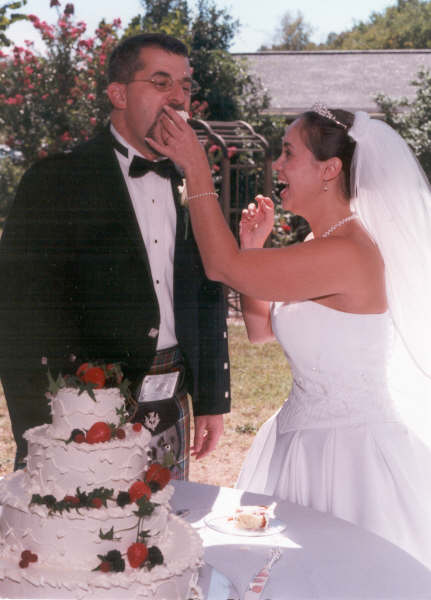
    That's me about 3 days before my first encounter with a haggis, which took place during Sarah's and my honeymoon in Scotland.


    Happy birthday, Rabbie. I'll drink a wee dram of the single malt to your memory this Burns Night.


    Further Reading:
    www.rabbie-burns.com/

    www.robertburns.org/

    www.robert-burns.eu/

    Burns National Heritage Park

    www.auldlangsyne.org/

    BBC - Burns Night - Homepage

    The Scottish Haggis Website

    Labels: , ,

    Sunday, December 31, 2006

    This Day in Jacobite History: Charles Edward Stuart Born in Rome - 31 December 1720

    Prince Charles Edward Stuart as a young boy

    Oran Air Breith a Prionnsa Tearlach *
    (A Song upon the Birth of Prince Charles)

    The tidings we have now received
    Which are freshly come to the land
    Have chased all my sorrow away
    And left me both joyful and proud
    No more are we going to be
    Under subjection to George
    Joy will come in the young Prince's time
    Peace will be to the exiles restored

    A Phoenix is born o'er in Rome
    A tale of great joy in its time
    May he who the King's right maintains
    Have strength and justice and aid
    Fortune's wheel will yet turn again
    And the man who's aloft will fall low
    The man who is climbing will rise
    And the other to earth will fall down

    Neptune does promise for him
    A sea as smooth as the land
    And Aeolus is ready always
    For him keeping his favoring winds
    Mars with his sword in his hand
    Will give victory wherever he be
    The herbs with their delicate leaves
    Give honor in their own abodes

    A change will come o'er barren lands
    No thorn on the ground but will fade
    Every hill will be laid in smooth rigs
    And wheat will grow on the hillsides
    Contention no more shall we own
    Since the root that won't grow is consumed
    There's the corn-field now cleansed of its weeds
    Which did hinder the growth of our crop

    Another tale that I'll not hide
    The woods will put leaves o'er our heads
    The earth will yield crops without stint
    The sea's fruit will fill every net
    Herds will give milk everywhere
    And honey on straw-tops be found
    Without want, unstinted, forever
    Without storms, but every wind warm


    * This is an English translation of a Gaelic song written in honor of the birth of Prince Charles Edward Stuart

    On this day 286 years ago - 31 December 1720, Prince Charles Edward Stuart (known later to history as "Bonnie Prince Charlie") - grandson of the last Stuart King to sit on the thrones of England and Scotland, King James II and VII - was born in exile in Rome.

    The Baptism of
    Prince Charles Edward Stuart

    Previous Pro Ecclesia posts on this subject:
    This Day in Jacobite History: Mary Queen of Scots Deposed - 24 July 1567

    This Day in Jacobite History: The Battle of Killiecrankie - 27 July 1689

    This Day in Jacobite History: Death of Queen Anne; George, Elector of Hanover, Becomes King - 1 August 1714

    This Day in Jacobite History: Proscription Act Introduced, Banning Tartan and Carrying of Weapons - 1 August 1747

    This Day in Jacobite History: Latin Mass Outlawed in Scotland - 11 August 1560

    This Day in Jacobite History: Raising of the Jacobite Standard at Glenfinnan - 19 August 1745

    This Day in Jacobite History: Marriage Ceremony of James Francis Edward Stuart and Princess Maria Clementina Sobieska - 1 September 1719

    This Day in Jacobite History: Death of King James II and VII - 16 September 1701

    This Day in Jacobite History: Charles Edward Stuart Arrives in Edinburgh, Proclaims His Father Rightful King - 17 September 1745

    This Day in Jacobite History: Lochaber No More - 20 September 1746

    This Day in Jacobite History: Charlie Stuart's Finest Hour, the Battle of Prestonpans - 21 September 1745

    This Day in Jacobite History: Birth of King James II and VII - 14 October 1633

    This Day in Jacobite History: Charles Edward Stuart's Entry into Derby, England - 4 December 1745

    This Day in Jacobite History: Jacobite Retreat from Derby - 6 December 1745

    Labels: , , ,

    hit counter for blogger