Thursday, September 01, 2011

Why Some Portions of the Old Testament Are Binding on Christians and Others Are Not

A MUST READ post at The American Catholic from my friend, Don McClarey regarding the Council of Jerusalem and why some Old Testament proscriptions are still binding on Christians while others are not:
... It is a good question and sometimes confuses Catholics and non-Catholics. The answer to the question is in the very earliest history of the Church. After the ascension of Jesus, the apostles went about the great task of making “apostles of all the nations”, and Christianity began to spread among Jew and Gentile alike. The question quickly arose as to whether Gentile converts would have to be circumcised (the males only of course!) and follow all of the Jewish laws regarding ritual purity...

[...]

Tensions over the issue of whether Gentile Christians should be required to follow all of the Jewish ritual purity laws, were settled doctrinally once and for all at the Council of Jerusalem in 49 AD which issued these decrees:

20 But that we write unto them, that they abstain from pollutions of idols, and from fornication, and from things strangled, and from blood.

21 For Moses of old time hath in every city them that preach him, being read in the synagogues every sabbath day.

The Gentiles were therefore not to be required to live like Jews. They were required to follow the ten commandments and the major teachings of the Old Testament, but the laws of ritual impurity were not to apply to Christians...


[Read the whole thing]
My Comments:
I don’t believe I have ever seen this issue explained more clearly and concisely. This should be a “must read” and a “must link” throughout St. Blog’s.

Save this one away in your favorites, folks. Keep it handy to access for whenever the topic inevitably rears its head. As Don says in the comments, "The Old Testament laws and their applicability to Christians is an issue that keeps coming up in current debates and Catholics need to know that the answer is a pretty simple one."

Labels: , , , ,

Tuesday, February 16, 2010

This Year's Lenten Reading: The Gargoyle Code

The Gargoyle Code

I just received in the mail today my Lenten reading for the next 40 days. It is Fr. Dwight Longenecker's new book, The Gargoyle Code: Lenten Letters between a Master Tempter and his diabolical Trainee.

The Gargoyle Code is written, "in the tradition of The Screwtape Letters", as a series of daily communiques from one demonic entity (the Master Tempter Slubgrip) to another (Slubgrip's protege, Dogwart). Master and trainee are each embroiled in efforts to destroy the souls of their respective "patients": Slubgrip's, an older Catholic in failing health; Dogwart's, a confused young Catholic. The letters begin on Shrove Tuesday (a.k.a Fat Tuesday, Mardi Gras) with Slubgrip admonishing Dogwart for attempting to use the Mardi Gras festivities to bring about the immediate moral degradation of the young Catholic "patient" under his influence. "Too much too soon," warns Slubgrip, "and they run away. You need to lead them downward slowly but surely."

And so begins the tutelage of Dogwart in the "art" of temptation. Slubgrip goes on to opine that the most predictable result of tempting the young Catholic to indulge in the Fat Tuesday revelry will be to remind him that the following day is Ash Wednesday, "and what we don't want him to do is attend Mass and go through that ridiculous ceremony where they smear ashes on their foreheads." Instead, the whole thing should be blocked out of his head, by reminding him of a TV program that he likes and having him sit up all night watching the banality on the screen, and by ensuring that he has plenty of junk food with which to engorge himself rather than fast for Ash Wednesday.

The following chapters, each a 1-2 page letter advising and/or critiquing the apprentice demon, provide an inside look at the diabolical and deceptive workings of the Underworld. Fortunately, we are warned at the beginning of the book by "Your Guardian" of the disturbing spiritual warfare techniques of the Evil One that are on display in the pages to follow.

So far, I have read the Introduction by "Your Guardian", the report by the "International Intelligence Agency" of intercepted and decoded transmissions of "what seem to be instructions and training for undercover agents working in the field of religious propaganda", and the first of the letters from Slubgrip pertaining to Shrove Tuesday. But from what I have read of the book at this point (as well as from Fr. Longenecker's past blog posts on The Gargoyle Code), I can highly recommend this book for your Lenten reading. I'm definitely looking forward to using Fr. Longenecker's book as part of my daily Lenten reflection.

Labels: , , ,

Monday, October 26, 2009

Speaking of Bishop Blair: "Sense and Nonsense"

Toledo Bishop Leonard Blair writes in the October 25, 2009 issue of The Catholic Chronicle:
Sense and nonsense

Written by Bishop Leonard P. Blair
Monday, 26 October 2009


... Far from being immune from this trend [of separating out one's "spirituality" from organized religion], it would appear that Catholics form a significant part of it. Throughout the country we see things that earlier generations of believers would find incomprehensible from the perspective of both faith and human reason.

In the sphere of religious practice, for example, many who claim to be Catholic not only fail to go to Mass on Sunday, but reject the belief that one is obliged to worship God as part of a church community at the Sunday Eucharist in observance of the Third Commandment. This attitude also applies to the sacrament of penance and other religious obligations and practices that are the spiritual heart and soul of what it means to be a Catholic.

When it comes to living the faith, it has to be asked how any person familiar with the foundations of Catholic belief, the interconnection of the mysteries of faith and teaching on faith and morals, could honestly claim to be Catholic and at the same time reject, and even undermine, fundamental moral truths that the Catholic faith believes are part of the deposit of faith from the Apostles.


[...]

There will always be people who fail to live up to the religion they profess, but it is not rationally coherent to insist that one can be a Catholic and not accept the fundamental teachings of the Catholic faith.

The question then arises: who has the authority to say what is Catholic? Even if one were to reject the answer from the Catechism that I wrote about in my last Chronicle article, what the Catechism says is a simple fact of history that goes back to the very beginning of Christianity.

This leads to an even more fundamental question about the very nature of Christianity and the Church. Is it a human project or a divine one? If it is human, it simply reflects what human beings think at any given time. If it is divine, then it is a revelation of truths about God, human life and the world that require conversion and the obedience of faith. If the core beliefs of Christianity and the Catholic Church are a human project, then they can — to use a favorite contemporary expression — be “re-defined.” If they are of divine origin, then it is sinful humanity that is meant to be re-defined.

Every pastor in the Church, and all Catholics in relation to one another, have an obligation “to speak the truth in love” (Eph 4:15). The ultimate judgment of every person belongs to Christ alone, whom we await “to judge the living and the dead.” In the meantime, however, as St. Paul says, we must “proclaim the Word; be persistent, whether it is convenient or inconvenient; convince, reprimand, encourage through all patience and teaching” (2 Tim 4:2).

All of us need to pray and do penance for ourselves and others, because “God may perhaps grant that they will repent and come to know the truth, and that they may escape from the snare of the devil, having been held captive by him to do his will” (2 Tim 2:25f ).


© Copyright 2002 - 2009 Catholic Chronicle
The Official Newspaper of the Catholic Diocese of Toledo
(emphasis added)

Labels: , , , , , ,

Thursday, August 27, 2009

Fr. Z Defends Well-Known Catholic Apologist Patrick Madrid ... [UPDATED]

... from an unhinged diatribe at America Magazine by someone named Michael Sean Winters.


UPDATE (28 August)
Don McClarey has more at The American Catholic: Ted Kennedy and the “A Word”.

Be sure to read the comments, which ought to get interesting. My contribution, in response to this and this, is here:
Yes, if I recall correctly, on the day of his death, Mr. Buckley – who by any objective measure was arguably the equal in stature on the American right as Sen. Kennedy was on the American left – was deemed to be “not a great man” and “just another cafeteria Catholic who simply refused to put the Church ahead of his secular ideological leanings”.

And what, praytell, was the reason Mr. Buckley was dressed down, while his body was still warm, as not great and insufficiently Catholic? Because he allegedly coined a phrase that he never actually coined (”Mater si, magister no”) as a cover story that was never actually a cover story, and was a proponent of free markets. For that, on the day of his death, Mr. Buckley was held up as an example of a “cafeteria Catholic” unworthy of being honored.

Meanwhile, we are told that we are “boors” if we don’t gloss over Sen. Kennedy’s despicable record as one of the most vocal advocates for unrestricted abortion on Capitol Hill, who used his position on the Senate Judiciary Committee to oppose any effort at resticting abortion via legislative means (yes, even the PBA ban) and to oppose (even resorting to slander and innuendo) any federal judge who might even think about overturning Roe v. Wade. And that’s not even covering his record on issues such as ESCR, same-sex “marriage”, etc.

No, we simply MUST NOT consider Sen. Kennedy to be, like Mr. Buckley, “just another cafeteria Catholic who simply refused to put the Church ahead of his secular ideological leanings”; rather, we are to agree with Sr. Fiedler that Sen. Kennedy was the very model of a modern Catholic in the public square (despite the clear problems Sen. Kennedy’s stance on abortion – a lead that was soon followed by a great many other Catholic politicans – has caused the Bishops), lest we be deemed “callous”, “inhumane”, and “indecent” by some blogger at America with his own partisan axe to grind.

Labels: , , , ,

Sunday, May 10, 2009

A Letter from Bishop Blair

A letter from Bishop Blair:
Most Reverend Leonard P. Blair
Bishop of Toledo in America

To the Clergy, Religious and Laity of the Diocese of Toledo:
May the Peace of the Risen Christ be with You.


My Dear Friends,

During this joyful Easter season we have the privilege of celebrating together our new life in Christ, risen from the dead. The mystery of Christ’s saving work is made present and fruitful among us thanks to the gift of the Holy Spirit whose outpouring we will commemorate on May 31, Pentecost Sunday.

Once again this year I invite parishes and individuals, from May 22-30, to pray the Novena of the Holy Spirit, which was published in booklet form by our diocese last year and favorably received by so many people. What was printed reflects last year’s calendar, but it can be used again with a few editorial adjustments. On our diocesan website you will now find a version that reflects these adjustments.

In imitation of Mary and the disciples in the Upper Room for nine days between the Ascension and Pentecost, we implore an outpouring of the Holy Spirit. He alone is our source of life and power for the mission we have received to bear witness to Jesus Christ.

This year that mission needs the special blessing of the Holy Spirit for a specific purpose. In preparation for the 100th anniversary of the Diocese of Toledo in 2010, I have asked all parishes to be involved in a program of evangelization, that is, an organized effort to share with others the good news of Christ, the good news of our Catholic Faith.

The theme is The Spirit of Jesus Alive Today: Pentecost in Our Time. Most parishes will participate directly in the diocesan program of that name. Some parishes have determined that a locally designed program better addresses their needs.

The diocesan program is built on the principle that personal contact is the most effective means of invitation and welcome. Parishioners are being organized to make home visits in their local communities in the hope that this personal contact will be used by God to draw into the “Catholic communion of the Church” people who have no church or who have fallen away from the practice of the faith. Happy and confident parishioners with a commitment to and love for their Catholic Faith bring a spiritual energy to evangelization that is far more effective than any media blitz or letter survey.

This is a wonderful opportunity for you who are the lay faithful to be actively involved in the life and mission of your parish and the wider Church. Every parishioner can be involved, whether you visit homes or not. All are encouraged to provide the necessary spiritual support through prayer, especially the Pentecost Novena, and through good works offered up as an appeal to God. Others might help prepare welcoming activities at the parish as part of the follow-up.

At any time, we can and should take advantage of opportunities to bear witness to our faith with friends, neighbors, family and co-workers. If we truly take to heart our obligation to make Christ better known and loved, then our parishes and our diocese will be blessed with new life in the next century.

In the months to come there will be more news about the Centenary of our diocese, which was founded on April 15, 1910. For now, I am happy to announce that the celebration will begin on our diocesan patronal feast, October 7, 2009, the Feast of the Holy Rosary, with a Mass in the Cathedral at noon that will be broadcast live nationwide on the EWTN network. Needless to say, we are hoping for a full cathedral that day from parishes throughout the diocese. More specific information will be forthcoming.

“Come Holy Spirit, fill the hearts of the faithful. Enkindle in them the fire of your love!” May the language of love be our motivating force, our guiding light, and the fruit of our efforts. “Come, Holy Spirit, Come!”

Most Reverend Leonard P. Blair
Bishop of Toledo
May 4, 2009
(emphasis in original)

Labels: , , , , , , , ,

Wednesday, February 04, 2009

Michael Dubruiel, Rest in Peace [UPDATED]

Michael Dubruiel, the husband of Amy Welborn, passed away yesterday. This is tragic. Please pray for Amy and her family, especially her little boys who will be missing their daddy terribly.

Requiescat in pace.


UPDATE
Danielle Bean has started a collection for Amy and her family at the Faith & Family blog:
... I have heard from so many of you expressing a deep desire to help the family in some tangible way during their time of loss. I’ve set up a Paypal button to collect donations that will be sent to Amy, to help cover the costs of Michael’s funeral and any other expenses she might be encountering at this time...

[More]

UPDATE #2
Please buy this book, royalties from which go toward the Dubruiel children's college funds.


UPDATE #3
Amy has posted the text of Michael's poignant last column that he wrote for the diocesan newspaper.

Labels: , , , , ,

Wednesday, January 28, 2009

Feast of St. Thomas Aquinas - 28 January


From the Medieval Saints Yahoo group:
St. Thomas Aquinas, priest, confessor, Doctor of the Church
Also known as Doctor Angelicus; Doctor Communis; Great Synthesizer; The "Dumb Ox"; The Universal Teacher

Died 1274 at Fossanuova near Terracina of apparent natural causes; relics at Saint-Servin, Toulouse, France

Canonized in 1323 by Pope John XXII and named a Doctor of the Church by Pope Pius V in 1567

Commemorated January 28

Patronage: academics, against storms, against lightning, apologists, book sellers, Catholic academies, Catholic schools, Catholic universities, chastity, colleges, learning, lightning, pencil makers, philosophers, publishers, scholars, schools, storms, students, theologians, universities, University of Vigo

In art, he is shown as a portly Dominican friar, carrying a book; or with a star on his breast and rays of light coming from his book; or holding a monstrance with Saint Norbert. At times he may be shown: (1) with the sun on his breast; (2) enthroned with pagan and heretic philosophers under his feet; (3) at a teacher's pulpit or desk, with rays coming from him; (4) with a chalice and host; (5) listening to a voice speaking to him from the Crucifix; (6) as angels bring him a girdle; or (7) in a library with Saint Bonaventure who points to the crucifix


St. Thomas Aquinas, Doctor of the Church, Patron of Catholic Schools
http://www.op.org/domcentral/people/vocations/Thomas.htm

Thomas the Apostle challenged the story that the Lord was risen, and his unbelief brought froth a glowing testimony of the reality of the Resurrection. Twelve centuries later, his namesake, Thomas of Aquino, questioned; without doubting; the great truths of faith, and demonstrated for all time the relationship of faith and reason.

As the first Thomas found by experiment: "Except I shall see in His hands the print of the nails, and put my finger into the place of the nails, and put my hands into His side"; that the Man who stood in the midst of them was none other than Jesus Christ, so Thomas, the Angelic Doctor, proved for all time that there is no quarrel between reason and revelation.

Thomas, son of the count of Aquino, (b. 1225-d. 1274) was first trained at the Benedictine abbey of Montecassino, and here, even in childhood, his great mind was wrestling with theological questions, "Master, tell me--what is God?" In order to better to train the boy's mind, his father sent him at an early age to the University of Naples. There he studied under Peter of Ireland and, undisturbed by the noise and wickedness of the great university city, proceeded rapidly on his quest for God.

Meeting the Dominicans, he was strongly attracted by their apostolic life and petitioned to be received as one of them. While recognizing the gifts of the young student, the friars refused him admittance to the Order until he was eighteen. Acting deliberately, without a backward glance at the power and wealth he was leaving, Thomas, at eighteen, joyfully put on the habit of the new Order.

Like many gifted young men, Thomas was bitterly opposed by his family when he attempted to become a religious. When both threats and persuasion failed, he was kidnaped by his brothers and locked in a tower for more than a year. His sisters were sent to influence him, and he proceeded to convert them to his own way of thinking. A woman was sent to tempt him; but he drove her from the room with a burning brand from the fire; afterwards, angels came to gird him with the cincture of perpetual chastity. When captivity failed to break his determination, his brothers relaxed their guard, and Thomas, with the help of his sisters, escaped from the tower and hurried back to his convent.

Thomas was given the finest education available in his day. He studied first at Cologne and later at Paris, under the Master, Albert the Great. This outstanding Dominican teacher and saint became his lifelong friend and loyal defender. They taught at Cologne and became a mutual influence for good in one of the most beautiful friendships in Dominican history.

For the rest of his life, Thomas was to teach and preach with scarcely a day of rest. What makes the amount of writing he did remarkable, was the great deal of traveling that he undertook. Death found him in a familiar place, on the road, where he was bound for the Council of Lyons in obedience to the pope's command. He died at the Cistercian Abbey of Fossanova, in a borrowed bed, obscurity hardly fitting the
intellectual light of the Order, but perfectly suited to the humble friar that Thomas had always been.

Overheard in a colloquy with the Master he served so well with heart and mind and pen, Thomas was heard to ask as his reward from the Lord, "Thyself, 0 Lord, none but thyself!" St. Thomas Aquinas is a Doctor of the Church and is honored as the patron of Catholic Schools. He is celebrated in the Church Calendar on January 28th.


-----------------------------

Saint Thomas experienced visions, ecstasies, and revelations. He stopped writing the Summa theologiae because of a revelation he experienced while saying Mass on the feast of Saint Nicholas 1273. He confronted the consternation of his brethren saying, "The end of my labors is come. All that I have written appears to be as so much straw after the things that have been, revealed to me." Nevertheless, the work became the basis of modern Catholic theology. (full article at http://www.saintpatrickdc.org/ss/0128thom.htm#thom )

-----------------------------

More on St. Thomas Aquinas at:
http://www.nd.edu/Departments/Maritain/etext/stthomas.htm
http://www.saintpatrickdc.org/ss/0128thom.htm#thom
http://www.traditioninaction.org/SOD/j063sdThomasAquinas_3-10.htm

My Comments:
St. Thomas Aquinas is of special significance to me, as Sarah and I were received into the Church at St. Thomas Aquinas parish in Charlottesville, VA.

The Apotheosis of St. Thomas Aquinas by Francisco Zurbarán

Labels: , , , ,

Monday, March 31, 2008

Creative Minority Report: "It's Morning Again in the Catholic Church"

Patrick at Creative Minority Report has produced an ad modeled on the famous 1984 Reagan campaign ad: "It's Morning Again in the Catholic Church".

Labels: , , , , , , , , , , , , ,

Thursday, March 06, 2008

Real Life Conversation on My Front Porch ...

... just an hour ago. Here's a small snippet:
"It's called apostolic succession. The current Pope and Bishops can trace their authority in an unbroken line back to St. Peter and the Apostles."

"So, you actually know who came after Peter as the Pope?"

"Yes. I have a book of the Popes inside that lists them all."

"Yeah, but I mean, when did it change over? At what point did it go from Peter and the Apostles to the Pope and the Bishops?"

"Well, during their lifetimes, the Apostles ordained others to be Bishops. As the Apostles died, there were other Bishops in place to succeed them."

"And the Catholic Church knows who these people are? Their names were written down somewhere?"

"Yes, in some form or another they were recorded as being the Apostles' successors. I don't know if EVERY Bishop is known or has his name recorded somewhere. But many of them are known."

"Yeah, but anyone could go back and make something up that claims 'These are the names of the people who succeeded the Apostles'."

"Certainly. Just like anyone could claim to have gone into the woods and dug up some plates that nobody else has ever seen."

UPDATE (10 March)
The young gentlemen with whom I conversed the other evening (and who kindly shoveled a foot-and-a-half of snow from my front sidewalk yesterday) were vastly better mannered (if a little pushy) than these jerks.

Labels:

Saturday, February 09, 2008

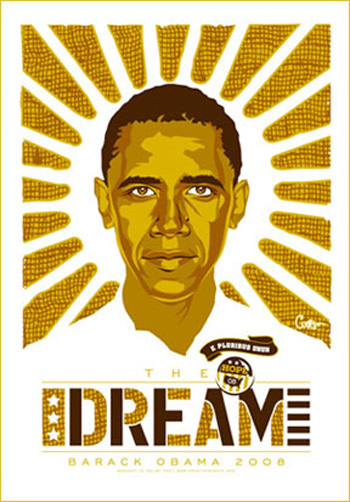
Is Barack Obama the Messiah?


Surely this is the Son of God.

Change we can believe in. Yes we can.

Labels: , , , , , , , ,

Wednesday, February 06, 2008

Fr. Aidan Nichols, OP, Says: Convert England to Catholicism

(Hat tip: Dave Hartline at The Catholic Report)

Fr. Z comments on a Catholic Herald (U.K.) article on English Dominican theologian Fr. Aidan Nichols' proposed program for re-converting England to Catholicism.

As the article notes, Fr. Nichols is regarded as a potential candidate to become the next Archbishop of Westminster. His new book is titled The Realm: An Unfashionable Essay on the Conversion of England.

For more on Fr. Aidan Nichols, OP, see his website Christendom Awake (also listed in my sidebar).


UPDATE (8 February)
See "The Conversion of England" by Fr. Richard John Neuhaus at First Things.

Labels: , , , , , , ,

Thursday, October 25, 2007

ZENIT Interview of Catholic Report's Dave Hartline

You can read ZENIT's interview of Catholic author and blogger (and my fellow Ohioan) Dave Hartline of Catholic Report here. Here's an excerpt that pertains to Catholic voters:
Q: One chapter of your book focuses on the Catholic vote. What are your thoughts about the Catholic vote and the upcoming U.S. presidential election?

Hartline: This question is a microcosm of the whole turning-tide phenomena. Many faithful Catholics were angered by politicians who spoke about the importance of their Catholic faith, only to denounce or ignore the teachings of the faith.

However, as more Catholic prelates have taken a courageous stance in defending the Church, it has inspired not only more clergy to the same, but lay people as well. There is still a long way to go in this effort, but at least the battle has been joined.

Labels: , , ,

Wednesday, October 17, 2007

An Invitation from Catholic Fire: Answer the Atheist

Jean at Catholic Fire sends along the following announcement:
There is a fiery, YET fruitful discussion going on at Catholic Fire. Check it out here:

An Invitation to Readers: Answer the Atheist

You are invited to join in.

Labels: ,

Tuesday, September 25, 2007

Abp. Chaput on Being "Manly" and Practicing Christian Love

(Hat tip: Rick Garnett at Mirror of Justice)

Archbishop Charles J. Chaput at the First Things blog On the Square:
... Never before had a religion taught that God loved people personally and that God’s love began before the person was even born. Abortion and birth control were rampant in the Roman Empire. Christians rejected both of them from the beginning. Athenagoras, a Christian layman, explained why in an open letter he addressed to Emperor Marcus Aurelius. He said: “For we regard the very fetus in the womb as a created being, and therefore an object of God’s care.”

Before Christianity came on the scene, no religion had ever taught that God could be found in our neighbor. The world largely ignored the poor, the hungry, the stranger, and the imprisoned. And it still does. And yet Jesus said that we find God in our love for these least brethren of ours.

Christian love is not weak or anesthetic. It’s an act of the will. It takes guts. It’s a deliberate submission of our selfishness to the needs of others. There’s nothing “unmanly” about it, and there’s nothing—and I mean nothing—more demanding and rewarding in the world. The heart of medieval knighthood and chivalry was the choice of a fighting man to put himself at the service of others—honoring his lord, respecting the dignity of women, protecting the weak, and defending the faith even at the cost of his own life.

That’s your vocation. That’s what being a Christian man means. We still have those qualities in our hearts. We are not powerless in the face of today’s unbelieving civilization. We can turn this world upside down if only we’re willing to love—the kind of Christian love that is vastly more powerful than just a sugary feeling; the kind of love that converts men into something entirely new; the kind of love that bears fruit in a man’s zeal, courage, justice, mercy, and apostolic action.

So I leave you with this: Be men who love well. Be the Catholic men God intended you to be. Be men of courage and fidelity to your God, your wives, your families, and your Church. Put your belief into practice. Do everything for the glory of God, even the little things you have to do each day. Love those who don’t love you. Love—expecting nothing in return. Love—and those you love will find Jesus, too. Love—and through your actions, God will change this world.


[Read the whole thing]
(emphasis added)

Labels: , , , , , , , ,

Saturday, September 22, 2007

Quote of the Day - Terry Nelson

"If people are making inquiries into Catholic teaching, they ought to go to responsible sources such as Catholic Answers and other apologetic resources online. Learning about Catholicism from most bloggers would be similar to a kid learning about sex on the street."

Labels: , ,

Friday, August 31, 2007

Knute Rockne, Notre Dame, and the Eucharist


Dave Hartline reports:
As College Football Season Gets Underway, Few Know The History Of How Knute Rockne A Norwegian Lutheran Came Into The Church. It Was His Players Devotion To The Eucharist

One of those stories one may never hear since it describes the faith of Knute Rockne. Though his wife and children were Catholic, Rockne never felt compelled to convert until the mid 1920s. Rockne wondered why some of his players were leaving very early in the morning from their dorms. He thought they might be doing something detrimental to themselves but as the story goes, they were going to early Mass. He asked them why they got up so early. After their response about the body, blood, soul and divinity of Christ Rockne started going to Mass. Soon there after he was received into the Church. Again, the faithful witness of some of his players brought him to the Church. A lesson for us all.


Remarks of President Ronald Reagan at the Unveiling of the Knute Rockne Commemorative Stamp at the University of Notre Dame in Indiana, March 9, 1988:
... And that inner strength is what Notre Dame and the legend of Rockne are all about. You know, so much is said about Rockne's influence on his ballplayers, but actually he liked to talk about their influence on him. In his autobiography, he described his inability to sleep one night before a big game. So, he was up early in the lobby and saw 2 of his boys come down the stairs and go out, and then others came and followed them. And though he had a pretty good idea of what was going on, he decided to follow along. ``They didn't realize it,'' he said in his diary, ``but these youngsters were making a powerful impression on me.'' And he said, ``When I saw them walking up to the Communion rail to receive and realized the hours of sleep they had sacrificed, I understood what a powerful ally their religion was to them in their work on the football field.''

And after Rockne found -- here at Notre Dame -- his own religious faith, a friend of his at the University of Maryland asked him if he minded telling him about it. ``Why should I mind telling you?'' he said. ``You know all this hurry and battling we're going through is just an expression of our inner selves striving for something else. The way I look at it is that we're all here to try and find, each in his own way, the best road to our ultimate goal. I believe I've found my way, and I shall travel it to the end.'' And travel it to the end he did. And when they found him in the Kansas cornfield where the plane had gone down, they also found next to him a prayer book and at his fingertips the rosary of Notre Dame, the rosary of Our Lady. Someone put it so well at the time: Knute Rockne did more spiritual good than a thousand preachers. His career was a sermon in right living.


Previous Pro Ecclesia posts on this subject:
Annual College Football Kickoff Post

Labels: , , , , ,

Monday, August 27, 2007

A Fellow Southern Evangelical's Journey to Rome

You really should read Tertium Quid's outstanding series on his journey from evangelicalism to the Catholic faith over at From Burke to Kirk and Beyond...

In fact, you really should be reading From Burke to Kirk and Beyond... on a daily basis.

Labels: ,

Tuesday, August 07, 2007

"How to Turn a Boring Drive Into a Fun and Formative Adventure"

Joseph Pronechen writes in the August 12-18, 2007 issue of the National Catholic Register:
“Are we there yet?” The famous refrain doesn’t have to be the backseat chorus as the family drives along this summer’s vacation route. Neither do children have to be distracted by electronic entertainments every mile of the way.

With proper care and planning, the annual long summer drive can become an occasion to turn the whole family into a holy family.

“For a Catholic parent, it’s a great time to show how faith and life can be deeply integrated,” says James Pauley, assistant professor of theology and catechetics at Franciscan University of Steubenville in Ohio. Remembering God while on vacation sends a powerful message to children about the need to live out the Catholic faith always and everywhere, he adds.

And that means outside the car as well as in it.

“Setting aside some time to pray at one of the missions founded by Junipero Serra before going to a California beach, or spending some time at the National Shrine of the Immaculate Conception in Washington, D.C. while on the way to tour the monuments and museums” — these are examples of great “detours” for kids to take, says Pauley.

Such stops, he adds, “wonderfully integrate Catholic American history into children’s understanding of the history of our country and provide a great chance to pray as a family and stay connected to the liturgy.”

***
Some secular books and sites inspire faith formation, too.

Says James Pauley: “Finding places that tell a story of virtue — the courage of the members of the original Jamestown settlement or the strength of African-American people facing persecution and bigotry as displayed at the Civil Rights Institute in Birmingham — can inspire children and teenagers to grow in virtue.”

***
Pauley says places noted for their natural beauty open up a kind of catechesis, too. He notes that, every summer, Pope Benedict XVI takes an extended break and “speaks eloquently about the tremendous benefits to our faith that can result from taking a vacation,” including up-close contact with nature.

“Beauty is a gateway to God. When we’re in the presence of natural beauty, we are at great ‘risk’ of running into God,” Pauley says. He points out that parents can make the most of such moments by exclaiming, “Thank you, God, for making such a beautiful place!”

Attending a weekday Mass can turn a vacation into a pilgrimage, Pauley continues. (Find schedules anywhere via Masstimes.org or Parishesonline.com.)


[More]

Labels: , , , ,

Friday, May 04, 2007

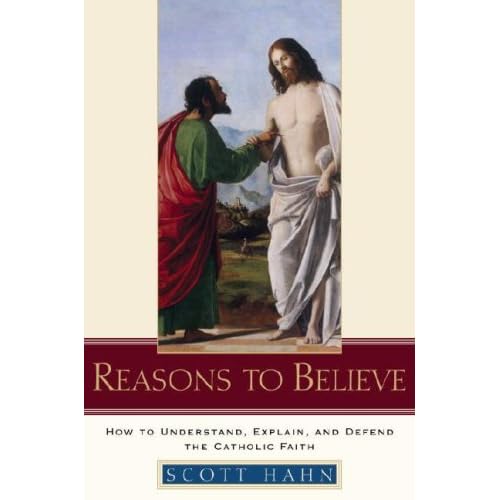
Reasons to Believe: Scott Hahn's New Book on Apologetics


I just received an advance copy of Scott Hahn's new book on apologetics titled Reasons to Believe: How to Understand, Explain, and Defend the Catholic Faith. I hope to read through it this weekend and have a full review sometime next week.

In the meantime, I'll post portions of the promotional material that I've received:
In REASONS TO BELIEVE: How to Understand, Explain, and Defend the Catholic Faith (Doubleday; May 8, 2007; $21.95; hardcover), Hahn provides his most sweeping apologetic for theism in general, and specifically the Roman Catholic Church - from the most basic questions about the existence of God to the thorniest points of contention between Protestantism and Catholicism. Readers will find Reasons to Believe not only an accessible defense of the faith, but one ... done "with gentleness and reverence" even towards those it disagrees with...
And all in less than 200 pages (not counting notes). The promotional material continues:
... Drawing from the natural world and the everyday, Hahn first addresses the non-believer. Hahn shows that reason and revelation, the natural and the supernatural, are not opposed to one another; rather they offer complementary evidence that God exists. But He doesn't merely exist. He is someone. He has a personality and a personal style that is discernible and knowable. Hahn leads readers to see that God created the universe with a purpose and a form - a form that can be found in the Book of Genesis and that is there when we view the natural world through a microscope, through a telescope, or through our own eyes.

Hahn moves on from "Natural Reasons" to believe in a God to a defence of the Catholic Church in chapters entitled "Biblical Reasons" and "Royal Reasons." Hahn not only dispells common mistaken beliefs about Catholicism, but he also provides rationale for the existing Catholic tenets and practices that so often come under fire from those who do not fully understant their foundations. These include:

  • The universality of the church

  • The nature of intercession

  • The Virgin Mary's role in Catholicism

  • The legitimacy of the Mass

  • The misconceptions of the Pope


  • In the end, Hahn urges his readers not just to study and skillfully present a defense of the faith, but to be "reasons to believe." And he does this adeptly in yet another book that is motivational, well-researched, and accessible to the Catholic and curious alike.
    Those giving advance praise to Reasons to Believe include Fr. Benedict Groeschel, Archbishop Charles J. Chaput, Marcus Grodi, Jeff Cavins, Patrick Madrid, Mark Shea, Thomas Howard, and Archbishop Donald Wuerl, among others.

    I'm looking forward to reading it.


    Product Details from Amazon.com

    Hardcover: 240 pages
    Publisher: Doubleday (May 8, 2007)
    Language: English
    ISBN-10: 0385509359
    ISBN-13: 978-0385509350
    List Price: $21.95
    Price: $14.93 & eligible for FREE Super Saver Shipping on orders over $25.
    You Save: $7.02 (32%)

    Labels: ,

    hit counter for blogger